


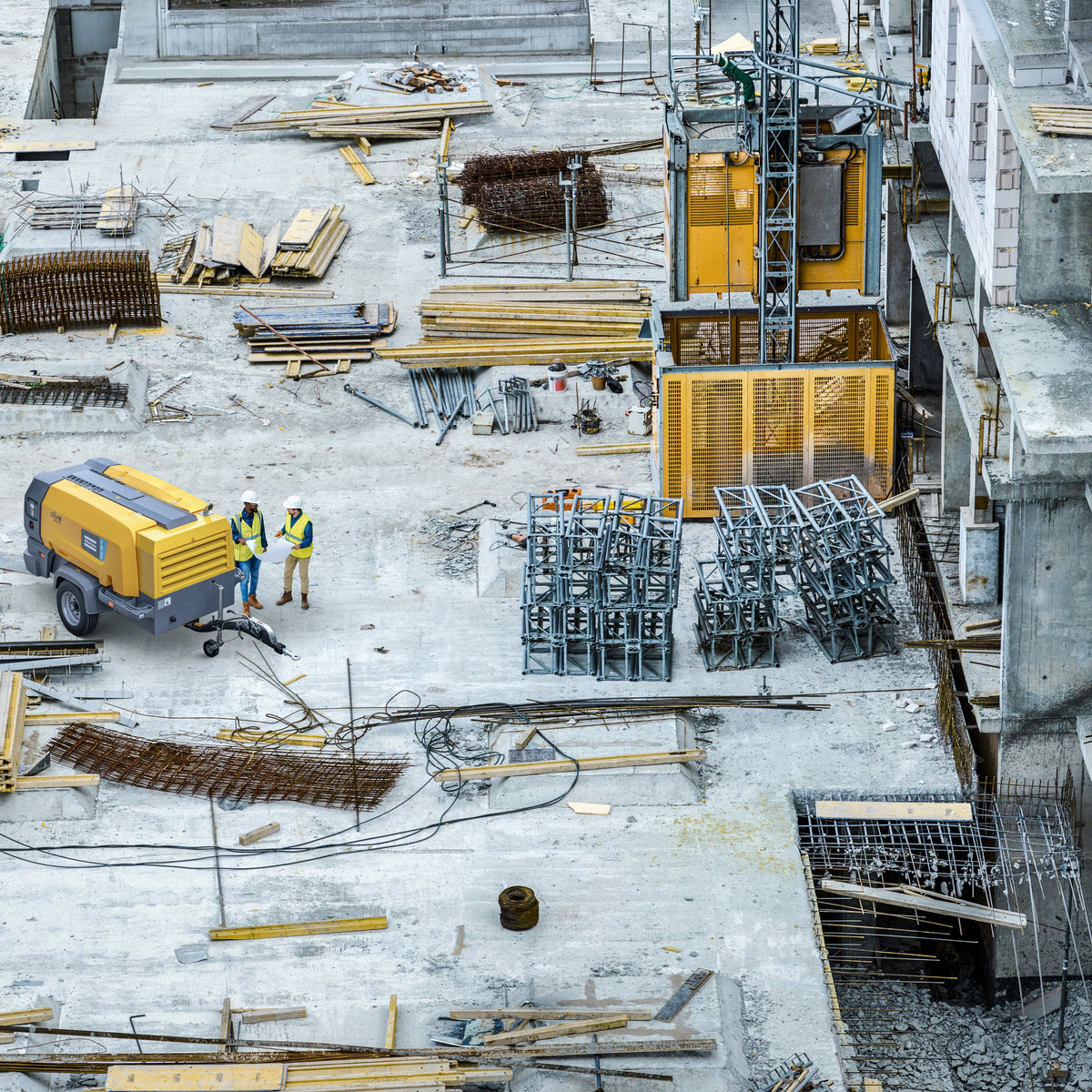
Two guys are standing over a 60 pound breaker at seven in the morning, and it is hitting like it has arthritis. The compressor is running flat out. The gauge at the machine says 100 psi. The gauge at the tool, if anybody bothered to put one there, would say something closer to 70. That is a hundred feet of half inch hose and a pair of worn couplers eating the job before the chisel ever touches concrete.
That scene plays out on jobsites every week, and it is almost never a tool problem. Compressed air for construction contractors is a different animal than shop air. Your compressor moves. Your hose runs are long and get run over. Your tools are the thirstiest ones made. And your "air room" is a trailer axle and whatever patch of dirt you parked on. Here is how to build the air side of a construction outfit so the tools actually hit.
Why Construction Air Is Not Shop Air
A fabrication shop runs a 10 hp rotary screw in a corner, pipes it overhead in aluminum, and calls it done. The demand is steady and the distances are short. Construction flips every one of those assumptions.
- The tools are enormous consumers. A 60 pound class paving breaker pulls roughly 60 to 65 CFM at 90 psi, running continuously. A single impact wrench in a body shop pulls 5. You are not in the same conversation.
- Duty cycle is near 100 percent. Breakers, rock drills, tampers and chipping hammers do not pulse. When the operator is on the trigger, the tool is drawing full rated flow, all day.
- Distance is the enemy. Two hundred feet of hose is normal. Every foot of it, every coupler, every kink costs you pressure, and pressure loss at the tool is the number one reason crews think they bought a weak breaker.
- Nobody treats the air. Which is mostly fine for demolition, and absolutely not fine the moment somebody hooks a spray rig or a sandblaster to the same machine.
Sizing: Add the Tools, Then Add Headroom
The math is not complicated, it is just that people skip it. Add up the rated CFM at 90 psi of every tool that will be on the trigger at the same time. Not every tool on the truck. The ones that run together.
| Tool | Typical CFM at 90 psi | Notes |
|---|---|---|
| 30 lb chipping hammer | 30 to 35 | Light concrete, tile, scaling |
| 60 lb paving breaker | 60 to 65 | Sidewalk, slab, footing work |
| 90 lb paving breaker | 70 to 90 | Thick slab, road base |
| Pneumatic backfill tamper | 25 to 40 | Trench compaction |
| Rivet buster | 30 to 40 | Rebar-heavy concrete, steel |
| Sandblast pot (3/8 nozzle) | 170 to 200 | Nozzle size drives everything |
| Rock drill, sinker | 90 to 120 | Add water or dust collection demand |
Two 60 pound breakers come to roughly 126 CFM. That does not mean you buy a 130 CFM machine. Run a portable at 100 percent of its plate rating all shift and it will sag as the day heats up, the intake filter loads, and the hose warms. The working rule most rental yards use is to land at 1.3 to 1.5 times the calculated demand. For those two breakers, that is a 185 CFM tow behind, which is why the 185 is the single most common unit on a jobsite in America.
If you want the full method with worked examples, we wrote it up in the air tool CFM chart and in our tow behind compressor sizing guide.
Pressure Loss Is Where Contractors Lose the Job
Here is the part that costs crews the most productivity and almost never gets measured. A breaker is rated at 90 psi at the tool inlet. Not at the compressor. If you are delivering 70 psi to the chisel, that tool is not making 78 percent of its blow energy, it is making a lot less than that, because impact energy falls off faster than pressure does.
Three things cause it:
- Hose that is too small. A 60 pound breaker wants 3/4 inch hose, and past about 50 feet it wants 1 inch. Running a breaker on 1/2 inch hose because that is what was in the truck is the most common mistake on a demolition site.
- Too many couplers. Every quick connect is a restriction. Three 50 foot sections with couplers between them will cost you noticeably more than one 150 foot run. If you have to couple, use full flow industrial couplers sized to the hose, not 1/4 inch automotive style plugs. We covered the interchange mess in our guide to air coupler types.
- Nobody put a gauge at the tool. A ten dollar gauge and a tee at the end of the hose will tell you more about your air system than any spec sheet. Put one on. Read it under load, not at idle.
Electric, Gas, or Diesel Tow Behind
What you buy depends on where the job is and what power you have.
| Type | Typical range | Best for |
|---|---|---|
| Electric portable, 120V or 240V | 5 to 20 CFM | Trim, nailers, finish work, service trucks with shore power |
| Gas engine portable | 10 to 30 CFM | Framing, roofing, small demo, no power on site |
| Truck mounted rotary screw | 60 to 185 CFM | Service fleets, utility work, one tool at a time |
| Diesel tow behind | 110 to 900+ CFM | Demolition, blasting, drilling, multi-tool crews |
A lot of contractors get stuck in the middle. They buy a big gas wheelbarrow unit hoping it will run a breaker, and it will not. If a 60 pound breaker is in your regular work, you are in tow behind territory, full stop. Browse what fits in portable air compressors, and if the work is truck-based, truck mounted units are worth a look.
And if you have been renting the same towable over and over instead of owning one, run the utilization math in tow behind air compressor: rent or buy before the next invoice shows up. Most contractors who do it are surprised by the total.
OSHA, Silica, and the Rules You Answer To
Construction air has real regulatory teeth, and two rules come up constantly.
Respirable crystalline silica, 29 CFR 1926.1153. If you are breaking, cutting, drilling or blasting concrete or masonry, you are in this standard. Table 1 lists engineering controls per task, and for handheld powered chipping and breaking that means either integrated water delivery or a dust collection system with the right filtration. If you go the water route, that is another demand on the rig. If you go respirator route beyond the Table 1 limits, you are now in breathing air territory, and that changes everything about your air treatment.
Compressed air for cleaning, 29 CFR 1926.302(b)(4). Air used to clean cannot exceed 30 psi at the nozzle, and you need chip guarding and effective eye protection. That means a proper relieving nozzle, not a pipe nipple. Same rule that gets people written up in shops gets people written up on sites.
If any of your crew is on a supplied air respirator for blasting or confined space work, you need Grade D breathing air per CGA G-7.1, which means a filtration and CO monitoring train ahead of the mask. That is a different setup than "we tee'd off the compressor." Read what Grade D breathing air actually requires before you plumb anything.
Treatment: How Much Do You Actually Need?
For straight demolition, very little. A breaker will happily run on wet, dirty air, and a shot of tool oil is doing more for it than a dryer would. Keep an inline lubricator in the line and drain the receiver. Sizing that lubricator and setting the drip rate is its own job, and we walked through it in air line lubricators for pneumatic breakers and tampers.
The moment the job changes, so does the answer:
- Abrasive blasting: water in the pot clumps the media and ruins the profile. You need at least an aftercooler and a water separator, and a moisture trap at the pot. The dryer side is covered in air dryers for sandblasting.
- Spray applied coatings, waterproofing, line striping: you need coalescing filtration and dry air, same as a paint shop. Water on a coating job is a callback.
- Pneumatic controls, concrete plant, shotcrete dosing: treat it like plant air, because it is.
Our air filters and air dryers categories cover the jobsite sizes, and the right order to build a treatment train matters more than which brand you pick.
The Four Mistakes We See Most
We get calls about this every week, so let me save you the call.
Buying on horsepower instead of CFM. Horsepower sells machines. CFM at 90 psi runs tools. Two units with the same engine can deliver very different air. Read the plate.
Undersized hose. Covered above, but it bears repeating because it is free to fix and it is the single biggest performance gain available to most crews.
Skipping winter prep. A tow behind that sat through a cold snap with water in the receiver and a frozen drain is a bad Monday. Winterizing takes an hour and saves a service call.
Running a machine at 100 percent of rating. It works in the parking lot in April. It does not work in July at 2 p.m. with a loaded filter. Buy the headroom.
Frequently Asked Questions
What size compressor do I need to run a 90 pound breaker?
A 90 pound class breaker typically draws 70 to 90 CFM at 90 psi. Size for one tool at 1.3 to 1.5 times that, which puts you at a 110 to 130 CFM tow behind for a single breaker, or a 185 if you expect to add a second tool or run long hose.
Can I run a jackhammer off my shop's rotary screw compressor?
If the screw makes enough CFM at 90 psi, yes, and plenty of precast and masonry yards do exactly that. The catch is hose. A 200 foot run from the compressor room to the work area in 3/4 inch will cost you real pressure. Run 1 inch out to a drop near the work, then a short 3/4 inch whip to the tool.
How much hose is too much?
There is no hard limit, there is only pressure at the tool. As a starting point, for a 60 CFM tool use 3/4 inch up to about 50 feet, 1 inch from 50 to 150 feet, and 1 1/4 inch beyond that. Then verify with a gauge at the tool under load and adjust.
Do I need an aftercooler on a jobsite compressor?
For breakers and tampers, no. For abrasive blasting, spray coatings, or anything where water shows up in the product, yes. An aftercooler knocks out the bulk of the moisture before it reaches your separator, and on a hot day that is the majority of the water in the system.
What pressure should I set for demolition tools?
90 psi at the tool inlet is the standard rating point for most pneumatic breakers and rock drills. Running higher does not buy you proportional performance and shortens tool life. Running lower costs you blow energy fast. Set the machine so the tool sees 90 under load.
Where to Start
Count your tools, add the CFM of the ones that run together, multiply by 1.4, and buy that machine. Then spend the next hundred dollars on properly sized hose and full flow couplers, because that is where most crews are quietly giving away a third of the air they already paid for. Getting compressed air for construction contractors right is mostly arithmetic and hose diameter, and both of those are cheaper than a second compressor.


