


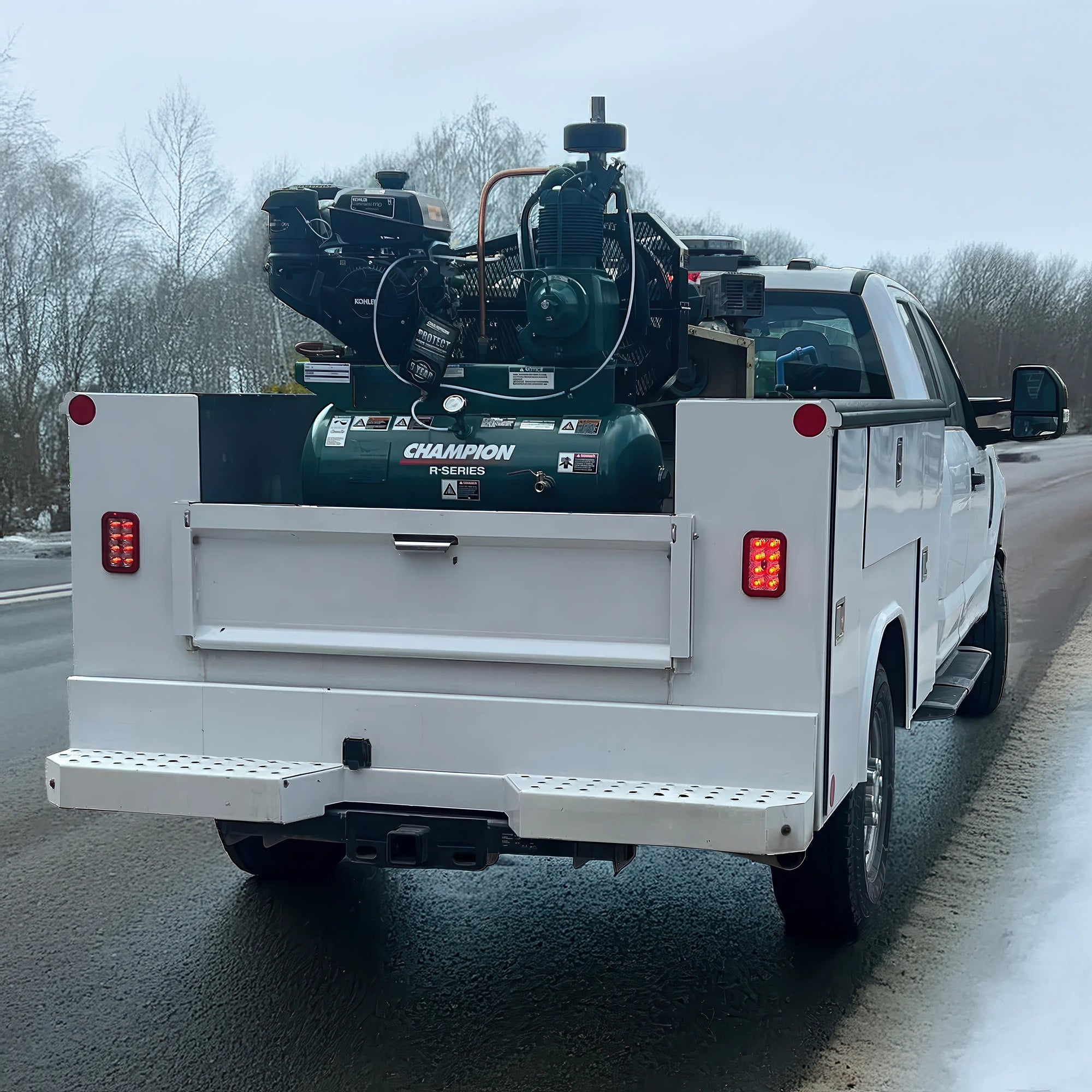
Picture a mobile mechanic parked on the shoulder with a loaded trailer behind him. The lug nuts will not budge, and the little pancake compressor he tossed in the bed ran out of air two sockets ago. That is the exact moment a truck-mounted air compressor earns its keep. When your shop is wherever you park, the air has to come with you.
We get this one a lot: what kind of air compressor for a truck actually makes sense? It comes down to three things. How you power it, how much air your tools drink, and how much room you have to give up on the truck. Let's walk through it the way we would on the phone.
What counts as a truck-mounted air compressor
The term covers a few very different machines. They all put air on your truck, but they get there in different ways, and that changes everything about cost, output, and upkeep.
PTO and underhood rotary screw
These run off the truck's own engine, either through a power take-off (PTO) on the transmission or a compact unit tucked under the hood. Because the engine does the work, they put out serious air without a second motor to maintain. A direct-transmission unit like the VMAC DTM70 delivers up to 70 CFM and weighs around 150 lb, which is light for what it does. Below-deck PTO rotary screw systems commonly run 90 to 220 CFM, and the biggest setups climb well past that. If you run air tools most of the day, this is the category that keeps up.
Gas and diesel engine-driven units
These carry their own engine, so they do not care whether your truck is running or whether there's a plug anywhere in sight. You can bolt one to the bed or tow it behind. They are the go-to when you need real air on a jobsite with no power. Upkeep looks like any small engine: oil, filters, and fuel.
Electric units with a reserve tank
For lighter duty, an electric compressor with a small reserve tank runs off shop power or a beefy inverter. Think tire inflation, blowing off parts, and the occasional impact. It will not feed a grinder all day, but it is cheap, quiet, and simple.
Matching air to the truck
Here's a plain comparison of the options so you can see where each one fits.
| Type | Power source | Typical CFM range | Best for |
|---|---|---|---|
| PTO / underhood rotary screw | Truck engine | 60 to 220+ | Full-time mobile mechanics running heavy air tools |
| Gas or diesel engine-driven | Its own engine | 30 to 185 | Jobsites with no shore power, bed-mount or tow-behind |
| Hydraulic-driven | Truck hydraulic system | 30 to 60 | Trucks already plumbed for hydraulics |
| Electric with reserve tank | Shop power or inverter | 2 to 15 | Tire work, inflation, light impact use |
How much CFM does a service truck really need
Air tools are rated in CFM at 90 PSI, and you size the compressor to the thirstiest tool you plan to run, plus headroom. This is where guys get burned. A three-quarter inch impact under a heavy pull can want around 40 CFM, and a die grinder pulls close to 25 CFM when you lean on it. Run both at once and you are looking at a 90 CFM unit or bigger once you account for startup surge and line loss. Undersize it and the compressor spends its life catching up while you stand there waiting on the tank to refill.
Most single tools are far more forgiving because you use them in bursts, not continuously. If your day is tire changes, inflation, and the odd half inch impact, you need a fraction of that. Add up the tools you might run together, not one at a time, and add roughly 30 percent on top. If you want the tool-by-tool numbers, our air tool CFM chart lays them out.
Reciprocating or rotary screw for a truck
Once you settle on how to power it, you still pick between two pump styles. A reciprocating (piston) unit is cheaper up front and fine for intermittent work like tire service and the occasional impact. It does not like running flat out for long stretches, though, and the heat and vibration add up on a truck that pounds down gravel roads all day. A rotary screw runs cooler, quieter, and holds full output for hours, which is why full-time mobile mechanics lean that way. It costs more, but if the compressor runs most of the day, it pays for itself in tools you are not replacing and time you are not losing.
Duty cycle is the number nobody checks
Duty cycle is the share of time a compressor can run before it needs a break. A cheap piston unit might be rated for 50 percent, meaning it should run about half the time. Push it past that on a busy truck and you cook it. Rotary screw units are built for 100 percent duty, so they run continuously without complaint. Before you buy on CFM alone, check the duty cycle and be honest about how hard you plan to work the thing. It is the number that separates a compressor that lasts from one that dies in a season.
Space, weight, and where it mounts
Every pound and every cubic foot you give a compressor is payload and storage you lose. That is why underhood and direct-transmission units are popular. They tuck away and free up the bed. A tow-behind keeps the truck clean but adds a trailer to back up and park. Be honest about how the truck gets used before you commit to a mount.
Do not forget air quality
Hot, wet air is hard on tools no matter where the compressor lives. A truck compressor still benefits from a decent water separator at the outlet, especially in humid country, so moisture does not end up in your impacts. It is a small add that saves you buying tools twice.
When you are ready to compare units, start with our engine-driven compressors for standalone power, or look at towable air compressors and portable units if you would rather not permanently mount anything. For the highest-output mobile setups, rotary screw compressors are the ones that keep up all day.
Frequently Asked Questions
Can I run a one-inch impact off a truck-mounted air compressor?
Yes, but only with the right unit. A one-inch impact under load is one of the thirstiest tools in the truck. You want a PTO or engine-driven rotary screw in the 60 CFM range or higher so it does not starve. A small electric unit will not cut it.
Will an underhood compressor drain my truck battery?
No. Underhood and PTO compressors are driven by the engine itself, not the battery. As long as the truck is running, you have air. That is the whole appeal over an electric unit that leans on your electrical system.
Is a tow-behind better than a mounted compressor?
It depends on how you work. A tow-behind gives you big CFM without eating truck space, and you can drop it and leave it on a site. A mounted unit is always with you and nothing to unhitch. If air follows you everywhere, mount it. If a few big jobs need a lot of air, towing can make more sense.
How much CFM should a general service truck have?
For a mixed day of tire work, impacts, and light grinding, many mobile techs are happy in the 30 to 60 CFM range. If you routinely run heavy tools back to back, step up to 90 CFM or more so you are never waiting on air.
Bottom line: the right truck-mounted air compressor is the one sized to the tools you actually run and powered in a way that fits how your truck works. Get those two right and you will never think about it again, which is exactly the point.


