


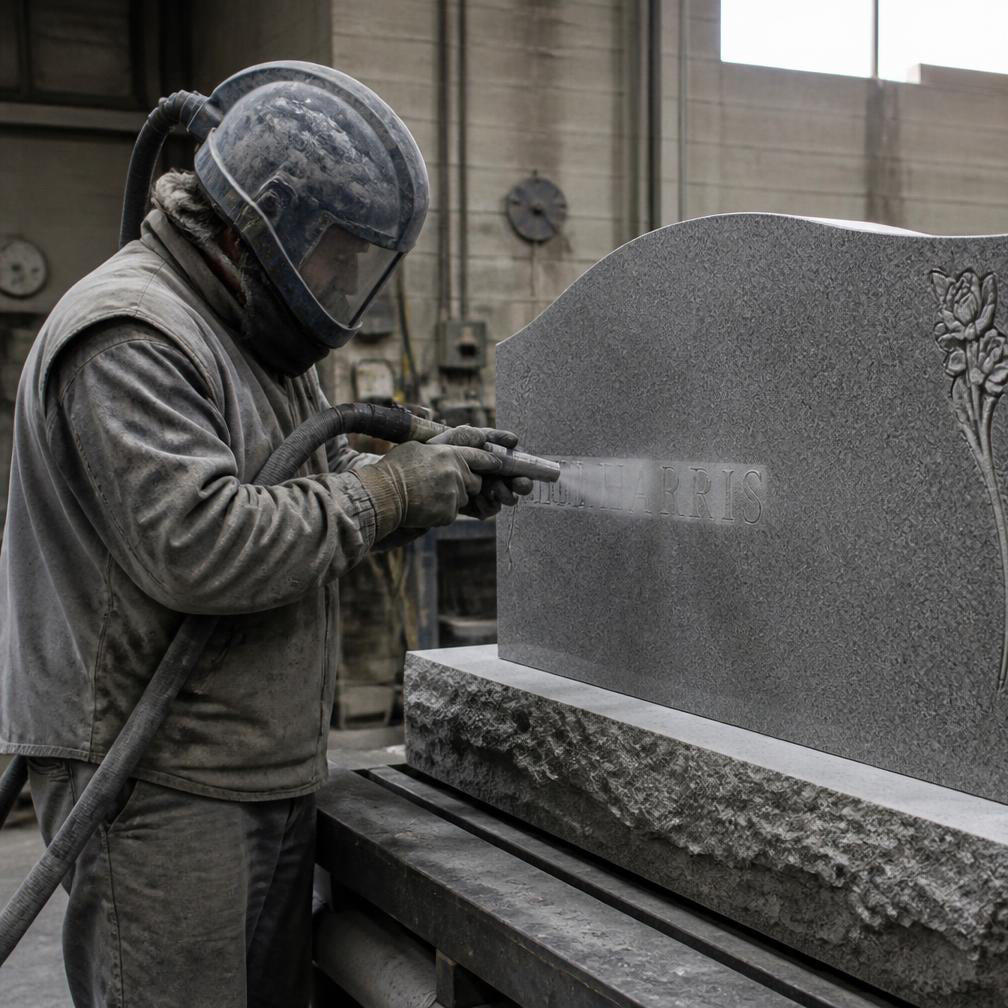
A No. 5 blast nozzle at 100 psi uses about 137 CFM. That one number, straight off Clemco's air consumption chart, explains most of the trouble we hear about from monument shops. The owner bought a 25 HP rotary screw because the salesman said it was "plenty for a stone shop," the stencil goes on a gray granite die, the blaster opens the valve, and five minutes later the gauge is sagging and the letters are cutting shallow on one end of the name and deep on the other.
Nothing is broken. The compressor is just smaller than the nozzle.
This piece is about compressed air for monument shops: the blast room, the carving bench, and the truck that goes out to the cemetery for final dates. We'll be upfront about one thing early. We don't sell blast pots, blast rooms, stencil or abrasive. We sell what feeds them: the compressor, the dryer, the filtration, the tanks and the hose. That's the part of the shop this article covers.
How a monument shop actually uses air
Most lettering on granite is still done the way it has been for decades. A rubber or plastic stencil with a pressure-sensitive adhesive goes on the polished face, the letters get cut out of the stencil by hand or by plotter, and the exposed stone is blasted away. A 3M patent on automated memorial engraving describes the typical setup well: a stencil around 1/16 inch thick, 36 to 60 mesh aluminum oxide as the abrasive, and blast pressure between about 70 and 100 psi, with 80 psi called out as the sweet spot for consistent depth. It uses a No. 5 (5/16 inch) nozzle.
Shops that sign their work on forums tell the same story. Aluminum oxide for granite, because coal slag is too soft to cut stone efficiently. Some run aluminum oxide in an indoor room and something cheaper like staurolite in an outdoor booth for rough work.
Then there's everything else in the building:
- Pneumatic carving hammers for shaping, roses, panels and hand-cut lettering
- Air polishers and grinders if you do any fabrication or repair
- Blow guns for clearing dust off the stone before the stencil goes down and after the blast
- The truck compressor for cemetery lettering, where the stone is already set and the family wants a death date added
The blast nozzle dwarfs all of it. Size for the nozzle first and the rest usually fits in the margin.
Size the compressor from the nozzle, not the horsepower
Here's Clemco's published air consumption for the three nozzle sizes you'll see in a monument shop. Figures are CFM at the nozzle, new nozzle, no wear.
| Nozzle | Bore | CFM at 80 psi | CFM at 90 psi | CFM at 100 psi |
|---|---|---|---|---|
| No. 4 | 1/4 in | 68 | 74 | 81 |
| No. 5 | 5/16 in | 113 | 126 | 137 |
| No. 6 | 3/8 in | 161 | 173 | 196 |
Now hold that up against a compressor. A typical oil-flooded rotary screw makes somewhere around 4 CFM per horsepower at 100 psi. Check the CAGI data sheet for the exact unit, but as a rough rule a 25 HP machine lands near 100 CFM. That will run a No. 4 nozzle all day at 90 psi with room left for a carving hammer. It will not hold a No. 5 at 100 psi. Not even close. You'd want something in the 30 to 40 HP range for that, and more if a second blaster ever works at the same time.
Two things make the gap worse than the chart suggests:
Nozzles wear. Aluminum oxide is hard on everything it touches, including the liner. As the bore opens up, air use climbs with it. A No. 5 that has worn toward a No. 6 is quietly asking for 30 or 40 more CFM than it did when it was new. Gauge your nozzle with a drill bit of the original size and replace it when it's worn noticeably oversize.
Pressure at the pot isn't pressure at the nozzle. Undersized blast hose, a long run, a restrictive coupling or a clogged moisture separator can eat 10 or 15 psi before the air ever reaches the stone. The chart is measured at the nozzle. If your gauge at the compressor reads 110 and you're getting 85 at the tip, you're cutting at 85.
We're not going to tell you every monument shop needs a 40 HP compressor. Chicago Pneumatic pitches its 15 HP QRS 15 at small and medium granite shops, and a Kaishan case study describes a family monument maker running a 25 HP screw with a 120 gallon tank and a refrigerated dryer. Those shops work. They just pick nozzles and pressures their compressor can actually hold. If you blast with a No. 4 at 80 to 90 psi, a 20 to 25 HP screw is reasonable. If you want No. 5 depth and speed at 100 psi, buy for it.
You can browse our rotary screw air compressors by horsepower and CFM. Compare delivered CFM at your working pressure, not the horsepower on the sticker.
Water is the enemy of a clean letter
Every monument shop has a summer story. Hot, humid afternoon, the pot starts to cough, abrasive comes out in surges, the cut goes uneven, and somebody spends an hour clearing a clogged metering valve. Wet abrasive clumps. It doesn't meter evenly, it sticks inside the pot and the hose, and it wastes media you paid good money for.
A compressor turns humidity into liquid water. A 25 HP machine on a muggy day can push gallons of it downstream over a shift. The tank catches some. The rest goes to the pot unless something stops it.
For a monument shop the treatment train is simple and it's not optional:
- Aftercooler on the compressor (most packaged screws have one built in)
- Wet receiver tank with a working automatic drain
- Refrigerated dryer sized for your compressor's full CFM at your summer inlet temperature, not the 100°F rating the brochure assumes
- A particulate filter after the dryer, then a moisture separator at the blast pot
A refrigerated dryer gets you to roughly a 35 to 39°F pressure dew point, which is plenty for blasting inside a heated building. If your blast booth is outdoors or unheated through a northern winter, that changes. Air at a 38°F dew point will condense again in a hose lying on frozen ground. Shops in that situation should look at a desiccant dryer for the booth line or at least keep the booth hose indoors between uses.
Our refrigerated air dryers are listed by CFM. Size up one step if your compressor room runs hot in July. Dryer capacity drops fast as inlet temperature rises.
Silica, the blast room and the blaster's own air
This is the part that keeps monument shop owners up at night, and it should. OSHA's silica hazard alert notes granite can run as high as 50 percent crystalline silica. When you blast through granite, you're turning that stone into fine respirable dust whatever abrasive you use. Using aluminum oxide instead of silica sand keeps you from adding more silica to the cloud, and NIOSH has recommended against silica sand for blasting since 1974. It doesn't make the granite dust go away.
The rules that apply to a monument shop:
- 29 CFR 1910.1053, the general industry silica standard. Permissible exposure limit of 50 micrograms per cubic meter over 8 hours, action level of 25. It points abrasive blasting back to 1910.94.
- 29 CFR 1910.94(a), abrasive blasting ventilation. Blast enclosures need continuous inward airflow at every opening, exhaust has to go through a dust collector, and anyone blasting inside a room needs a NIOSH-approved abrasive blasting respirator.
- 29 CFR 1910.134(i), breathing air quality. If that respirator is supplied air, the air has to meet at least Grade D: oxygen between 19.5 and 23.5 percent, carbon monoxide at or below 10 ppm, limits on oil and odor. If the compressor feeding it is oil-lubricated, you need a high-temperature alarm, a CO alarm, or both.
That last one gets shops in trouble. The blaster's hood is often teed off the same plant air that feeds the pot. Plant air from an oil-flooded screw is not breathing air until it goes through a breathing air purifier panel and you've dealt with the CO question. If you're running a hood off a tee in the shop line with nothing but a regulator in between, that's the first thing to fix. Our article on Grade D breathing air walks through what the panel needs.
Also check the intake. The compressor shouldn't be pulling air from anywhere near the dust collector exhaust or the blast room door. Fine granite dust in the inlet filter shortens filter life and, if it gets past the filter, it's abrasive inside an airend that costs more than the rest of the shop's equipment.
Carving hammers are easy, if you treat them right
Compared to the nozzle, pneumatic carving barely registers. Carvestone, run by a working stone carver, lists 1/2 and 3/4 inch hammers at around 4 CFM and 1 inch hammers around 6 CFM, and says carving hammers generally run 5 to 7 CFM. The same author runs Trow and Holden "B" and "D" hammers all day on a 17.5 CFM two-stage piston compressor with the tank set at 110 psi.
So a carver working alone doesn't need much. The issue in a monument shop is sharing. If the carving bench is on the same line as the blast room, the hammer starves every time the blaster opens up. Two fixes:
- Put the carving bench on its own branch with a regulator and a small receiver near the bench, so a pressure dip at the pot doesn't reach the hammer.
- Or keep a separate small two-stage piston compressor just for carving and finishing. In a lot of shops this is the cheaper answer, and it gives you a backup when the big machine is down for service.
Carving hammers do want a little oil. Use an inline lubricator on the carving drop only. Never let that lubricated line anywhere near the blast pot or the stencil side of the shop. Oil mist on polished granite will keep a fresh stencil from sticking.
Cemetery lettering: the truck rig
Final dates are steady work. The stone is already set, the family wants a date added, and the crew can't haul the stone back to the shop. So the shop goes to the stone.
There are purpose-built portable blasters for this. WEHA's Cemetra unit, sold for lettering directly at the cemetery, is rated at 550 liters per minute of air (about 19 CFM) at 3 to 4 bar with a 4 mm nozzle, and cuts about 3 mm deep. That's a light setup meant for small date panels.
Shops that run a conventional pot in the field size the truck compressor the same way they size the shop compressor: off the nozzle chart. A No. 4 nozzle at 80 psi needs 68 CFM, which a gas-drive piston unit won't hold. That's diesel towable or engine-drive screw territory. Whatever you run, put a water separator at the pot. A portable compressor running on a humid morning in a cemetery makes water just like the one in your shop, and there's no dryer in the truck.
What we'd put in a two-blaster shop
Here's a sensible starting point for a shop with one blast room, one outdoor booth and a carving bench, blasting No. 4 nozzles at 90 psi:
- A 25 to 30 HP rotary screw delivering at least 100 to 120 CFM at 110 to 125 psi, so you have headroom for pressure drop
- A 120 to 200 gallon wet receiver right after the compressor, with a zero-loss or timed drain
- A refrigerated dryer rated for the full compressor output at your real summer inlet temperature
- A particulate filter after the dryer and a moisture separator at each pot
- A breathing air purifier panel and CO monitor if the blasters use supplied-air hoods
- A separate regulated branch, with lubricator, for carving
If both blasters will ever run together, or you want No. 5 nozzles, double the nozzle math before you pick the compressor.
Frequently Asked Questions
Can I run a blast pot off a 7.5 HP two-stage piston compressor?
Only with a very small nozzle, and only in short bursts. A 7.5 HP two-stage piston unit typically makes around 25 to 30 CFM. A No. 4 nozzle at 80 psi needs 68. You'll drain the tank in a couple of minutes and then wait. That compressor is a good fit for the carving bench, not the pot.
Do I need a dryer if my compressor has an aftercooler?
Yes. An aftercooler drops the temperature and knocks out the bulk of the water, but the air leaving it is still saturated. As it cools further in the pipe, more water condenses. A refrigerated dryer is what keeps that water out of the pot.
Is aluminum oxide safe because it isn't sand?
It's safer than silica sand as an abrasive, but you're still blasting granite, and granite contains a lot of crystalline silica. The dust from the stone itself is the exposure. Ventilation, the dust collector and the right respirator still apply.
Why do my letters cut deeper at the start of a name than at the end?
Almost always pressure decay. The tank holds pressure for the first few letters, then the compressor falls behind the nozzle and pressure drops as you work across the stone. Check the gauge at the pot while blasting. If it's sliding, your compressor is smaller than your nozzle, your nozzle is worn, or something between the two is restricting flow.


