


Two shops call us in the same week. Both have a 30 HP piston compressor that has been on the floor for twenty years, and both are tired of it. One shop runs three shifts and the machine is going most of the day. The other runs one shift with a few big intermittent draws.
The first shop needs a rotary screw air compressor. The second one probably does not. That distinction is the whole decision, and it comes down to duty cycle rather than horsepower, brand, or price.
How a rotary screw actually compresses air
Forget pistons for a minute. There is no reciprocating motion here at all.
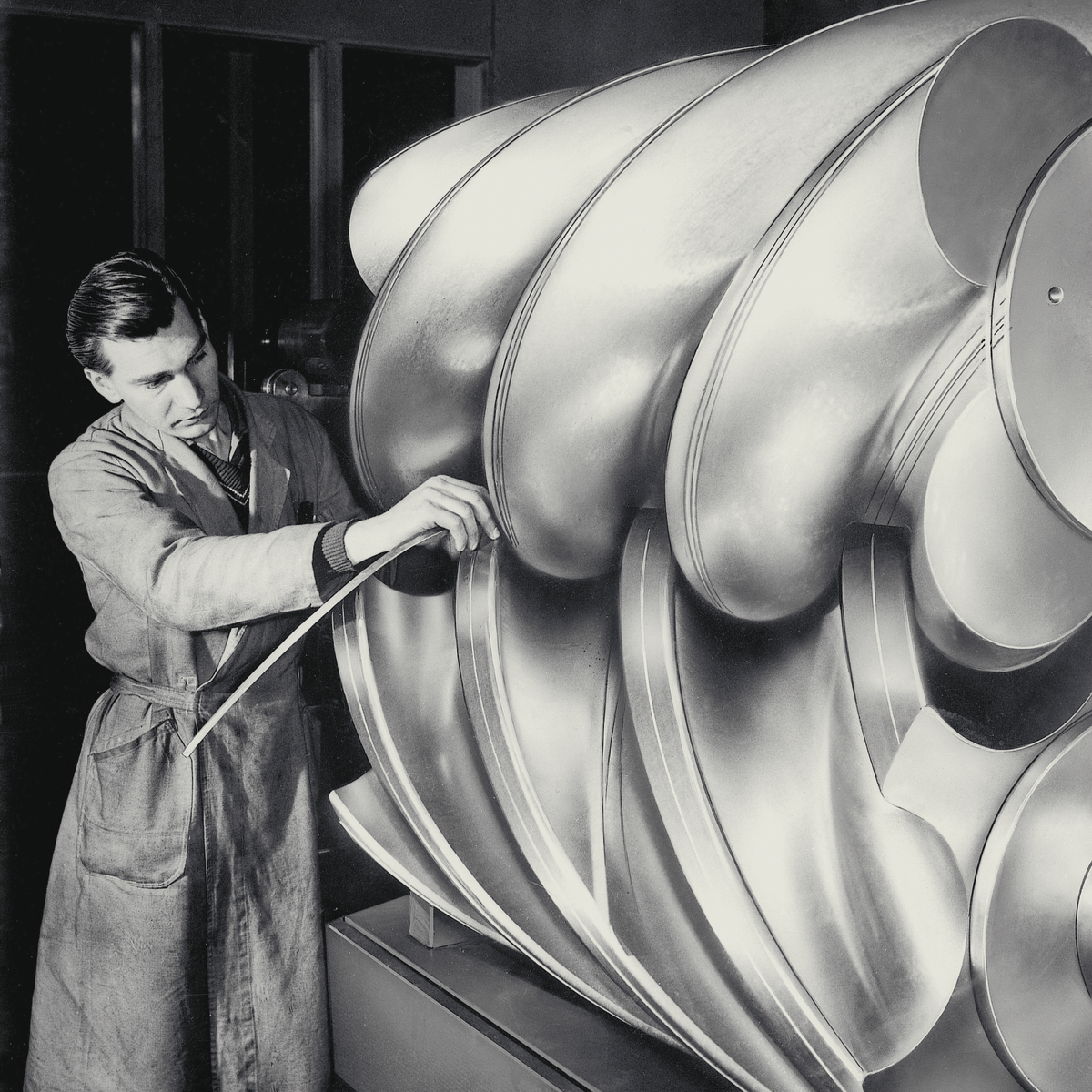
Inside the airend are two helical rotors, a male rotor with lobes and a female rotor with flutes, meshed together in a close-tolerance housing. Air enters at one end. As the rotors turn, the volume trapped between a lobe and the housing gets progressively smaller as it travels toward the discharge end. By the time it reaches the outlet, that pocket of air has been squeezed to full discharge pressure. It is a continuous process. Air is flowing in at the inlet and out at the discharge at the same moment, all the time.
That is why the flow out of a screw machine is smooth instead of pulsing, and why a screw compressor can run all day without stopping. There is no piston reversing direction thousands of times a minute, no reed valves to fatigue, and far less to balance.
Oil-injected vs oil-free
Most industrial screw compressors are oil-injected, sometimes called oil-flooded. Oil is sprayed into the compression chamber where it does three jobs at once: it seals the tiny clearance between the rotors, it lubricates, and it absorbs a large share of the heat of compression. Downstream, an air-oil separator pulls the oil back out and returns it to the sump.
That oil is why oil-injected screws are efficient and long-lived, and it is also the one thing to plan around. Some oil carryover into the air stream is inherent, typically a few parts per million on a healthy machine with a good separator element. For most shop work that is irrelevant. For food contact, pharmaceutical, breathing air, or paint, you either add filtration to bring it down or you buy an oil-free machine.
Oil-free screws use coated rotors that never touch, timing gears to keep them in phase, and no lubricant in the air path at all. Usually two stages with an intercooler, since without oil to carry heat away one stage cannot get you to full pressure. They cost significantly more and are less efficient than an oil-injected machine of the same size. If you genuinely need ISO 8573-1 Class 0 oil, that is the price of it. If you do not, oil-injected plus filtration is the better buy nearly every time.
Where a screw beats a piston, and where it does not
| Rotary screw | Two-stage piston | |
|---|---|---|
| Duty cycle | Designed for 100 percent. Runs continuously by design | Typically 50 to 75 percent. Needs cool-down |
| Noise | Much lower, often enclosed | Loud, and it is a harsher noise |
| Discharge air temperature | Lower, easier on downstream equipment | Hot. Aftercooling matters more |
| Flow character | Smooth and continuous | Pulsing, needs receiver volume |
| Up-front cost per CFM | Higher | Lower |
| Maintenance | Predictable and scheduled. Oil, filters, separator, eventual airend | Simpler parts, more frequent attention |
| Rebuildability | Airend rebuild at high hours restores the machine | Pump rebuild or replacement |
| Best fit | Steady demand, several hours a day or more | Intermittent demand, short bursts, lower budget |
The trap is buying a screw machine for intermittent demand. A screw compressor that starts and stops repeatedly is being abused, because each start pulls the sump oil around and the motor takes the inrush. Screws want to run. If your air demand is genuinely bursty and low duty, a good two-stage piston is the cheaper and more appropriate machine. Our side-by-side on rotary screw vs piston goes deeper on that comparison.
Sizing: CFM at your pressure, not horsepower
Horsepower is a rough proxy that people fixate on. The number that matters is delivered CFM at the pressure you actually run.
Work it in this order:
- Total your tool and process demand. Add up the CFM of everything that runs at the same time, at the pressure they need. The air tool CFM chart gets you started for hand tools, but process equipment always publishes its own figure and you should use that.
- Weight it by duty. A grinder that runs three minutes out of ten is not a continuous load. A blow-off nozzle or a pneumatic pump is. Continuous loads go in at full value.
- Set your real pressure. Find the highest pressure any tool genuinely requires, add the pressure drop across your dryer, filters, and piping, and that is your discharge target. Do not pad it. Every extra 2 psi of discharge pressure costs roughly 1 percent more energy for nothing.
- Add headroom, then check for leaks. 20 to 30 percent on top is reasonable for growth. But if the machine you are replacing was undersized because of leaks, fix the leaks first or you will buy the same problem in a larger size.
Then add storage. A receiver tank lets a screw machine unload cleanly instead of hunting between load and no-load, and it absorbs short spikes so you are not sizing the compressor for your worst two seconds of the day.
Fixed speed or VSD
A fixed speed screw runs its motor at one speed and manages capacity by loading and unloading. Unloaded, it still draws real power, commonly in the range of 25 to 35 percent of full load, while producing nothing useful. That is fine if the machine is loaded most of the time.
A variable speed drive machine changes motor speed to match demand, so at part load it draws roughly proportional power instead of paying the unloaded penalty. Published figures put a fixed speed screw around 16 to 18 kW per 100 CFM at 100 psi, with a VSD machine reaching roughly 14 to 16 kW per 100 CFM at part load.
The rule of thumb that holds up: VSD pays when your demand actually varies. If the machine runs fully loaded nearly all the time, a VSD adds cost and complexity for very little return. If demand swings widely across the day or the week, a VSD is usually the cheapest energy decision available. If you have never measured your demand profile, a flow meter before you buy will tell you more than any brochure will. There is more detail in our rundown of compressor control modes.
Compare machines with CAGI data sheets, not brochures
This is the single most useful thing in this article, and almost nobody uses it.
CAGI, the Compressed Air and Gas Institute, runs a performance verification program where participating manufacturers publish standardized data sheets tested to ISO 1217. Each sheet gives you package input power, actual delivered CFM, full-load specific power in kW per 100 CFM, and sound level, all at stated conditions.
Ask for the CAGI sheet at the pressure you will actually run. Then compare like for like:
- Delivered CFM at your pressure. Not free air delivery, not the CFM at 100 psi if you run 125.
- Specific power in kW per 100 CFM. This is the efficiency number. Lower is better, and the spread between machines is large enough to matter over a decade of electricity bills.
- Package input power. The whole package, including the fan and controls, not just the motor nameplate.
- Sound level in dBA at the stated distance, if the machine lives near people.
If a vendor cannot or will not produce a CAGI sheet, that tells you something.
What a screw compressor needs from you
| Item | Typical interval | Why it matters |
|---|---|---|
| Compressor oil | 2,000 to 8,000 hours depending on oil type and duty | Oil is doing sealing, lubrication and cooling. Degraded oil varnishes the airend |
| Oil filter | With or between oil changes, per manual | Cheap insurance on the most expensive part of the machine |
| Air-oil separator element | Roughly annually or by pressure drop | A loaded separator raises carryover and costs you pressure |
| Intake filter | Annually or by environment | Everything the machine breathes ends up in the oil and the rotors |
| Condensate drains | Verify monthly | A failed drain either floods downstream or dumps live air |
| Coolers, cleaned | As the environment demands | A dusty cooler is the most common cause of high temperature trips |
| Airend | 30,000 to 50,000+ hours, then rebuild or replace | The wear item that defines the machine's second life |
Two things worth stressing. Use the oil the manufacturer specifies. Screw compressor oil is doing sealing work that engine oil is not formulated for, and a wrong-oil decision shows up as varnish and a stuck bypass valve years later. And give the machine a room it can breathe in, at a sensible ambient temperature, with clearance around the coolers. High-temperature shutdowns are almost always an installation problem rather than a compressor problem. Our notes on compressor room requirements cover the ventilation math.
Get the duty cycle judgment right, size on delivered CFM at your real pressure, compare CAGI sheets, and a rotary screw air compressor becomes a twenty year asset instead of a recurring headache. Browse the range in the rotary screw air compressors collection, or send us your tool list and running hours and we will size it with you.
Frequently Asked Questions
How long does a rotary screw air compressor last?
Think in hours, not years. The airend is the defining wear item and commonly runs 30,000 to 50,000 hours or more before it needs a rebuild, at which point rebuilding typically costs a fraction of a new machine and buys a comparable second life. Motors and coolers frequently outlast the first airend entirely.
Is a rotary screw compressor worth it for a small shop?
It depends on run time rather than shop size. If your compressor is loaded several hours a day, a screw machine will be quieter, cooler and cheaper to run. If the demand is a few short bursts a day, a two-stage piston is the more sensible purchase and a screw machine will short-cycle in a way it was not designed for.
Do I need a dryer with a rotary screw compressor?
Almost always. A screw compressor produces a lot of condensate, and a continuous machine produces it continuously. A refrigerated dryer is the baseline for general shop use, with desiccant drying where you need a low dew point or the air passes through cold space.
Should I buy fixed speed or VSD?
VSD pays when your demand varies, because it avoids the power a fixed speed machine burns while unloaded. If the machine runs fully loaded nearly all the time, fixed speed is simpler and cheaper with almost no efficiency penalty. Measure your demand profile with a flow meter before deciding, since guessing here is expensive in both directions.
How much oil carryover does an oil-injected screw produce?
A healthy machine with a good separator element runs in the low parts-per-million range, which is fine for general shop air. If you need food contact, pharmaceutical, breathing or paint quality air, add coalescing and carbon filtration or specify an oil-free machine, and check the ISO 8573-1 oil class your application requires.


