


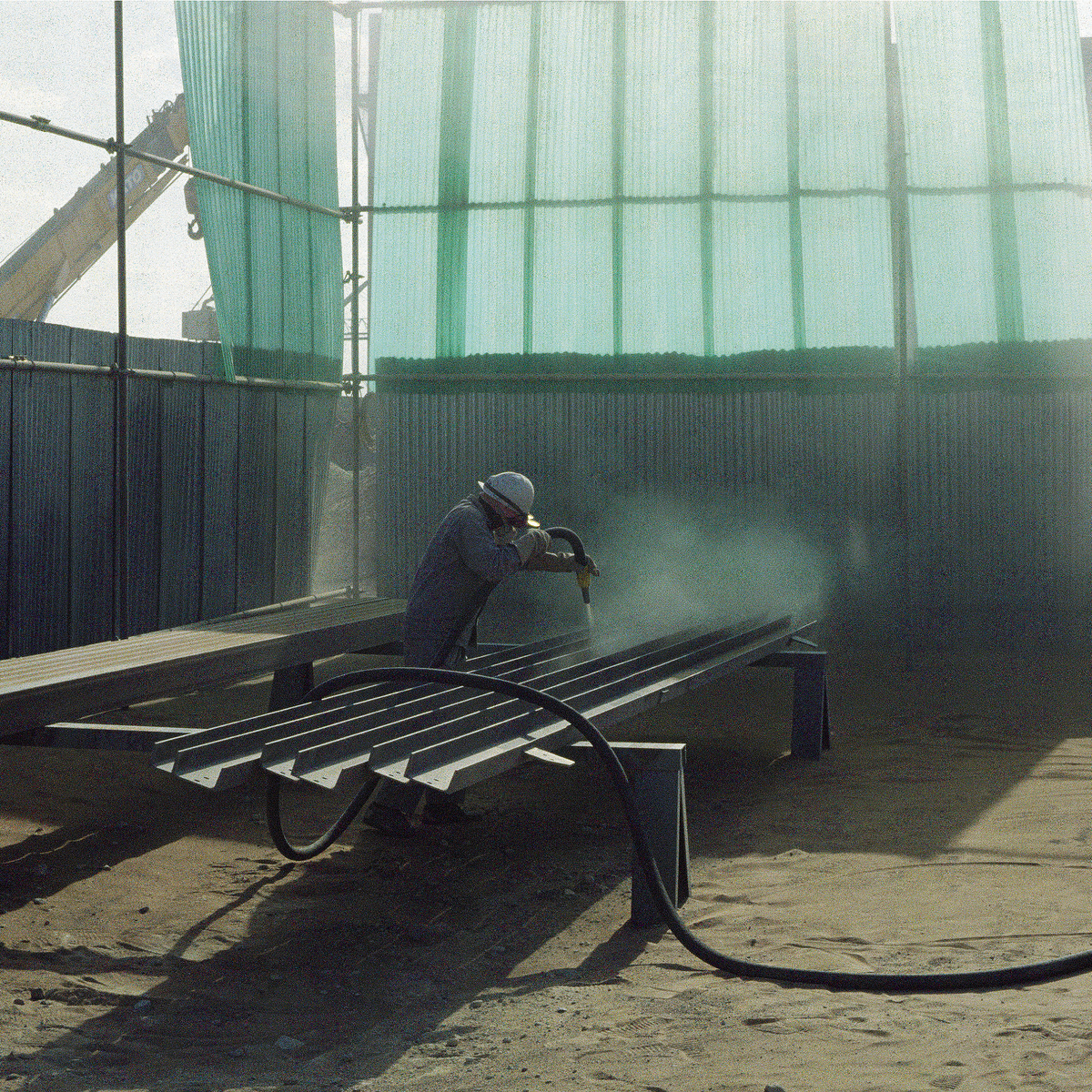
You blast a tank shell on a humid morning, the profile looks right, and by the time the painter shows up after lunch there's a light orange bloom across the whole thing. Now you're reblasting a surface you already paid to blast once.
Nine times out of ten the culprit isn't the abrasive and isn't the operator. It's water riding through the hose with the air. An air dryer for sandblasting is the cheapest insurance in the whole setup, and it's the piece most crews skip because the compressor seemed like the expensive part.
This is a companion piece to our broader guide on compressed air for abrasive blasting, which covers the compressor, the volume math and the breathing air side. Here we're staying on moisture.
What water actually does to a blast job
Four separate problems, and they show up in this order.
The pot clogs. Damp abrasive cakes. Garnet, coal slag, and anything with fines in it will bridge over the metering valve and choke the flow. You get surging, then nothing, then somebody's tapping the pot with a hammer.
The profile goes inconsistent. Surging media means uneven impact energy, which means your anchor pattern varies across the panel. On a coating spec with a profile range, that's a rejected job.
Flash rust. This is the expensive one. You've just stripped every bit of protection off bare steel and left it chemically hungry. Put water back on it and oxidation starts within minutes. On a hot humid day you can watch it happen.
Adhesion failure. Moisture or oil trapped under a coating is a delamination waiting to happen, sometimes months later on a job you thought was closed.
The test your inspector is going to run
If you're doing any kind of industrial or bridge work, somebody is going to hold a white blotter in the air stream. That's ASTM D4285, the standard practice for indicating oil or water in compressed air. The inspector holds a clean white collector roughly 18 to 24 inches from the air outlet, downstream of your separators and dryers, for about a minute.
The acceptance criterion on most specs is simple and unforgiving: nothing visible on the blotter. Not "a little." Nothing. And under NACE and SSPC practice it gets run at the start of every shift and after every shutdown, not once at the start of the job.
Worth knowing what the blotter test isn't. It catches liquid water and visible oil. It won't see oil vapor and it doesn't give you a dew point number. It's a go/no-go field screen, and a system that only just squeaks past it on a cool morning will fail it at two in the afternoon.
Why an aftercooler alone doesn't get you there
This is the misunderstanding that costs crews the most money, so it's worth being precise.
Your compressor discharges air at 200 degrees F or better, and hot air holds a lot of water as vapor. An aftercooler drops that temperature and condenses most of it out, and the moisture separator behind it dumps the liquid. That's a big win and you absolutely want it.
But here's the catch. The air leaving an aftercooler is at roughly ambient temperature and it is fully saturated. One hundred percent relative humidity. Its pressure dew point is basically whatever the air around the machine is. So the moment that air moves through a hose lying on cooler ground, or expands and chills across the nozzle, water condenses out again. You removed a lot of water and left the air right at the edge of making more.
An aftercooler is stage one. It is not a dryer.
Building the drying train
| Stage | Job | Skip it and you get |
|---|---|---|
| Aftercooler | Drops discharge temp, condenses the bulk water | A dryer that's instantly overwhelmed |
| Moisture separator | Mechanically removes the liquid the cooler made | Slugs of water hitting the dryer |
| Coalescing filter | Catches oil aerosol and fine mist | Oil on the blotter, contaminated desiccant |
| Dryer | Suppresses dew point below ambient | Condensation downstream, every time |
| Drain | Gets the collected water out | A separator bowl that refills and carries over |
Order matters. Cool it, separate it, filter it, then dry it. Running a dryer on uncooled air is how people destroy a desiccant bed in a week.
Which dryer for blasting
Deliquescent (tablet) dryers are the traditional jobsite answer. A pressure vessel full of hygroscopic tablets that dissolve as they absorb water. No power, no moving parts, which is exactly why they live on skids behind tow-behind compressors. The tradeoff is that the dew point suppression floats with inlet temperature rather than holding a fixed number, and you're buying tablets and draining brine forever. For outdoor production blasting where nobody has 480 volts to spare, they still make sense.
Refrigerated dryers hold a pressure dew point in the high 30s to low 50s Fahrenheit. In a fixed shop with a blast booth and a stable indoor ambient, that's usually plenty, and the operating cost is low. Outdoors in the winter it isn't, because your ambient drops below the dryer's dew point and you're condensing again.
Regenerative desiccant dryers take you to minus 40 F pressure dew point and hold it regardless of what the weather is doing. This is what you want on coating work with a tight spec, on anything going into a shop primer within a fixed window, or when you're blasting in cold weather where a refrigerated unit can't help you. Browse desiccant dryers and size them at your compressor's full rated flow, not your average use.
Not sure which side of that line you're on? We laid out the comparison in refrigerated vs desiccant air dryer.
Sizing: match the dryer to the compressor, not to the nozzle
Blasting is a high-volume application and the numbers get big fast. Nozzle demand scales with orifice area, so stepping up one nozzle size is a large jump in CFM, and a half inch nozzle is a several-hundred-CFM appliance on its own. The full nozzle-by-nozzle consumption table lives in our abrasive blasting guide. Whatever that number works out to, your dryer has to pass all of it without choking.
Three sizing rules that keep you out of trouble:
- Size the dryer for the compressor's full rated output, not your nozzle's rated draw. Nozzles wear. An orifice that started at 3/8 inch is bigger a hundred hours later, and it's eating more air than the chart says.
- Correct for real inlet conditions. Dryer ratings assume something like 100 degrees F inlet and 100 psi. A hot afternoon with a compressor sitting in the sun is nothing like the catalog condition, and that's exactly when you need the dryer working.
- Add headroom for nozzle wear. A worn nozzle pulls meaningfully more air than a new one, which is why sizing to nameplate alone leaves you short by mid-job.
The mistakes we see over and over
Manual drains that nobody pulls. A separator bowl that fills up and never gets dumped is a water reservoir feeding your hose. Put automatic drains on everything and check them.
Undersized hose. Restriction drops pressure at the nozzle, and pressure drop means temperature drop, which means condensation in the last place you want it. It also costs you profile.
Dryer on the wrong side of the receiver. Put your storage where it helps and make sure the air is cooled and separated before the dryer sees it.
Forgetting the breathing air line. If the operator's respirator is fed from the same compressor, that's a completely separate requirement under Grade D breathing air rules, with its own filtration, CO monitoring and alarms. A blast dryer does not make air breathable.
Assuming indoor means dry. A blast booth in a humid building still condenses. Ambient is not the same thing as conditioned.
Frequently Asked Questions
Do I need a dryer if I already have an aftercooler?
Yes. An aftercooler leaves the air saturated at roughly ambient temperature, so any further cooling downstream, in the hose or across the nozzle, puts water right back into the stream. The aftercooler removes the bulk of it and a dryer suppresses the dew point below ambient so the rest stays as vapor.
What dew point do I need for sandblasting?
A pressure dew point at least 15 to 20 degrees F below your lowest expected ambient is the working rule, so the air never reaches saturation anywhere downstream. Indoor booths in a stable environment can often live with a refrigerated dryer. Outdoor and cold weather work, or coating specs with a tight recoat window, generally want minus 40 F from a desiccant unit.
How do I know if my air is dry enough?
Run the ASTM D4285 blotter test: a clean white collector held in the air stream about 18 to 24 inches from the outlet for roughly a minute, downstream of all your separators and dryers. Any visible water or oil is a fail. Run it at the start of each shift and after any shutdown, and run it on a hot afternoon rather than a cool morning if you want an honest answer.
Will a deliquescent dryer pass a blotter test?
Often yes, and they're common on jobsites for exactly that reason. The catch is that the dew point suppression moves with inlet temperature instead of holding a set number, so a system that passes at 70 degrees may not at 95. Keep the tablet bed full, keep the aftercooler ahead of it working, and retest when conditions change.
Can I just add a water trap at the nozzle?
An inline trap at the pot catches slugs and is worth having as a last line of defense, but it does nothing about vapor that condenses after it. Solve moisture at the compressor with a proper cooling, separation and drying train. The trap is a backstop, not the plan.
The short version
Cool the air, separate the liquid, filter the oil, then dry it below ambient. Size the dryer to the compressor rather than the nozzle, correct for the hot day rather than the catalog day, and blotter test when conditions are worst. Get the air dryer for sandblasting right and the flash rust problem, the clogged pot problem and the inconsistent profile problem all go away at once.


