


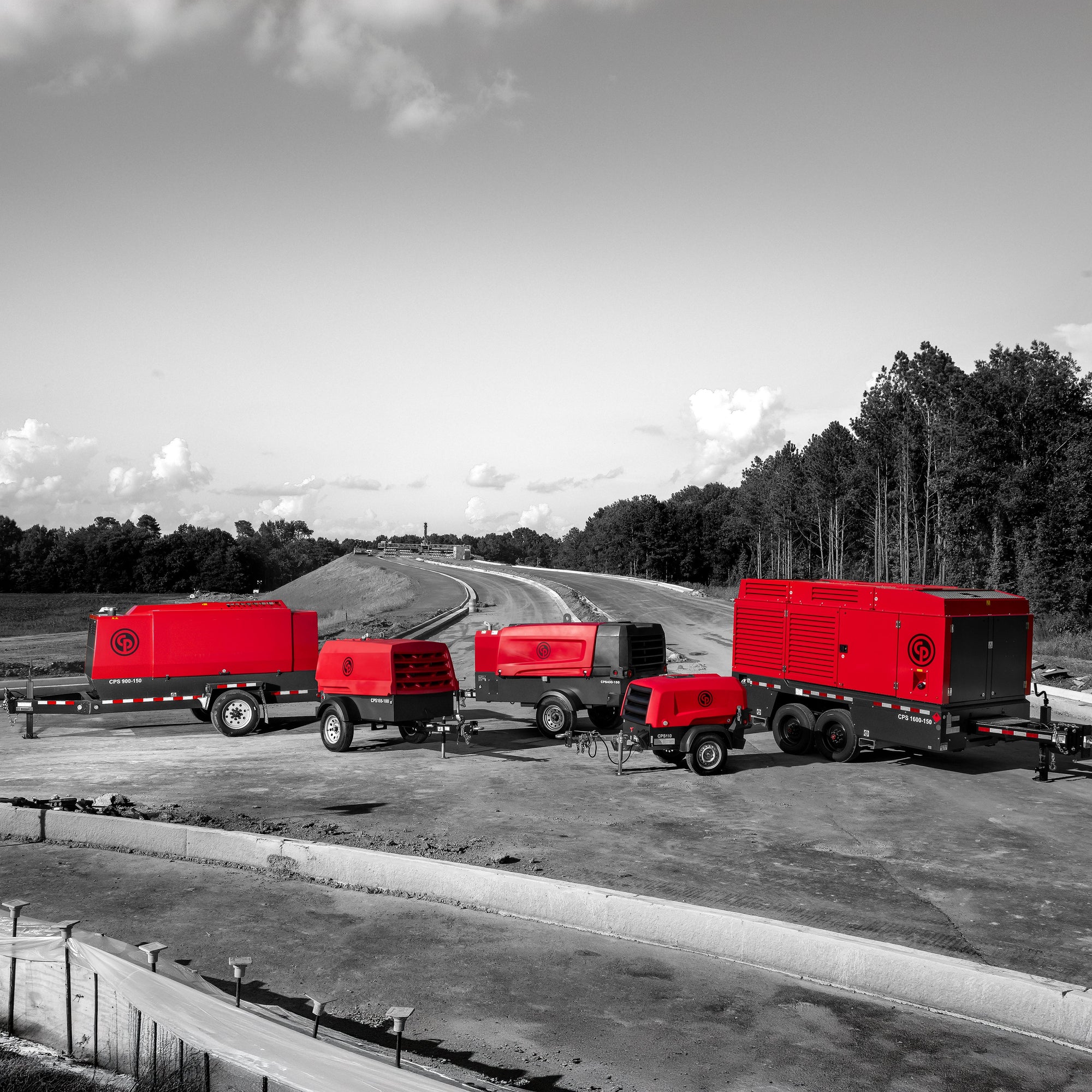
Rental yards don't stock 185 CFM compressors by accident. That number is the jobsite standard because it runs one big demolition tool with headroom, or two smaller ones at once, and a tow behind air compressor in that class hooks to a pickup and follows the crew anywhere. But 185 isn't the answer for every crew, and buying the wrong size, in either direction, costs real money. Here's how to get the sizing right, what the spec sheet is actually telling you, and when owning beats renting.
What Counts as a Tow Behind Air Compressor
We're talking about the trailer-mounted, engine-driven units you see parked behind road crews: a rotary screw air end, a diesel (or sometimes gas) engine, a fuel tank, and running gear with a 2 inch ball or pintle hitch. Unlike your shop compressor, there's no big storage tank; a rotary screw makes its rated flow continuously, so the machine is sized by CFM output, not gallons. Typical outputs run from about 90 CFM at the small end to 400, 900, even 1,600 CFM for drilling and blasting rigs. The workhorse of the range delivers 185 CFM at around 100 PSI.
Size by the Tools, Not the Habit
The sizing method is the same one we preach for shop air: add up every tool that will run at the same time, then add a buffer of about 20 percent for hose losses, altitude, and the tool that shows up next month. What's different on a jobsite is the scale. Demolition and drilling tools drink air by the barrel.
| Tool | Typical draw | What runs it |
|---|---|---|
| 90 lb jackhammer / pavement breaker | 70-90 CFM | One 185 with headroom |
| Rock drill | 100-185 CFM | One 185, fully loaded |
| Sandblast nozzle (3/8 in) | 150-200 CFM | One 185 minimum, bigger is better |
| 1 in impact wrench | 10-16 CFM | Small towable or truck unit |
| Chipping hammer | 25-40 CFM | Two or three on a 185 |
Run the math honestly. Two 90 CFM breakers working at once is 180 CFM before the buffer, which means a single 185 is already maxed. That's how crews end up with breakers that hit soft and drills that bog: not broken tools, an overdrawn compressor. If the plan says two big breakers all day, the plan says 250 CFM class, not 185.
Reading the Spec Sheet Without Getting Burned
Three numbers matter, and they travel together. CFM is the volume of air delivered. PSI is the pressure it's delivered at; most demolition tools want 90 to 100 PSI, while some drilling and pipeline work wants 150 or more, and high-pressure variants exist for exactly that reason. Engine power pays for both. A machine advertising big CFM from a suspiciously small engine is measuring at a lower pressure than you'll run. Confirm the CFM figure at your working pressure.
Beyond the big three, the features that separate a good week from a bad one are boring and vital: an aftercooler if you're feeding blast pots or paint (hot, wet air ruins abrasive and finishes), cold-start capability for winter concrete season, curbside service points so nobody crawls under the trailer, and a DOT-legal chassis with working lights and brakes, because this machine lives on the highway between jobs.
Rent or Buy? Do the Utilization Math
Around here the honest answer is utilization. A 185 class machine rents for roughly $150 to $250 a day depending on market, while buying one new runs well into five figures. The break-even shows up fast though: a crew that needs air three or four days a week, most weeks, pays for a machine in a couple of seasons and then air is nearly free. Renting still wins for the occasional demo weekend, for oddball sizes you need twice a year, and for jobs far from home where hauling doesn't pencil. If your rental invoices are starting to look like a mortgage payment, browse our towable air compressor collection and run the numbers against last year's rentals.
Diesel, Gas, and the Small End of Towable
Diesel dominates the category for fuel economy under continuous load and for torque at altitude, and units like the Atlas Copco towable rotary screw line are built around exactly that duty. At the smaller end, gas-engine machines in the 20 to 90 CFM range cover service trucks, fence crews, and irrigation work without trailer plates; you'll find those among our engine-driven compressors. If the job never leaves the shop, skip the wheels entirely and put the money into a stationary unit from our main compressor lineup instead.
Owning One: The Upkeep Reality
A tow behind air compressor is two machines sharing a frame, and both keep schedules. The engine wants what every diesel wants: oil, filters, coolant, and clean fuel. The air end wants compressor oil and separator changes on hours, not vibes, plus daily drain-downs in humid weather. The one item owners forget is the running gear: wheel bearings, tires, and brake adjustments. The compressor half can be perfect and the machine still can't legally leave the yard. Budget a service day each season for the trailer itself.
Frequently Asked Questions
What will a 185 CFM tow behind air compressor run?
One 90 lb breaker or rock drill with comfortable headroom, one modest sandblast nozzle, or a pair of lighter tools like chipping hammers running together. It's the standard because it covers the single-big-tool jobsite completely.
Can I tow one with a regular pickup?
Generally yes in the 185 class; most weigh in the 2,000 to 4,000 lb range and use a standard 2 inch ball or pintle hitch. Check the machine's actual trailer weight against your truck's tow rating and make sure the lights and brakes work before you hit the road.
Do towable compressors have air tanks?
Not meaningful ones. They're rotary screw machines that produce rated flow continuously, so there's no big receiver to draw down. That's why they're sized purely on CFM at working pressure.
How much fuel does one burn?
A 185 class diesel typically burns roughly 1 to 2 gallons per hour depending on load. Figure a full shift on the standard fuel tank, but verify the tank size if your crews run long days away from fuel.
When does buying beat renting?
When the machine works three or more days a week across a season. At typical daily rental rates, steady users hand the rental yard the purchase price of a machine every year or two.
Get the CFM right with a real tool count, confirm the pressure spec, and a tow behind air compressor becomes the least dramatic machine on your jobsite: hook it, start it, forget it. Ready to compare models? Start with our towable air compressors and match one to your heaviest air day.


