


Your shop compressor makes air that is perfectly good for running an impact wrench and completely unfit to breathe. That is not an insult to your machine. It is just what happens when you pull in ambient air, squeeze it, run it past hot metal and oil, and push it down a steel pipe. Particulate, oil aerosol, water, and in the worst case carbon monoxide all come along for the ride.
So when somebody in the shop needs a supplied-air respirator for blasting, painting, tank entry, or spraying isocyanates, the question stops being about CFM and becomes about air quality. The standard you have to hit is Grade D breathing air, and it is a real, testable specification with numbers attached. Here's what those numbers are and what it takes to actually meet them.
Where the requirement comes from
OSHA's respiratory protection standard, 29 CFR 1910.134, is the rule. Paragraph (i) covers breathing air quality and use, and it points at the Compressed Gas Association's Commodity Specification for Air, ANSI/CGA G-7.1. OSHA requires employer-supplied respirator air to meet CGA Grade D or better.
That "or better" matters. Grade D is the floor for industrial supplied-air respirators. Grade E and up exist for SCBA and dive applications with tighter limits. If someone hands you a spec sheet for Grade E equipment, you are not out of compliance, you are above it.
The Grade D numbers
Five things get specified. Memorize these, because they are the whole test.
| Constituent | Grade D limit | Why it's there |
|---|---|---|
| Oxygen | 19.5 to 23.5 percent by volume | Too low and you get hypoxia, too high and you have a fire risk |
| Carbon monoxide | 10 ppm or less | Binds to hemoglobin, no smell, no warning |
| Carbon dioxide | 1,000 ppm or less | Headache, drowsiness, poor judgment on the job |
| Condensed hydrocarbons | 5 mg/m3 or less | Oil mist and vapor from the compressor |
| Odor | No noticeable odor | The catch-all for anything the other four missed |
Notice what is not on that list: dew point. Grade D does not put a hard number on moisture. That does not mean water is fine. Wet air rusts the delivery line, ruins the filter media, and in cold weather freezes at the regulator. Most people running supplied air treat a solid dryer as part of the package even though the spec doesn't force it.
Two roads to compliant air
There are only two legitimate ways to feed a supplied-air respirator, and they have very different costs.
1. A dedicated breathing air compressor
These are oil-free by design, usually reciprocating, with the intake deliberately located in clean outside air away from any exhaust source. Because there's no lubricant in the compression chamber, you eliminate the hydrocarbon problem and the main carbon monoxide source at the same time. This is the clean answer. It's also a second machine to buy, house, and maintain.
OSHA's language on these is specific: for compressors that are not oil-lubricated, the employer has to ensure carbon monoxide stays at or under 10 ppm. You still have to prove it, you just don't need the alarm.
2. A purification panel on your existing plant air
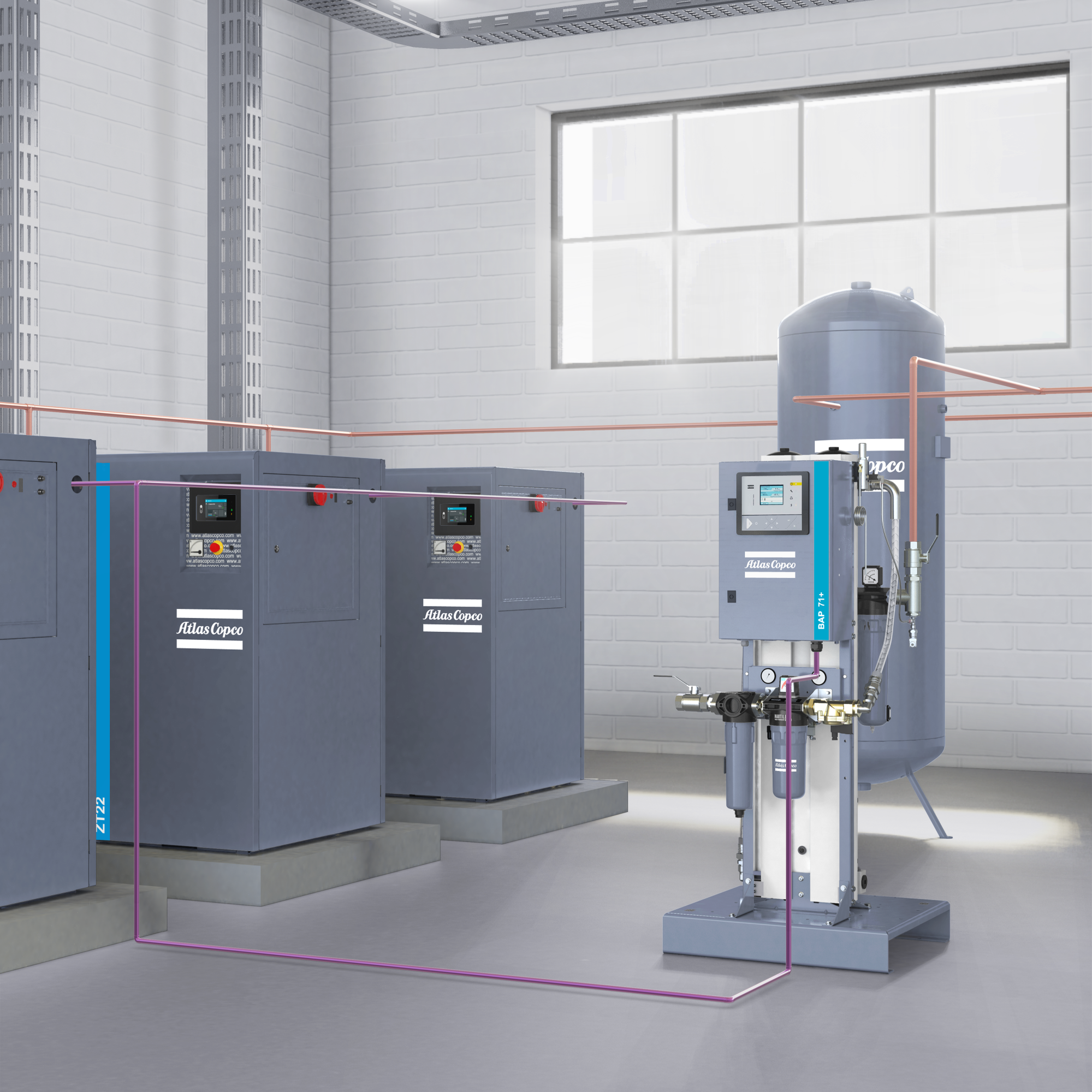
This is what most shops actually do. You tap your existing air compressor, run the air through a purification panel, and monitor it. The panel is a stack of stages, each one handling a different contaminant.
If your compressor is oil-lubricated, and almost every rotary screw and industrial piston machine is, OSHA requires a high temperature alarm or a carbon monoxide alarm or both. If you only run a high temperature alarm, the air supply has to be monitored often enough to keep CO under 10 ppm. In practice, everyone running oil-lubed plant air puts a continuous CO monitor on the panel, because it's the only thing that actually watches the failure mode you're worried about.
Why the high temperature alarm at all? Because carbon monoxide out of an oil-lubed compressor usually means the oil is cooking. An overheating airend or an overheating pump partially breaks down the lubricant, and CO is one of the products. The temperature alarm catches the cause, the CO monitor catches the effect.
The filtration chain, in order
Order matters here, same as it does anywhere else in a compressed air system. Each stage protects the one behind it.
- Aftercooler and water separator. Drop the air temperature and knock out bulk liquid before it reaches anything with media in it.
- Dryer. A refrigerated or desiccant air dryer to get the dew point below your lowest ambient. This is the stage people skip and regret.
- Particulate filter. General purpose, catches pipe scale and rust so the fine elements last.
- Coalescing filter. This is where liquid oil aerosol comes out. Usually a two-stage arrangement, a 1 micron grade followed by a 0.01 micron grade.
- Activated carbon. Oil vapor and odor. Coalescing filters do nothing for vapor phase oil, which is why activated carbon is not optional on a breathing air panel.
- CO catalyst, if fitted. Some panels include a catalyst bed that converts carbon monoxide to carbon dioxide. It is not a substitute for monitoring.
- Final filter and continuous CO monitor with alarm. The last line before the hose.
Every one of those stages has a service life, and the carbon is the one that fails silently. A coalescing element tells you it's loaded through rising pressure drop. Carbon does not. It just quietly stops adsorbing and passes oil vapor downstream while the gauge reads normal. Change it on a calendar, not on a differential pressure reading. Six to twelve months is typical depending on duty and inlet oil load, and the panel manufacturer's interval wins over any general rule.
Sizing the panel
Size for the number of respirators running at once, not the number hanging on the wall. Airline respirator demand runs roughly 6 CFM per hood for a continuous flow half mask and closer to 15 CFM for a loose-fitting hood or a supplied-air blast helmet. Add them up, add margin, and then check that your compressor can carry that load on top of everything else in the shop without the pressure sagging.
That last part is where shops get in trouble. Somebody adds a two-hood panel to a system that was already running at capacity, the pressure drops when the blast pot and the panel both call for air, and now the guy in the hood is the one who notices first.
Testing and paperwork
OSHA doesn't spell out a testing frequency in 1910.134 the way some people expect, but quarterly sampling is the widely used interval and many industrial hygiene programs and state plans expect it. You pull a sample at the point of use, meaning at the end of the hose where the respirator connects, not at the panel outlet. Testing at the panel proves the panel works. Testing at the coupling proves the air the worker breathes is clean.
A few other items that get cited more often than the air quality itself:
- Breathing air couplings have to be incompatible with your shop air couplings. This is a hard requirement. Nobody should ever be able to plug a respirator into an unfiltered plant air drop.
- Breathing air hose has to be identified as breathing air hose and rated for it.
- Cylinders and containers of purchased breathing air need a certificate of analysis showing the air meets Grade D.
- Keep the test reports. If you can't produce them, from a compliance standpoint the testing didn't happen.
Frequently Asked Questions
Can I use my regular shop compressor for breathing air?
Yes, if you add a proper purification panel and monitoring. An oil-lubricated compressor feeding a supplied-air respirator requires a high temperature alarm, a carbon monoxide alarm, or both, plus a filtration chain that ends in activated carbon. A dedicated oil-free breathing air compressor is cleaner and simpler, but a well-built panel on plant air is a legitimate and common approach.
What are the Grade D breathing air limits?
Oxygen 19.5 to 23.5 percent by volume, carbon monoxide 10 ppm or less, carbon dioxide 1,000 ppm or less, condensed hydrocarbons 5 mg per cubic meter or less, and no noticeable odor. Those five items are the whole specification under ANSI/CGA G-7.1.
How often should breathing air be tested?
Quarterly sampling at the point of use is the common industrial practice and what most programs and auditors expect. Test at the respirator coupling, not at the panel outlet, and keep the reports on file.
Does Grade D air require a dryer?
The specification does not set a dew point limit, so strictly speaking no. In practice you want one. Water destroys the carbon and coalescing media, rusts the delivery line, and can freeze at the regulator in cold weather. Nearly every working breathing air setup includes a dryer.
Why can't breathing air fittings match my shop air fittings?
Because somebody will eventually plug the wrong thing into the wrong place. OSHA requires breathing air couplings to be incompatible with outlets for nonrespirable air, so a respirator physically cannot be connected to a plant air drop.
Bottom line: Grade D breathing air is five numbers, a filtration chain that ends in carbon, a monitor that watches for CO, and a paper trail that proves it. Get the filtration and the monitoring right and the testing takes care of itself. If you need help spec'ing the filtration side of a panel, that part we can help with.


