


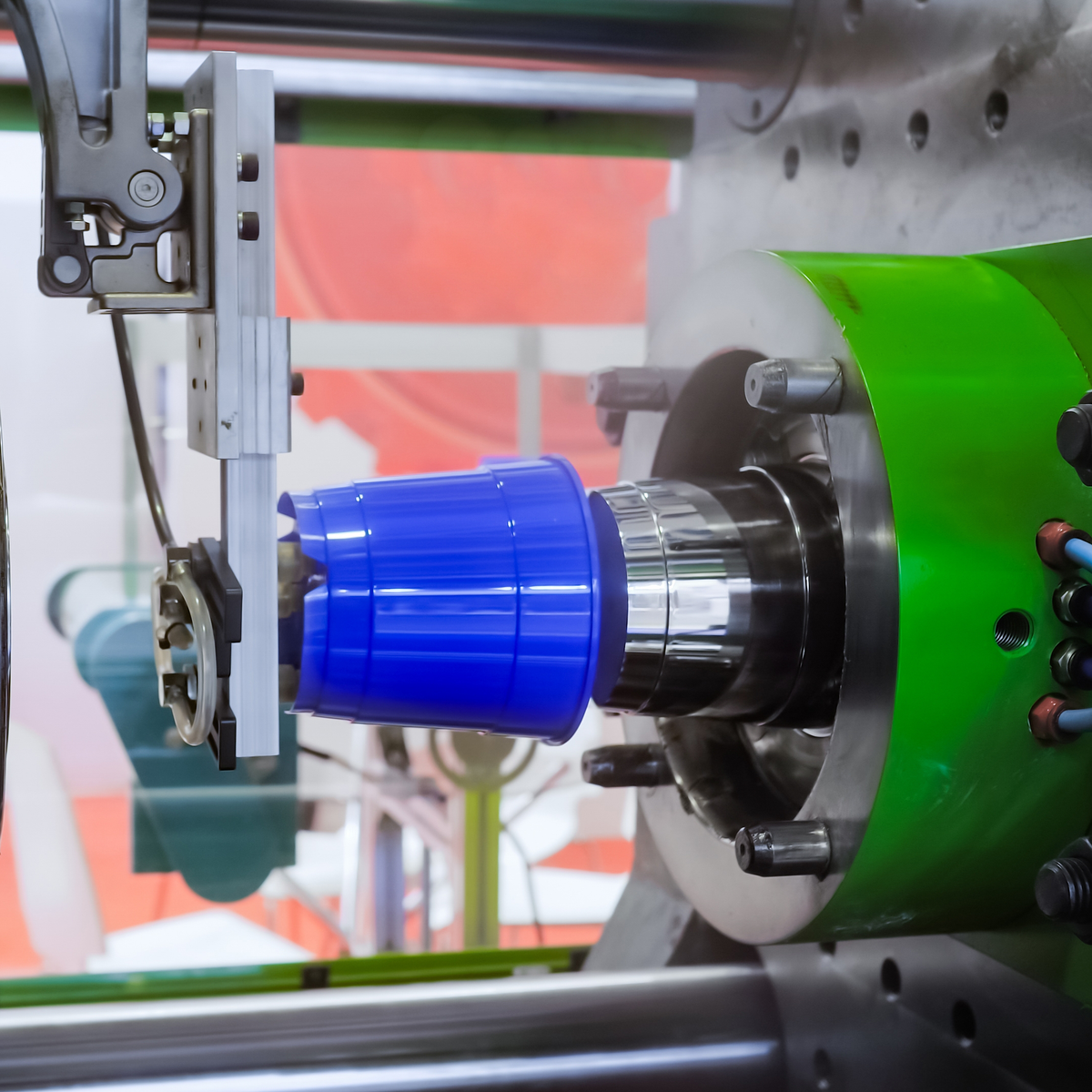
Walk a molding floor at shift change and listen. You'll hear the press, sure, but under it there's a steady hiss that never stops. That's a venturi vacuum generator on a robot arm, pulling a part off the core. Multiply it by twelve presses and you're looking at the single largest compressed air load in the building, and nobody has ever put a gauge on it.
That's the thing about compressed air for injection molding. It isn't one big dramatic demand like a sandblast booth. It's forty small ones running around the clock, and they add up faster than anyone budgets for. Get the system wrong and you don't get a bang, you get short shots, slow cycles, parts sticking in the mold, and a pressure gauge that sags every time the robots index together.
Why a Molding Plant Is Different
A general machine shop uses air in bursts. Somebody pulls a trigger, air moves, then it stops. A molding plant is the opposite: the demand is continuous, highly repetitive, and tightly synchronized to cycle time. Every press finishes its cycle and every robot reaches at roughly the same moment. If your compressor is sized to average demand, it will be fine 80 percent of the time and it will fall on its face during the synchronized peak, which is exactly when you can least afford it.
The second difference is cleanliness. Plastics touch food, medical devices, and cosmetics. If the air blowing a part out of the mold carries oil aerosol, you get a contaminated surface that will not print, will not bond, and will not pass a customer audit. Molders get held to air quality specs that a welding shop never sees.
Where the Air Actually Goes
Before you size anything, understand what's drawing. In a typical thermoplastic injection plant the loads break down like this:
| End use | Pressure | Character of demand | Notes |
|---|---|---|---|
| Robot EOAT vacuum (venturi generators) | 60 to 80 psi | Continuous while gripping | Usually the biggest single load in the plant |
| Air-assist part ejection | 80 to 100 psi | Short pulse, every cycle | Fires at the same instant across presses |
| Mold and core blow-off | 60 to 90 psi | Short pulse, every cycle | Prime candidate for engineered nozzles |
| Resin conveying (dilute phase) | Low pressure or blower | Intermittent | Often better served by a blower than plant air |
| Mold clamps, slides, valve gates | 80 to 100 psi | Cyclic | Small draw, high sensitivity to pressure dips |
| Water manifold and mold blow-down | 90 to 120 psi | Occasional, heavy | Mold changes only, but big short peaks |
Resin conveying deserves its own look, because dilute phase and dense phase are two different systems and only one of them belongs on your plant air. We broke it down in pneumatic conveying air for plastics plants.
Venturi vacuum is the load nobody counts
Robot end-of-arm tooling almost always makes its vacuum with a venturi ejector rather than a vacuum pump, because a venturi has no moving parts and mounts right on the arm. The trade is that it eats compressed air the entire time the cup is holding, not just during the pull-down. A single-stage generator running continuously on one arm is a real load, and a cell with six or eight cups can quietly become the equivalent of a large air tool that never lets off the trigger.
Two fixes are worth knowing. First, multi-stage generators use a series of nozzles to expand the air in stages and deliver noticeably better vacuum flow per SCFM of air consumed than a single-stage unit. Second, and cheaper, is a vacuum switch with a hold circuit: once the cup seals, the generator shuts off and only re-fires if vacuum decays. On a plant with a dozen robots, that one change often shows up on the power bill.
The Air Quality Target
Here's where molders get into trouble, because the right answer depends on what you're making.
If the air only ever touches the outside of an industrial part that gets painted or assembled, ordinary shop-grade air, dried with a refrigerated dryer to about a 38 degree F pressure dew point and filtered to 1 micron, is fine. That's roughly ISO 8573-1 Class 1:4:2 territory and it's what most general molders run.
If you mold food contact packaging, closures, medical components, or anything that ships into a cleanroom, the bar moves. The commonly specified target for compressed air in direct or indirect contact with product is Class 1:2:1, which means effectively no particles above 0.1 micron, a pressure dew point of -40 degrees F, and oil content at or below 0.01 mg per cubic meter. A refrigerated dryer cannot get you to a -40 dew point. That takes a desiccant dryer plus a proper filtration train. If you are weighing the two, we broke the choice down in Refrigerated vs Desiccant Air Dryer.
PET stretch blow molding is its own animal. The stretch air runs at roughly 30 to 40 bar, which is 435 to 580 psi, from a dedicated high pressure booster, and because the air goes inside a food container it has to be oil free at the point of use. You do not feed that from the same 100 psi header that runs your ejectors. It gets its own machine.
What to install, in order
The order matters more than most people think. Coming off the compressor: aftercooler, water separator, then a general purpose particulate filter, then the dryer, then a coalescing filter, then activated carbon last if you need Class 1 oil. Putting the coalescing filter before the dryer is the classic mistake. It loads up with bulk water, blows through, and the dryer sees liquid it was never meant to handle. We cover the sequencing in detail in our piece on shop air piping and in the treatment articles.
Sizing the Compressor
Don't size from the press nameplates. Injection presses themselves usually draw very little air, because the hydraulics or the electric servos do the real work. The air goes to the ancillaries hanging off the press, and the press manual will never tell you about those.
The only honest way to size is to add up the end uses, then apply a use factor. Something like this:
- List every air-consuming device per cell: vacuum generator, blow-off nozzles, ejector assist, sprue picker, valve gates.
- Get the SCFM at your actual operating pressure from the device data sheet, not the catalog headline number.
- Assign each one a realistic duty: a vacuum generator with no hold circuit might be 90 percent, a blow-off nozzle firing 1.5 seconds on a 30 second cycle is 5 percent.
- Sum the plant, then add 25 to 30 percent for leaks, because a molding plant with hundreds of fittings and constant-flex robot hose always has them.
- Add headroom for the next press. You will buy another press.
If the plant already runs and you're replacing equipment, skip the arithmetic and put a flow meter on the header for a week. Real data beats a spreadsheet every time, and it will show you the synchronized peak that the spreadsheet averages away.
Fixed speed or VSD
Molding demand is steady but not flat. It rises and falls with how many presses are running and how many cells are cycling. That profile is close to ideal for a variable speed rotary screw compressor, which tracks demand instead of loading and unloading against a fixed setpoint. The usual smart build is one VSD unit as the trim machine and a fixed speed unit as the base load, so the fixed machine runs at its efficient full load point and the VSD handles the wiggle.
What you want to avoid is a single oversized fixed speed compressor serving a plant that runs two shifts. At night with three presses up, it spends its life unloaded, burning 25 to 35 percent of full load power to make nothing.
For the full sizing and control walkthrough on the compressor itself, including two-stage payback and where storage beats horsepower, see Rotary Screw Air Compressors for Injection Molding: Sizing and Control.
Storage and Piping
The synchronized peak is a storage problem, not a compressor problem. When twelve robots grip at once and every mold blows off in the same half second, you need volume near the demand to ride through it. Rule of thumb for a screw machine is about 4 gallons of receiver per CFM; for a molding plant with sharp peaks, go heavier, and consider a secondary receiver out at the far end of the loop where the peaks actually happen.
Pipe it as a loop, not a tree. A loop feeds every drop from two directions, which halves the effective run length and cuts pressure drop meaningfully. Take every drop off the top of the header with a gooseneck and put a drip leg at the bottom of each riser. Water that gets past your dryer will find the lowest robot in the plant, and it will find it on a Friday.
Mistakes Molders Make
- Running the whole plant at 120 psi to fix one machine. Every 2 psi of extra header pressure costs roughly 1 percent in compressor power, and it increases flow through every leak and every open blow-off. Find the one machine that needs the pressure, put a booster or a dedicated regulator on it, and drop the header.
- Open copper tube for blow-off. A piece of 1/4 inch open tube blasting a core is one of the most expensive things in a plastics plant. Engineered nozzles entrain ambient air and hit the same force for a fraction of the flow, and they get you under the OSHA 30 psi dead-end limit at the same time.
- No hold circuit on vacuum generators. Covered above, and it's the biggest single savings on most molding floors.
- Undersized regulator and FRL at the press. The header can be at 100 psi and the tool still starves if the point-of-use FRL is a size too small. Sizing a 3/8 FRL for a cell that flows like a 3/4 is a common and invisible fault.
- Treating resin conveying as a compressed air job. Dilute phase conveying wants high volume at low pressure. That is a blower's job. Using 100 psi plant air and throttling it down is throwing away most of the energy you paid for.
- Skipping the dryer because "the parts get painted anyway." Water in the lines rusts steel pipe, and that rust ends up in solenoid valves and vacuum generators. The repair bill on fouled valves usually exceeds the dryer.
A Starting Spec by Plant Size
| Plant | Typical air demand | Compressor approach | Treatment |
|---|---|---|---|
| 2 to 4 presses, one robot cell | 25 to 50 CFM | One 15 to 25 HP rotary screw | Refrigerated dryer, 1 micron plus coalescing |
| 6 to 12 presses, mostly automated | 80 to 180 CFM | One VSD plus one fixed base load | Cycling refrigerated dryer, full filter train |
| Medical or food contact molding | Varies | Oil-free or Class 0 rated machine | Desiccant to -40 F, coalescing plus carbon |
| PET stretch blow molding | Separate system | Dedicated high pressure booster, 435 to 580 psi | Oil free at point of use |
Treat these as starting points, not answers. The end use audit is what gets you the real number.
Frequently Asked Questions
Does an injection molding machine itself need much compressed air?
Usually not. Most of the press function is hydraulic or electric servo. The air goes to the ancillaries: robot vacuum, ejector assist, blow-off, valve gates, and mold clamps. When people undersize a molding plant compressor, it is nearly always because they sized from press nameplates and ignored the cell hardware.
Do I need oil-free air to mold food packaging?
You need air that meets the oil limit your customer or auditor specifies, which for food contact is typically ISO 8573-1 Class 1 oil, at or below 0.01 mg per cubic meter. You can reach that with an oil-lubricated compressor plus a proper coalescing and activated carbon train, and many plants do. An oil-free machine removes the risk at the source and simplifies the audit conversation, which is why medical and pharmaceutical work usually specifies it outright.
Why do my parts stick or my cycle time creep up when the plant gets busy?
Almost always pressure sag at the synchronized peak. Air-assist ejection and blow-off need full pressure in a very short window. When every cell fires together and your storage is thin, the header drops for a second and the assist does not do its job. Add receiver volume near the demand before you consider a bigger compressor.
What dew point do I actually need?
For general industrial molding in a heated plant, a refrigerated dryer at roughly a 38 degree F pressure dew point is adequate. If any line runs outdoors or through an unheated space, or if you are on a food, medical, or cleanroom spec, you need a desiccant dryer at -40 degrees F. Half measures here produce liquid water at the worst possible place.
Is a VSD compressor worth it for a molding plant?
Often yes, because molding demand varies with how many cells are running rather than sitting flat. VSD pays best where load swings across shifts. If you truly run all presses all the time at a constant rate, a well-sized fixed speed machine at full load is just as efficient and costs less. Meter your demand for a week before you decide.
If you are building or rebuilding a plastics plant air system, start with the end use audit, set your air quality target from your toughest customer spec rather than your easiest, and buy storage before you buy horsepower. Sound compressed air for injection molding is not exotic. It's just counted honestly.


