


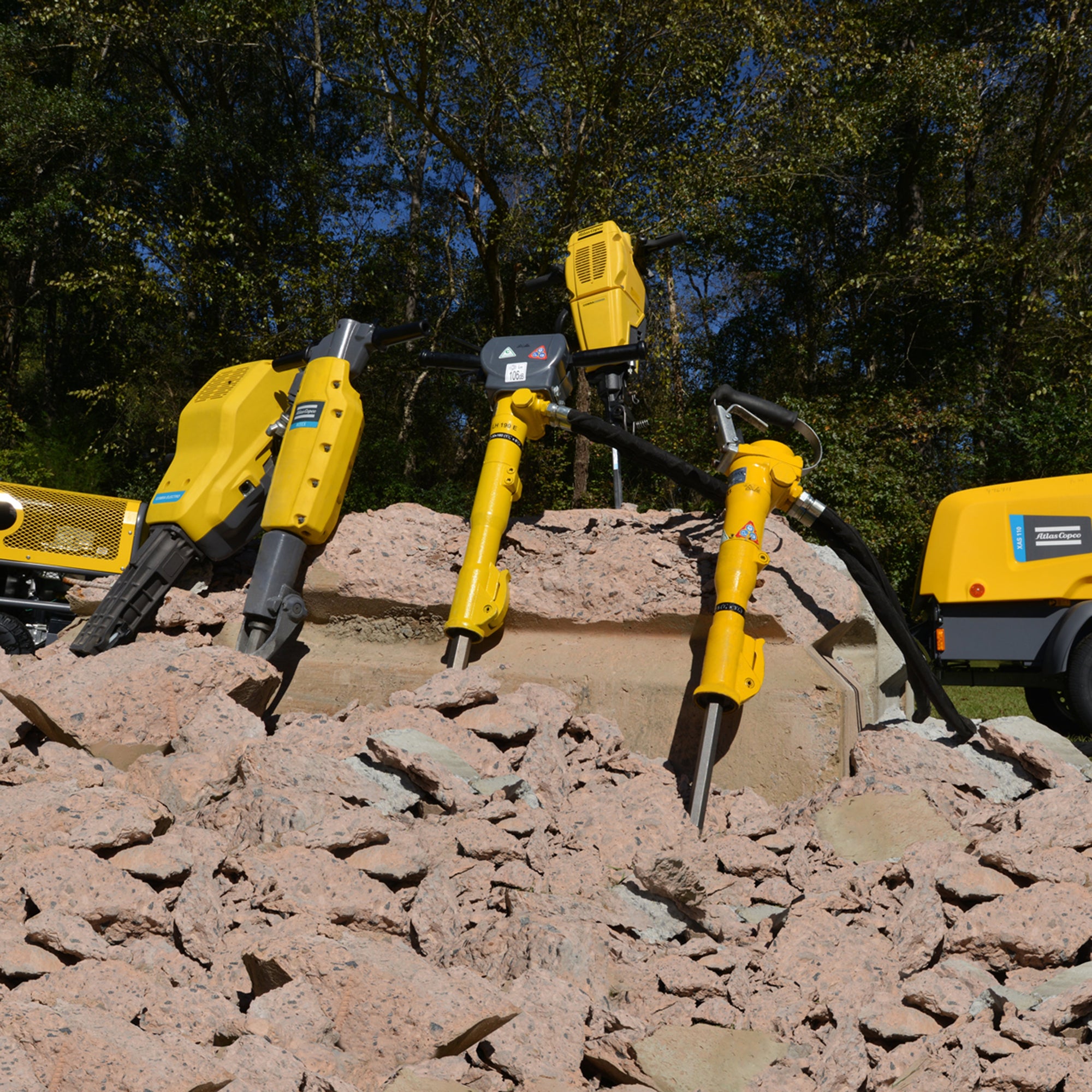
A demo crew called us last spring because their brand-new breaker felt gutless. It hit hard for ten seconds, then the blows went soft and slow. The tool was fine. Their compressor could not feed it. That is the number one mistake people make with a pneumatic breaker: they buy the tool and forget it is only as strong as the air behind it. Get the pairing right and an air breaker will chew through concrete all day. Get it wrong and you are standing around waiting for pressure to recover.
An air breaker is a percussion tool. Compressed air drives a piston that pounds a steel bit dozens of times a second, and that hammering is what breaks concrete, busts rivets, or chips slag. Because it runs on air alone, with no motor and no cord, it is tough, simple, and safe around water and dust. The trade-off is appetite. Percussion tools drink air, and they drink it continuously while the trigger is down.
The types of pneumatic breaker
Breaker is a loose word that covers a family of tools, from a light chipping hammer you hold in one hand to a 90 pound pavement breaker you lean your whole body into. Picking the right class comes down to the work and how much air you can supply.
| Tool | Typical air need at 90 PSI | Best for |
|---|---|---|
| Chipping hammer | About 20 to 40 CFM | Chipping tile, slag, light concrete, weld cleanup |
| Rivet buster | About 45 to 50 CFM | Cutting rivets, light to medium demolition |
| Pavement or paving breaker (30 to 60 lb) | About 40 to 70 CFM | Sidewalks, slabs, foundations |
| Heavy breaker (60 to 90 lb) | About 50 to 90 CFM | Thick pavement, mass concrete, hardpan |
Those numbers are rated draw with the trigger held down. A small jackhammer might list 25 CFM, a big 90 pound breaker 90 CFM or more. Read the tool's spec, do not guess, because the air figure is what decides everything downstream.
Sizing the compressor for a pneumatic breaker
Here is the rule that would have saved that demo crew a bad morning. Size the compressor to the tool's rated CFM plus a healthy margin, not to the average of how you think you will use it. A percussion tool that gets starved does not just slow down, it loses impact energy fast, and a soft-hitting breaker takes three times as long to do the job.
Work it in this order:
- Find the breaker's rated CFM at 90 PSI from its data sheet.
- If more than one tool will run off the same compressor, add up the CFM of everything that could run at once. Size to that peak, not the average.
- Add 20 to 30 percent on top for hose losses, heat, altitude, and a worn tool that leaks a little more than a fresh one.
- Match the pressure too. Most breakers want 90 PSI at the tool, so account for pressure drop down a long hose.
A quick real-world check: a common 185 CFM towable compressor comfortably runs two 90 pound breakers at once, since 90 plus 90 is 180 CFM. Drop to a 60 pound class and that same 185 CFM machine feeds three of them. Scale it to your crew and your work.
Duty cycle matters more than you think
There is a difference between a breaker you pull the trigger on for ten seconds at a time and one you run flat out for an hour. Intermittent work lets a smaller compressor recover between hits. Continuous breaking needs the machine sized to feed the tool nonstop, which is often 30 to 40 percent more air than the intermittent rating. If your crew leans on the trigger all day, size up. It is cheaper than a stalled job.
Hoses, oil, and keeping it alive
The tool and the compressor are only part of it. A few things keep a pneumatic breaker hitting hard and lasting:
- Use a big enough hose. A skinny hose or a long run chokes airflow and drops your pressure at the tool. For heavy breakers, 3/4 inch or 1 inch supply hose is normal, not the 3/8 inch line you use for a nailer.
- Oil it. Percussion tools need tool oil in the air line or a few drops down the inlet at the start of each shift. Run one dry and the piston and bushings wear out fast.
- Keep the air reasonably clean and dry. A little inline filtration protects the valve and piston from grit and water.
- Match the bit to the job. A moil point for breaking, a chisel for cutting, a spade for clay. The wrong steel makes the tool work harder than it should.
The short version
Pick the pneumatic breaker class that fits the work, read its CFM rating, then buy or rent a compressor that beats that number with room to spare. Add margin, feed it with a fat hose, and keep it oiled. Do that and the tool will hit as hard on the last swing as it did on the first. Skip it and you will be the crew standing around watching a gauge.
Frequently Asked Questions
What size compressor do I need for a pneumatic breaker?
Match the compressor to the breaker's rated CFM at 90 PSI plus 20 to 30 percent margin. A chipping hammer may need only 20 to 40 CFM, while a 90 pound pavement breaker can want 90 CFM or more. If you run more than one tool, size to the peak of everything running at once.
Why does my air breaker lose power after a few seconds?
Almost always the compressor cannot keep up. A percussion tool that runs out of air loses impact energy quickly and the blows go soft. Check the tool's CFM rating against your compressor output, and make sure your hose is big enough and your pressure holds 90 PSI at the tool.
Do pneumatic breakers need oil?
Yes. They are percussion tools with a piston and bushings that need lubrication. Use an inline tool oiler or put a few drops of air tool oil down the inlet at the start of each shift. Running one dry wears it out fast.
What is the difference between a chipping hammer and a pavement breaker?
Size and power. A chipping hammer is light, one-handed, and made for tile, slag, and light concrete, drawing 20 to 40 CFM. A pavement breaker is heavy, stood on end, and made for slabs and foundations, drawing 40 to 90 CFM depending on weight class.
Can I run a jackhammer off a shop air compressor?
A small chipping hammer or light breaker can run off a large shop compressor if it makes enough CFM. Full-size 60 to 90 pound pavement breakers usually need a towable or truck-mounted compressor in the 185 CFM range, because most fixed shop units cannot feed that much air continuously.
Ready to break some concrete? Browse our air breakers and demolition tools below, and if you still need the air to run them, size up with the right air compressor or a rotary screw compressor that can feed the tool without bogging.


