


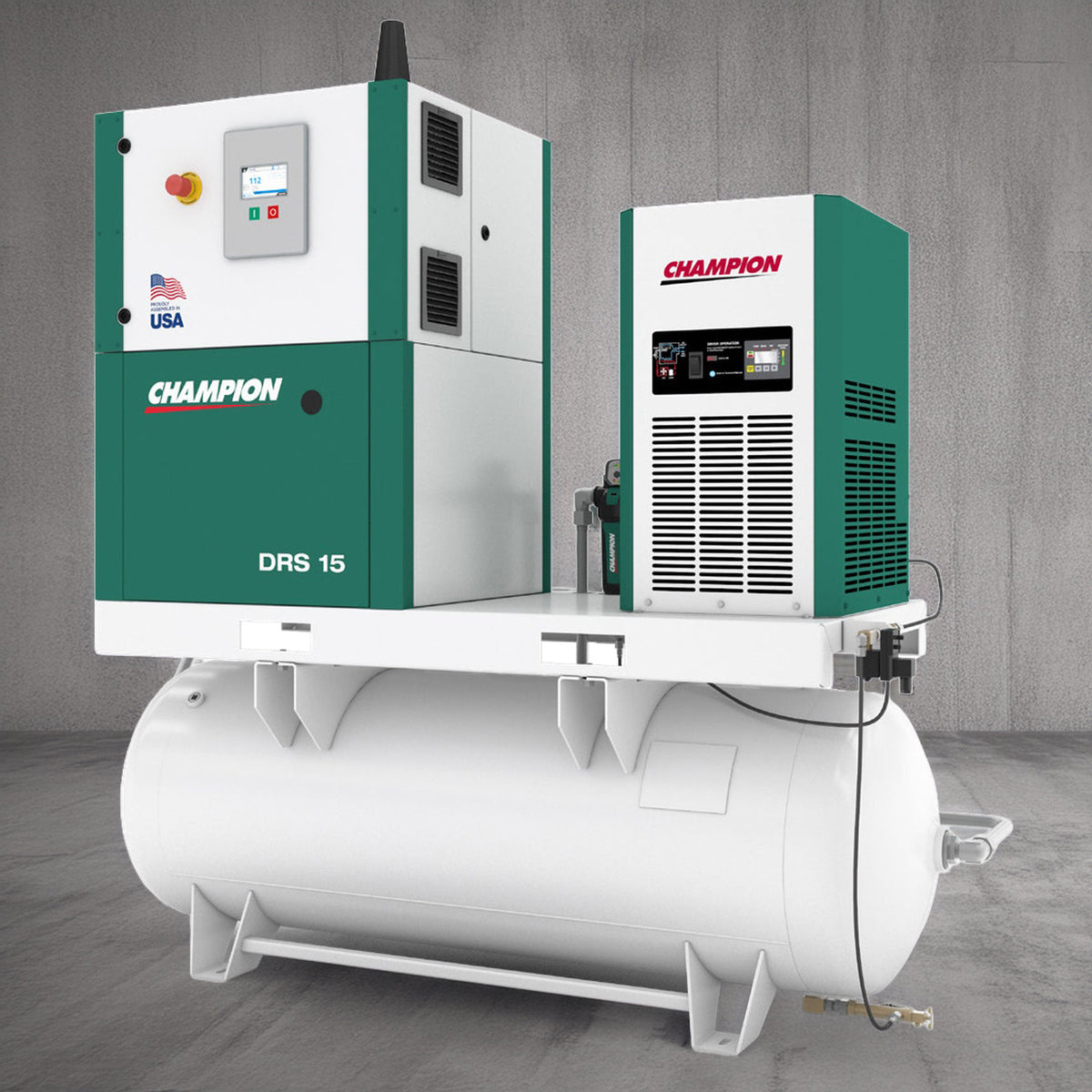
Short answer first: a rotary screw air compressor with a dryer built into the package is the right buy for most shops between 5 and 30 HP that have one compressor, one room and no plans to add a second machine soon. It's the wrong buy if any of those three things isn't true.
We get asked about this every week, usually by someone comparing two quotes. One is a tank-mounted screw with the dryer already on it. The other is the same compressor plus a separate dryer, a few feet of pipe and an install bill. Here's how to decide.
What "integrated dryer" means on the spec sheet
An integrated package puts a refrigerated dryer on the same frame or tank as the compressor, piped and wired at the factory. You bring power and you pipe one outlet to your shop. That's it.
The ABAC AS line we carry is a good example of how these are usually offered. Every model comes in a few configurations:
| Suffix | What you get | Where it fits |
|---|---|---|
| TMD | Tank mount with dryer: compressor, dryer and receiver in one footprint | Small and mid-size shops that want one machine against one wall |
| BMD | Base mount with dryer: compressor and dryer on a base, receiver supplied separately | Shops that already own a good tank, or need a bigger one than the package offers |
| TM / base only | Compressor without a dryer | Shops that already have a dryer or need a different type |
In our integrated dryer collection, the range runs from the AS-5251TMD, a 5 HP unit rated 20.3 CFM at 125 psi on a 71-gallon tank, up to the 30 HP AS-30253TMD at 114.1 CFM and 125 psi on a 131-gallon tank. The 20 to 30 HP models also come as BMD base mounts. Sound levels on the spec sheets run from 63 to 71 dBA, quiet enough to sit in a shop rather than a separate room in a lot of cases.
ABAC's brochure lists the dryer on its 20 to 30 HP AS models at a pressure dew point of around 37°F and says the drain is an automatic type that wastes no air. Hold onto that 37°F number. It matters later.
Why the package usually wins
The dryer is matched to the compressor
The most common dryer mistake we see is a dryer bought separately and sized off the compressor's horsepower instead of its real output at the shop's real conditions. A factory package takes that guess away. The manufacturer picked the dryer for that airend's flow.
That doesn't mean it's matched to your room. More on that below.
One footprint, one install
A 5 HP tank-mount AS unit measures about 56 by 23 by 55 inches and weighs around 571 pounds according to ABAC's listing. Put a standalone dryer next to a comparable tank-mount and you've added floor space, a couple of unions, a bypass if you do it right, and another power drop. In a crowded shop corner that floor space is the whole argument.
Fewer field connections, fewer leaks
Every threaded joint an installer adds is a joint that can leak. Factory piping isn't perfect, but it's done once, on a bench, and pressure-tested before it ships.
The dryer actually gets bought
This is the unglamorous one. When the dryer is a line item, it's the first thing cut when the budget gets tight. Then the shop runs wet air for three years and spends more on rusted pipe, sticky tools and fisheyes in the paint than the dryer would have cost. A package makes that decision for you.
When a separate dryer is the better call
You'll add a second compressor
An integrated dryer treats that compressor's air and nothing else. If you plan to grow into two machines, or you already run a backup unit, one central dryer sized for the combined flow, with both compressors feeding it, is usually cheaper and simpler than two package dryers. It also means your backup compressor's air is dry, which a lot of shops forget until the day they need it.
You need a lower dew point than about 37°F
A refrigerated dryer can't get water out below the temperature of its own evaporator. A pressure dew point near 37°F is fine for air that stays in a heated building. It isn't fine if a line runs outdoors, through an unheated warehouse or across a loading dock in a northern winter. Air that cools below its dew point drops water, and below 32°F that water freezes in the pipe.
If any part of your system sees freezing temperatures, or your process calls for drier air (powder coating, instrument air, some food and pharma uses), you need a desiccant dryer for that air. A package with a refrigerated dryer can still be the base, with a desiccant unit downstream on the branch that needs it. But don't buy the package thinking it solves the cold-line problem. Our comparison of refrigerated and desiccant dryers goes into which applications need which.
Your compressor room runs hot
Refrigerated dryers are typically rated at 100°F ambient and 100°F inlet. Inside a compressor package, the dryer lives right next to the heat source. In a cramped, poorly ventilated room in July, both numbers can climb past the rating, and a refrigerated dryer loses capacity quickly once that happens. Compressed Air Best Practices cites a correction factor of 0.69 at a 115°F inlet, meaning the dryer handles about two-thirds of its rated flow.
A package dryer that's matched to the compressor at 100°F has no margin left at 115°F. A separate dryer can be placed in cooler air or sized one step up. If you're putting a package in a closet, fix the ventilation first. Our guide to compressor room ventilation has the fan math.
You want the dryer serviceable without stopping the compressor
Ask how the package is piped and whether there's a dryer bypass. On some packages, a dryer that needs service means the compressor comes down too, or runs undried while you work. A separate dryer with a three-valve bypass can come out of line while the compressor keeps the shop running. For a one-compressor shop, that difference may decide the whole question.
Wet tank or dry tank? Ask before you buy
On a tank-mounted package, find out which way the air flows. If the compressor feeds the dryer and the dryer feeds the tank, the tank stores dry air. That's good for your pipe but it means the dryer has to handle every surge from the compressor directly. If the compressor feeds the tank first and the dryer draws from the tank, the tank acts as a wet receiver that catches bulk water and smooths the flow, and the dryer sees a steadier load.
Both layouts work. They just behave differently, and the answer changes where you put your condensate drains and whether you need a second receiver downstream. The spec sheet doesn't always say. Ask.
A quick way to decide
| Your situation | Our pick |
|---|---|
| One compressor, 5 to 30 HP, heated building, decent ventilation | Tank-mount package with dryer |
| Same, but you already own a good ASME receiver | Base-mount package with dryer |
| Two compressors now or planned within a few years | Compressors without dryers, one central dryer sized for both |
| Any line exposed to freezing, or a process needing very dry air | Package or standalone base, plus a desiccant dryer on the cold or critical branch |
| Hot, tight compressor room you can't ventilate | Separate dryer placed in cooler air, sized with the derate |
Don't skip the filters
A dryer removes water vapor. It doesn't remove oil aerosol from an oil-flooded screw, and it doesn't remove rust or pipe scale. ABAC lists coalescing filters as an option on the larger AS packages, not standard. If you're painting, running anything sensitive or just want your tools to last, add a particulate filter and a coalescer after the dryer. That's true whether the dryer is built in or not.
Frequently Asked Questions
Does an integrated dryer cost more to run than a separate one?
Not inherently. A refrigerated dryer of the same capacity uses about the same power either way. What changes the cost is whether it's cycling or non-cycling and how much of the day your compressor runs loaded. We break that down in cycling vs non-cycling refrigerated dryers.
Can I add a dryer to a compressor I already have instead?
Yes, and if your compressor is healthy that's usually smarter than replacing it to get a package. Size the dryer for the compressor's actual CFM at your summer room temperature, add a bypass, and put it before your main distribution line.
Is 37°F dew point dry enough for a body shop?
In a heated shop, a refrigerated dryer plus coalescing and particulate filtration at the booth is the setup most body shops run. Check your paint system's own air spec to be sure. If your pipe runs through cold space before it reaches the booth, 37°F isn't enough, and you'll see water in winter.
What happens if the dryer fails on a package unit?
Depends on the package. Ask whether it can be bypassed so the compressor keeps running while the dryer is repaired. If it can't, keep a spare drain and know who services the refrigeration side before you need them.
If you're still comparing a package against separate pieces, the rotary screw compressor guide covers the compressor side of the decision.


