


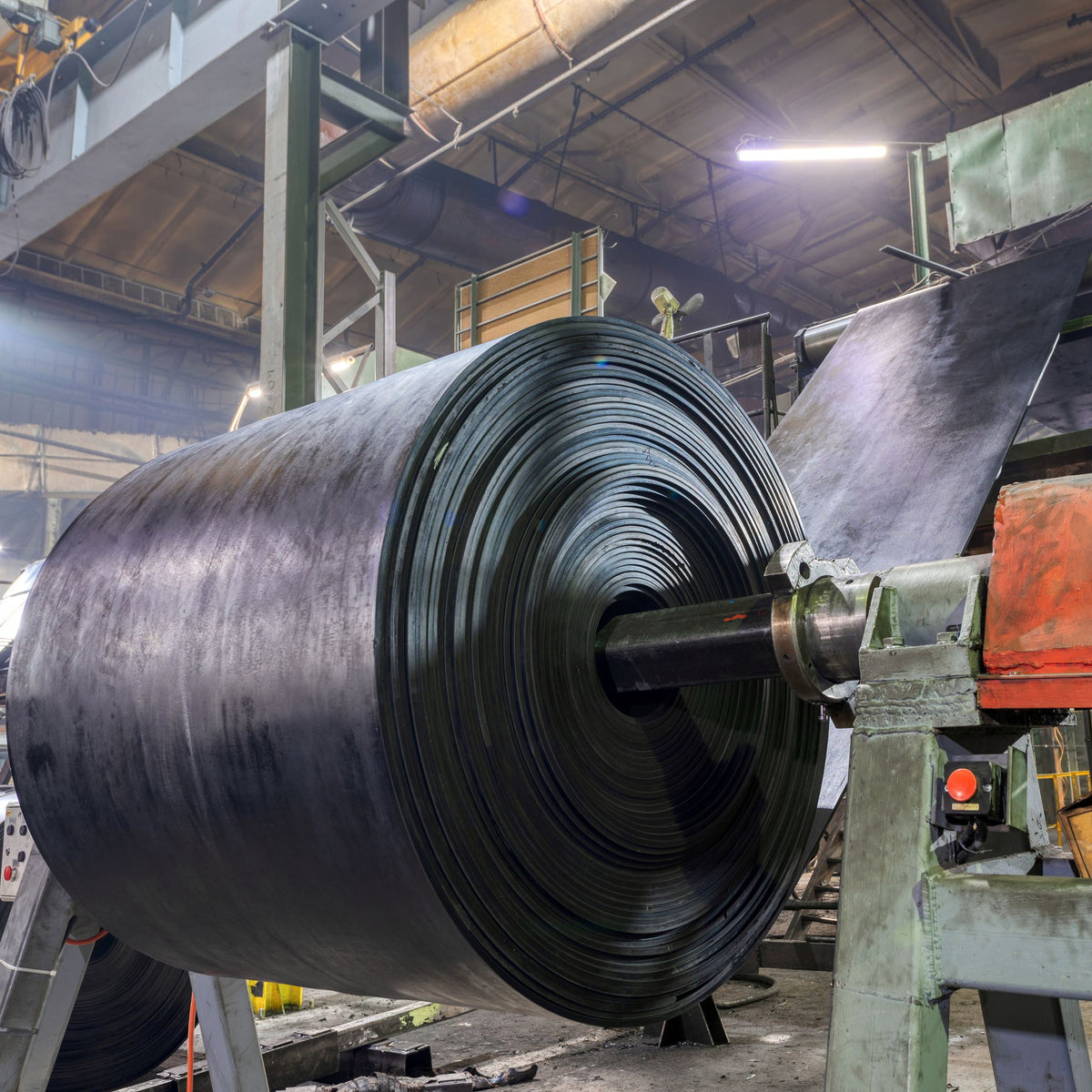
A rubber molding press cures parts somewhere between 140 and 200 degrees C. The air system feeding the building has no say in that number. What it does decide is whether the bonded part peels at the customer, whether the hose comes off the mandrel in one piece, and how long the mold cleaning crew has the press tied up on a Tuesday.
That is the odd thing about compressed air for rubber manufacturing. It's rarely the headline utility (steam, heat and hydraulics get the attention), but it touches the steps where scrap gets made. This piece walks through a molded goods and hose plant department by department, with the numbers we could pin to a source, and says plainly where air is not the answer.
Where the air goes in a rubber products plant
Every plant is laid out differently, but the air users tend to fall into the same handful of places:
- Mixing room. Pulse-jet dust collectors on the powder and filler handling, and on some internal mixers, a pneumatic ram.
- Metal prep and bonding. Grit blasting inserts and spraying primer and adhesive for rubber-to-metal parts.
- Molding. Air blasts to strip parts, cylinders on press automation, blow guns at every press.
- Hose and extrusion. Floating hose off mandrels, drying extrusions after a water bath or wash.
- Mold maintenance. Dry ice blasting, which can be the single biggest air user in the building when it runs.
Some of these care about volume. Some care about oil and water. A couple care about both, and that's where plants get into trouble.
The mixing room
Internal mixers aren't all built the same. Some Banbury-style machines drive the ram hydraulically. Others use an air cylinder. One manufacturer of pneumatic-ram kneaders lists a supply of 0.6 to 0.8 MPa (roughly 87 to 116 psi) and air capacity from at least 0.3 cubic meters per minute on its smallest model up to at least 2.0 on its largest. That's about 11 to 71 CFM. If your mixer is a pneumatic-ram type, check its nameplate, because the top of that range will push some older plant compressors hard all by itself.
The dust collectors on carbon black, clay and other fillers are the other mixing room load. Pulse-jet collectors clean their bags with short bursts of air. Baghouse.com's guidance is to start around 60 psi, that roughly 70 psi is adequate for felted media, and that you shouldn't go above 100 psi except for some difficult applications. More pressure is not more cleaning past a point. It's more wear on the bags and more air out the pulse valves.
Mixing rooms are dusty, so look at where the compressor intake sits. A compressor breathing filler dust will eat intake filters and, eventually, its airend. Duct the intake to clean air if the compressor shares a wall with the mixers.
Bonding: the department that pays for clean air
If you make rubber-to-metal bonded parts (engine mounts, bushings, seals with a metal case), this is the section that matters most.
Parker LORD's application guide for solvent-based Chemlok adhesives is blunt about it. It tells users to "utilize clean, dry sources of compressed air to avoid contamination." For grit blasting the metal, it calls for "an air stream that is free of oil and water" and says removal of oil and water "is critical to preventing contamination." It lists "filters and moisture traps in air lines" for spray equipment, and it notes that any oil or grease left on the metal surface will reduce adhesion.
Think about what that means in practice. You grit blast an insert to get a clean, rough surface. If the blast air carries compressor oil aerosol, you just sprayed a thin film of oil onto the part you're about to bond. The primer goes on fine. The part molds fine. It fails a peel test, or worse, it passes the peel test and fails in a vehicle.
The same guide makes one more point that's easy to miss: if spray pressure is too high, adhesive droplets disperse and dry before they reach the metal. So the bond line needs a good regulator at the gun, not just clean air at the header.
What we'd put on the bond line branch
Treat it like an automotive paint line, because the failure mode is the same (oil on a surface that needs to wet out):
| Stage | What it does | Why it matters for bonding |
|---|---|---|
| Refrigerated or desiccant dryer | Pulls water out of the air | Water in blast air flash-rusts steel inserts and clumps grit |
| General purpose filter | Catches particulate and bulk liquid | Protects the next stage |
| High efficiency coalescing filter | Removes oil aerosol | This is the one that keeps oil off the metal |
| Activated carbon filter (spray booth only) | Removes oil vapor | Optional, but cheap insurance on primer and adhesive spray |
| Point-of-use regulator | Sets gun pressure | Too much pressure dries adhesive before it lands |
You don't need to dry and polish the whole plant to that level. Put the coalescing and carbon stages on the branch that feeds blast cabinets and spray booths, and leave the press floor on standard dried air. If you want a refresher on how coalescing elements work, our coalescing filter guide covers it, and the ISO 8573-1 classes piece explains how to write the spec down so a supplier can't argue with it.
The press floor
Compression molded parts are usually demolded by hand. Transfer and injection molding is where air shows up more, as short blasts that strip a part off the cores while the mold opens. One rubber and LSR injection molding patent describes parts "simply blown off by a short blast of air during the mold opening process." That's a small volume per cycle, but it's every cycle on every press, and those little blasts add up across a molding floor.
Then there are blow guns. Every press has one, and operators use them to clear flash and debris from cavities. Two things to watch:
- OSHA 1910.242(b) says compressed air used for cleaning has to be reduced to less than 30 psi, with chip guarding and PPE. A blow gun on a 110 psi header with no restriction fails that.
- Open blow guns and drilled pipe are pure waste. An engineered nozzle uses less air and stays OSHA compliant.
On the deflashing side, be honest with yourself about whether it's an air load at all. Cryogenic deflashing freezes parts with liquid nitrogen and throws polycarbonate media at them with a turbine wheel spinning up to 6,000 to 10,000 RPM. That's a nitrogen bill and an electric bill, not a compressed air bill. Tumble deflashing is the same story. Don't size a compressor for a department that doesn't use it.
Hose and extrusion lines
Mandrel-built hose is a good example of air doing a job nothing else does as cleanly. After the hose cures (often in an autoclave), it has to come off the mandrel. A common method is injecting compressed air or water between the mandrel and the hose to float the hose off. Air keeps the bore dry. The catch: the air you inject ends up inside the finished hose, so if your customer cares about bore cleanliness (fuel, coolant, anything going into an engine), oil and water in that air are a quality issue, not just a maintenance one.
Continuous extrusion lines bring their own needs. Freudenberg runs a liquid curing method line where the vulcanization medium is molten salt heated to around 200 degrees C, followed by washing and cooling to remove remaining salt. After the water, the profile is wet, and wet product doesn't cut, coil or label well.
That's where air wipes earn their keep. EXAIR published a case where a rubber hose extruder reduced total scrap by blowing off its extrusion more effectively after a water bath, using a 2 inch Super Air Wipe with a 360 degree airstream. In a rubber cable case, the customer ran air wipes at 80 psig after cooling baths and reported using 30 percent less compressed air than with its homemade blow-offs. If your line still dries product with copper tube bent into a ring and drilled with holes, that's the first thing we'd change.
Mold cleaning can be your biggest single load
This one surprises people. Rubber molds foul with release agent, compound residue and bonding agent, and the old way to clean them was to pull them, let them cool and scrub or media blast. Dry ice blasting lets you clean molds in place, hot, without major disassembly. Cold Jet cites a customer, Vernay, that cut mold cleaning time from more than six hours to 30 minutes.
The air side of that trade is real, though. Cold Jet's spec sheet for its Aero2 ULTRA puts nozzle consumption at 12 to 100 CFM at 80 psi on the PCS model and 50 to 165 CFM at 80 psi on the PLT model. A mid-size plant whose compressor was sized for presses and a few blow guns can watch header pressure sag the minute the blaster starts.
Three ways to handle it, roughly in order of cost:
- Add a receiver near the blasting station so the blaster draws from storage instead of yanking the whole header down.
- Schedule mold cleaning for shifts when the press floor is lighter.
- Rent or buy a portable compressor dedicated to the blaster, so it never touches plant air at all.
Whatever you do, run the blaster on dry air. Wet air and dry ice make clumps and plug hoses.
Sizing it: add up the departments, then be skeptical
We can't give you a CFM-per-press number that holds across plants, because rubber shops vary too much. A gasket shop with six compression presses and a hose plant with a mandrel line and a salt bath extruder have almost nothing in common. Here's the method that works:
- List every air user by department, from the nameplate or manufacturer data (mixer ram, collectors, blast cabinets, press automation, air wipes, dry ice blaster).
- Separate the continuous users from the intermittent ones. Air wipes on an extrusion line run all shift. Mold cleaning doesn't.
- Don't add every tool at full flow. Apply a diversity factor to intermittent loads. We wrote about this in why adding up every tool buys too much compressor.
- If you have an existing system, measure it. A flow meter or a data-logged week beats every spreadsheet.
For most molded goods and hose plants, that lands on a rotary screw air compressor rather than a piston unit, because the press floor and extrusion lines run long, steady shifts. If demand swings a lot between shifts (heavy daytime molding, light night shift), a variable speed screw usually pays for itself. If it's flat all day, a fixed speed machine is fine and cheaper.
Pair it with a refrigerated air dryer for the plant and save the desiccant dryer for a branch that needs it, such as an outdoor line in a cold climate or a bonding department that wants extra margin.
What we'd fix first in most rubber plants
If you only have budget for a couple of changes this year, here's our order:
Put real filtration on the bond line. It's the cheapest fix with the biggest scrap payoff, and it's specific: coalescing filtration and a regulator at the blast cabinet and the adhesive booth.
Replace homemade blow-offs on extrusion lines. Air wipes and engineered nozzles use less air and dry better.
Give the dry ice blaster its own storage or its own compressor. Don't let mold cleaning starve the presses.
Get the compressor out of the dust. Mixing rooms and compressor intakes don't mix.
And if you're not sure where your air is going, start with a week of measurement before buying anything. We'd rather sell you a filter than a 50 HP compressor you didn't need, and so would your plant manager.


