


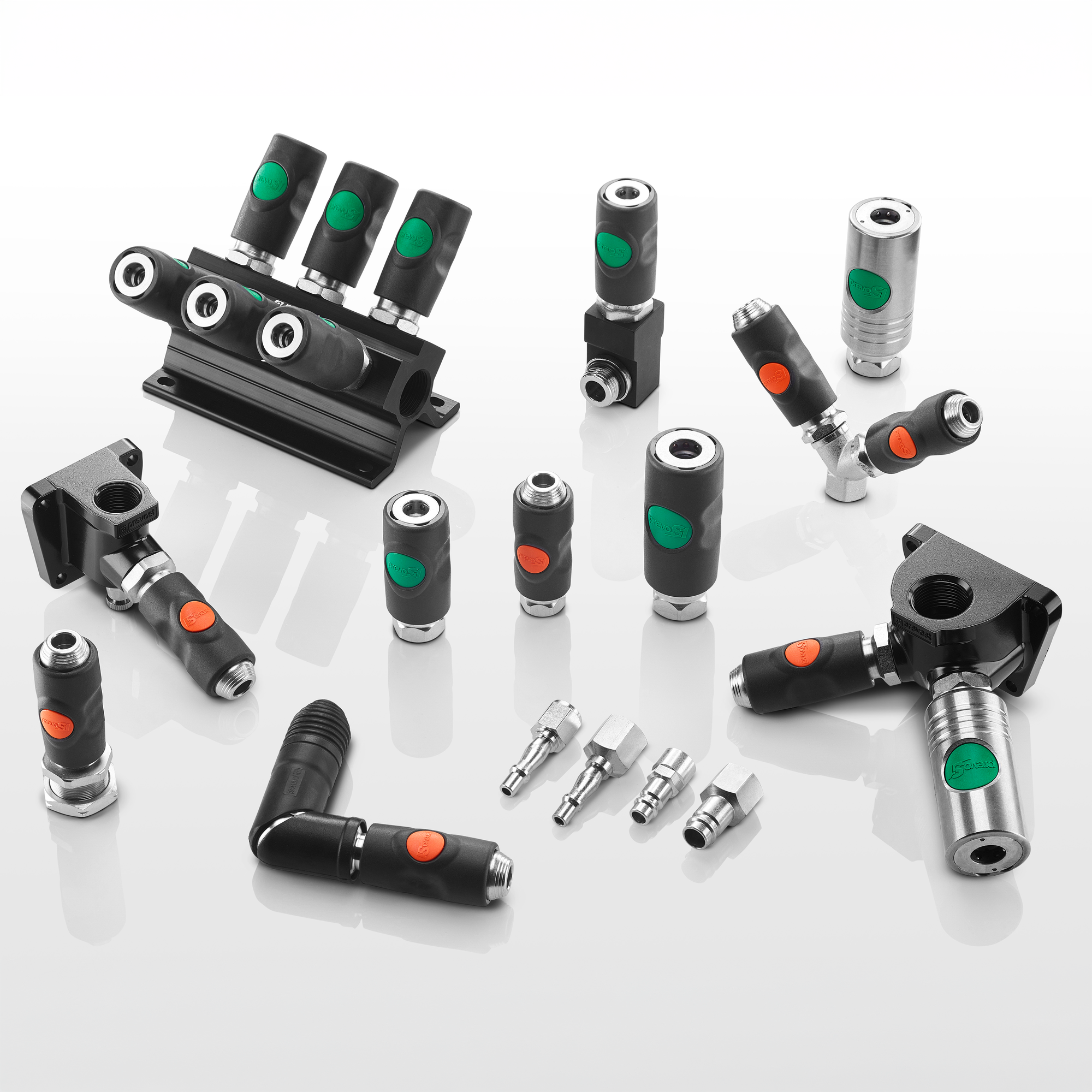
Here is a problem we get asked about every single week. Somebody buys a new air tool, brings it to the bench, snaps the plug into the hose, and it will not click. Or worse, it clicks but leaks like crazy and blows off under pressure. The parts look identical sitting next to each other on the bench. They are not.
Air couplers come in several different interchange profiles that share the same nominal size and the same general shape, and they do not talk to each other. Understanding which one your shop runs on is a fifteen minute education that saves years of aggravation.
Coupler, plug, nipple: getting the words straight
The female half with the sliding sleeve is the coupler. It mounts on the hose end, the manifold, or the wall drop. The male half that snaps into it is the plug, also called a nipple. It goes on the tool.
When somebody says a coupler is a "quarter inch," they might mean two completely different things, which is where half the confusion starts. More on that below.
The four interchange profiles you will actually meet
An interchange is just an agreed-upon plug shape. A coupler built to one interchange accepts plugs built to that same interchange and rejects the rest. In North American shops, four of them cover nearly everything.
| Interchange | Also called | How to spot the plug | Typical flow | Where you find it |
|---|---|---|---|---|
| Industrial | ISO 6150-B, Milton M-style, 30 Series | Shorter nose, two thin stripes | Around 32 CFM | Industrial and manufacturing plants, most shop air systems |
| Automotive | Tru-Flate, T-style, 10 Series | Shortest nose, one thin stripe | Around 32 CFM | Auto shops, tire work, a lot of consumer tools |
| ARO 210 | A-style, 50 Series | Longer nose, one thick stripe | Around 28 CFM | Textile, furniture, carpet, and plenty of older plants |
| Lincoln | L-style, 40 Series | Longest nose, one thick and one thin stripe | Around 22 CFM | Lube equipment and grease guns, occasionally general air |
The stripe trick is the fastest field check there is. Lay the plug on the bench, look at the machined grooves around the body, and count them. Two thin stripes and a short nose is industrial. One thin stripe and an even shorter nose is automotive. One thick stripe on a long nose is ARO. Long nose with a thick and a thin stripe is Lincoln.
You will also find multi-fit or universal couplers that accept two or three of these profiles. They are handy on a service truck where you have no control over what shows up. In a fixed shop they are a mixed blessing, because they usually flow less than a dedicated coupler and they let mismatched plugs stay in circulation instead of forcing you to standardize.
Body size versus port size, and why people order the wrong thing
Two different numbers get called the size of a coupler.
Body size describes the internal flow path. A 1/4 inch body is the common small coupler you see everywhere. A 3/8 inch body is physically larger and flows noticeably more. Half inch and 3/4 inch bodies exist for high demand tools and manifolds.
Port size is the pipe thread on the back end, usually 1/4, 3/8, or 1/2 NPT.
These are independent. You can get a 1/4 inch body coupler with a 3/8 NPT port, and you can get a 3/8 inch body with a 1/4 NPT port. When you order, say both. "Industrial interchange, 3/8 body, 1/4 NPT female" leaves nothing to guess at.
Your couplers might be strangling your tools
Air tool performance dies from restriction, and a coupler is the tightest restriction in most systems. A 1/4 inch body coupler is a hole roughly the diameter of a pencil that your entire air supply has to squeeze through, and you usually have two or three of them between the compressor and the tool.
Run the math on a typical setup. A 3/8 inch impact wrench wants somewhere around 4 to 5 CFM at 90 psi in real duty, and a 1 inch impact or a decent DA sander wants a lot more. Stack up a wall coupler, a hose, a reel, and a tool-end coupler, and it is common to lose 10 to 15 psi at the tool before you have squeezed the trigger. The tool feels weak, somebody cranks the regulator up to compensate, and now the whole shop runs at higher pressure and leaks more.
Two fixes, in order of payoff:
- Move up a body size on anything feeding a hungry tool. Going from a 1/4 to a 3/8 body coupler on a sander or a big impact is often the single cheapest performance upgrade in the building.
- Use high flow couplers where you cannot go bigger. High flow designs open up the internal path and the valve geometry without changing the interchange, and they are worth the premium at the tool end.
None of that helps if the hose is the bottleneck instead. If you are still running 1/4 inch hose to a tool that wants volume, fix that first. Our air hoses and hose reels both come in sizes worth matching to the coupler you pick.
Safety couplers: the ones that vent before they release
A standard coupler dumps the plug the instant you pull the sleeve. Whatever pressure is trapped in the hose downstream comes out all at once, and the hose whips. It is startling at best, and at the end of a 50 foot line with a heavy tool on it, it is an injury.
A safety coupler splits the disconnect into two motions. The first pull vents the downstream air. The second releases the plug, which by then is holding nothing. You feel it as a soft hiss instead of a crack.
OSHA does not name a specific coupler in its standards, but 29 CFR 1926.302 requires that pneumatic tools be secured to the hose in a way that prevents accidental disconnection, and the general duty clause covers hose whip as a recognized hazard. Insurance carriers and plant safety programs increasingly write safety couplers into the spec outright. If your shop is due for a walk-through, this is a cheap box to check.
We stock the Prevost coupler line in industrial, ARO, and automotive interchanges, in both standard and safety versions, so you can standardize a whole shop without changing every plug on every tool.
Materials, briefly
Steel and zinc-plated steel are the default and are fine indoors. Brass resists corrosion better and is easier on the plug, so it shows up on cleaner installations. Stainless is for washdown, food plants, and coastal humidity. Composite and aluminum bodies save weight on tools that get carried all day, which matters more than people expect on an eight hour shift.
Rubber coupler covers are a small item with an outsized return. They keep the sleeve from freezing up with grinding dust and they stop the coupler from chipping paint and glass when a hose gets dragged across a vehicle.
Pick one standard and enforce it
Whatever profile you land on, run it everywhere. Mixed interchanges are how you end up with a drawer of adapters, three plugs on every tool, and a leak at every joint.
If you are starting fresh, industrial interchange is the safest default in a work shop because it flows well and it is the most widely stocked. If you are in an automotive setting where every customer tool and every parts store plug is Tru-Flate, standardize on automotive and stop fighting it. Then buy a box of plugs in that profile, spend an afternoon swapping every tool in the building, and throw the odd ones out. Do not leave them in a drawer. They will come back.
Frequently Asked Questions
Are all 1/4 inch air couplers interchangeable?
No. The 1/4 inch refers to the body size or the thread, not the plug shape. An industrial 1/4 inch coupler will not accept an ARO or a Lincoln plug even though every one of them may be called a quarter inch. Match the interchange profile first, then the size.
How do I tell which interchange I already have?
Look at the machined stripes on a plug you know works. Two thin stripes on a short nose is industrial. One thin stripe on the shortest nose is automotive. One thick stripe on a long nose is ARO 210. A thick and a thin stripe on the longest nose is Lincoln.
Do I need a safety coupler on every drop?
You get the most benefit where hoses are long, tools are heavy, and disconnects happen often. Many shops put safety couplers at the tool end of every hose and on all wall drops, and leave standard couplers on short bench jumpers. Check your own safety program, since a lot of them now require them everywhere.
Will a bigger coupler really make my air tool work better?
On a high consumption tool, yes, noticeably. Sanders, big impacts, grinders, and cut-off tools are the ones that wake up when you step from a 1/4 to a 3/8 body or move to a high flow design. A brad nailer will not care.
What pressure are air couplers rated for?
Most common pneumatic interchanges in these profiles are rated up to about 300 psi, which is well above normal shop pressure. Confirm the rating on the specific part before using couplers anywhere near their limit, and never use air couplers on hydraulic service.


