


A body shop called us a while back because their clear coat kept fisheyeing. They had already replaced the gun, the regulator, and every foot of hose in the booth. They had a refrigerated dryer, a water separator, and a good coalescing filter on the wall. On paper the air was clean.
What they did not have was an activated carbon filter, and that is why the oil kept coming through.
Aerosol versus vapor, and why it matters
Compressor oil leaves an airend in two forms, and they behave completely differently.
Oil aerosol is liquid oil broken into tiny droplets suspended in the air stream. A coalescing filter handles this beautifully. The fibers catch the small droplets, merge them into bigger ones, and gravity pulls them down into the bowl. That is what coalescing means.
Oil vapor is oil that has evaporated into gas. It is not a droplet anymore. It flows through a coalescing element the same way the nitrogen and oxygen do, because there is nothing there for a fiber to catch. You can install the best coalescer made and vapor walks straight past it.
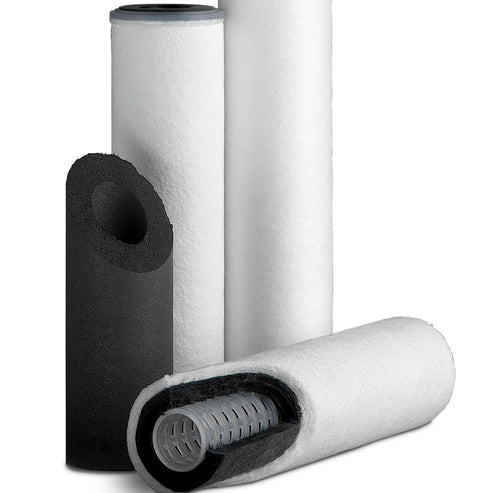
The only practical way to remove oil vapor is adsorption, and that means activated carbon. The carbon is riddled with microscopic pores that give it an enormous internal surface area, and hydrocarbon molecules stick to that surface as the air passes through.
This is also why the temperature of your air matters more than people expect. The hotter the air, the more oil is carried as vapor rather than aerosol, and the less capacity the carbon has. Air coming off a hot compressor into a hot filter is the worst case on both counts.
What the ISO numbers actually mean
When a spec sheet or a customer asks for "Class 1 air," they are pointing at ISO 8573-1, which grades compressed air separately for particulate, water, and oil. The oil column is total oil, meaning liquid plus aerosol plus vapor added together.
| ISO 8573-1 oil class | Total oil (mg/m3) | Typical use |
|---|---|---|
| Class 0 | Stricter than Class 1, specified by the user | Pharma, semiconductor, critical process |
| Class 1 | 0.01 or less | Food contact, paint, medical device, sensitive electronics |
| Class 2 | 0.1 or less | General instrument and process air |
| Class 3 | 1 or less | Quality shop air |
| Class 4 | 5 or less | General plant air |
A coalescing filter alone will typically get you into Class 2 territory on a lubricated compressor. Getting to Class 1 essentially always requires carbon downstream of the coalescer. Good carbon elements are commonly documented down around 0.003 mg per cubic meter of remaining oil, which is well inside Class 1.
Where a carbon filter goes in the line
Order matters here more than almost anywhere else in an air system, because a carbon element that gets hit with liquid is a carbon element you just ruined.
- Compressor
- Aftercooler and moisture separator. Knock out the bulk liquid while the air is still hot and wet.
- Particulate or general purpose filter. Protects everything downstream from scale and rust.
- Dryer. Refrigerated or desiccant depending on the dew point you need.
- Coalescing filter. This is the carbon filter's bodyguard. It has to remove essentially all the liquid and aerosol first.
- Activated carbon filter. Now it only has to deal with vapor, which is what it is good at.
- Point of use.
Skip step five and the carbon soaks up liquid oil, saturates in weeks instead of months, and then starts releasing what it collected back into your air. That last part is the one that catches people out. A flooded carbon filter is worse than no carbon filter, because it gives back concentrated slugs of what it grabbed.
Some shops also add a small dust filter after the carbon to catch any fine carbon migration. On a well-made element it is a belt and suspenders move, but on food or pharma work it is standard practice.
When you actually need one
Not every shop needs carbon, and we would rather tell you that than sell you a housing you will forget to service. You need one when:
- You spray finish. Oil vapor in paint air causes fisheyes and adhesion failures, and it does not show up until the job is on the rack.
- Air touches food or packaging. Direct contact air almost always calls for Class 1 oil and often odor removal too.
- You have an odor complaint. Carbon is the only stage that removes smell. If your air smells like a compressor, it is vapor.
- Sensitive electronics or optics. A film of oil on a circuit board or a lens is a scrap part.
- A customer or an auditor specified Class 1. You will not hit it on coalescing alone.
You probably do not need one when you are running impacts, nailers, and blow guns in a general shop. Class 3 or 4 air is fine for that work, and a good coalescer plus a dryer gets you there.
The oil-free question
People assume an oil-free compressor makes a carbon filter pointless. Mostly true, with a real caveat: your compressor pulls in whatever is floating around the room. If your intake is anywhere near a loading dock, a paint booth exhaust, a forklift, or a solvent bench, hydrocarbons are coming in through the inlet whether your machine has oil in it or not. Plenty of oil-free installations still run a carbon stage for exactly that reason, especially in food plants.
The safety line you should not cross
Worth stating plainly, because we get asked: an activated carbon filter does not make compressed air breathable. It removes oil vapor and odor. It does nothing about carbon monoxide, and CO is the thing that actually kills people on supplied-air respirators. Breathing air requires a purpose-built breathing air system with CO monitoring and alarms, built to the applicable Grade D requirements. Do not improvise that with a shop filter.
When to change the element
Here is the part that trips up most maintenance programs. On a particulate or coalescing filter you watch the differential pressure gauge and change the element when it climbs. That does not work on carbon.
A carbon element does not plug up as it saturates. Pressure drop stays low right up until the carbon has no capacity left, and then oil vapor simply passes through with no warning at all. There is no gauge that tells you.
So you change carbon on time, not on pressure. Most manufacturers land in the range of every six to twelve months, and the correct answer for your system is whatever your element maker specifies for your operating conditions. Shorten it if:
- Your inlet air temperature runs high. Heat cuts adsorption capacity.
- Your compressor is older and carrying over more oil than it used to.
- You run close to the filter's rated flow rather than comfortably under it.
- The application is food, medical, or anything with a documented air quality requirement. Those usually get a fixed six month interval regardless.
Put it on the calendar with a date sticker on the housing. That is the only system that survives staff turnover. It goes on the same schedule as your air filter elements and your air dryer service.
Sizing and pressure drop
Size a carbon filter to your actual peak flow, not your compressor nameplate, and then go one size up if you are close to the limit. Oversizing a filter has almost no downside. It lowers pressure drop, extends element life, and costs a little more once.
Undersizing costs you continuously. Every PSI of unnecessary pressure drop is roughly half a percent on your energy bill, and it never goes away. Given that filter housings last decades, buying the bigger one is usually the cheaper decision over the life of the system.
You can browse housings and elements in our activated carbon filters category, and the upstream coalescing stages live under air filters.
The short version
A coalescing filter removes oil droplets. An activated carbon filter removes oil vapor and odor, and nothing else in your system does that job. Put it after a good coalescer so it never sees liquid, size it generously, change it on a calendar rather than a gauge, and do not confuse it with breathing air equipment. If you spray finish or your air touches food, it is not optional. If you run impact wrenches, it probably is.
Frequently Asked Questions
What is the difference between a coalescing filter and an activated carbon filter?
A coalescing filter mechanically captures liquid oil and oil aerosol by merging tiny droplets into larger ones that drain away. An activated carbon filter adsorbs oil vapor and odor, which are in gas form and pass straight through a coalescer. They do different jobs and a Class 1 system needs both, with the coalescer first.
How often should I change an activated carbon element?
On time rather than on pressure drop, because carbon does not plug as it saturates. Most makers specify somewhere between six and twelve months depending on conditions, and food or medical applications often fix it at six. Follow your element manufacturer's interval and shorten it if your air runs hot or your compressor carries over more oil than it used to.
Does an activated carbon filter make compressed air safe to breathe?
No. It removes oil vapor and odor but does nothing about carbon monoxide, which is the real hazard in supplied-air breathing. Breathing air needs a dedicated breathing air system with CO monitoring and alarms built to the applicable Grade D requirements.
Do I need carbon filtration with an oil-free compressor?
Often not, but check your intake. An oil-free machine still compresses whatever hydrocarbons are in the room air it pulls in, so a compressor sitting near a loading dock, a solvent bench, or a paint booth exhaust can still deliver oil vapor. Many food plants run carbon on oil-free systems for exactly this reason.
Will a carbon filter hurt my flow or pressure?
A properly sized one adds only a small pressure drop. An undersized one adds a lot, and that drop is permanent operating cost. Size to your real peak flow and go one size larger if you are near the rating, since the extra cost is one time and the savings are ongoing.


