


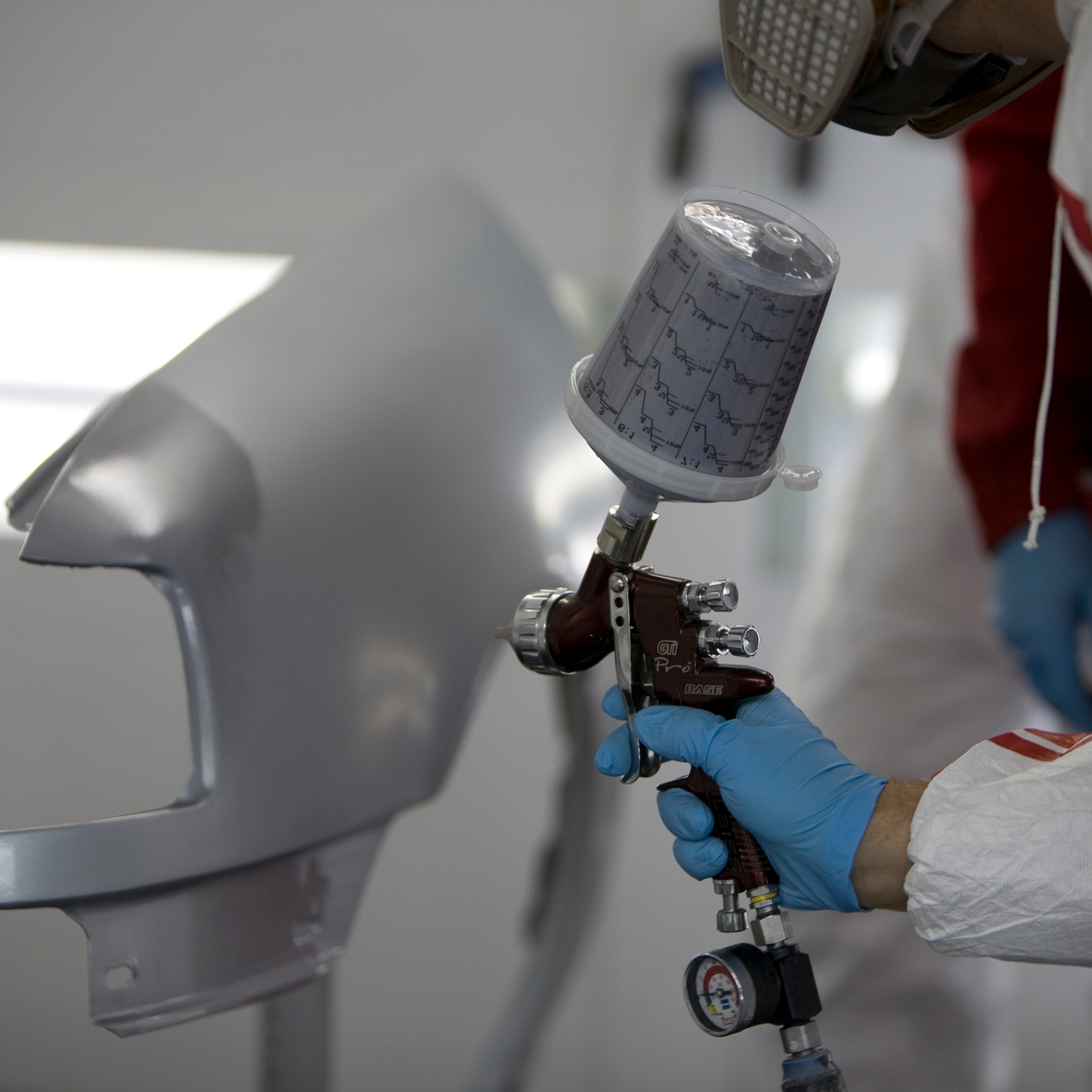
Fisheyes in the same three spots on the same door, twice. You wet-sanded it, you cleaned it, you changed the gun, and they came back. At that point most painters start blaming the product. It is almost never the product. It is oil vapor, it came out of your own compressor, and no amount of tack cloth is going to fix it. Air filtration for auto body paint booths is the only thing standing between an oil-injected rotary screw and a panel you have to shoot again.
This one goes deeper on the filter wall specifically. For the whole system, including compressor sizing and booth makeup air, start with compressed air for auto body shops.
Where the oil is actually coming from
If you run an oil-injected rotary screw, and most shops do, the air leaving the machine carries oil in three forms. There is bulk liquid, which the air/oil separator catches. There is aerosol, a fine mist of droplets that a coalescing element catches. And there is vapor, oil that has evaporated into the air stream because the discharge is hot.
That third one is the problem. Vapor is a gas. It goes through a coalescing filter the same way steam goes through a screen door. Your dP gauge reads fine, your filter bowl is dry, and the vapor is still landing on your basecoat. The only thing that removes it is adsorption, which means activated carbon.
Even oil-free compressors are not a free pass. The intake pulls in whatever is in your shop air, and a body shop is full of hydrocarbons. You still need the wall, you just need less carbon capacity.
What the air has to be
Paint booth specs are usually written against ISO 8573-1, which gives three numbers in the order particulate, water, oil. Booth manufacturers commonly call for Class 2 water or better, and the tightest practical oil class you can reach with a filter train. In plain terms, you want the air dry enough that it will not condense anywhere in the shop, and oil content low enough that it cannot be measured on a panel.
What that translates to in equipment is the three stage wall below. Skip a stage and you have a gap in the chain, and the gap always finds the paint. If you want the full breakdown of what each class actually promises, see ISO 8573-1 air quality classes, decoded.
The three stage wall, in order
| Stage | Filter type | What it removes | Typical rating | Change interval |
|---|---|---|---|---|
| 1 | Water separator plus particulate (general purpose) | Bulk liquid water, rust, pipe scale, large solids | 1 to 5 micron | 12 months |
| 2 | Coalescing (high efficiency) | Oil aerosol, fine solids, remaining moisture droplets | 0.01 micron, oil carryover around 0.01 mg per cubic meter | 12 months |
| 3 | Activated carbon | Oil vapor and hydrocarbon odor | Down to roughly 0.003 mg per cubic meter | 6 to 12 months, sooner if odor returns |
The order is not a suggestion. Each stage protects the one behind it.
Stage 1 keeps liquid and grit off the coalescing element, which is the expensive one. Stage 2 keeps liquid oil off the carbon. Stage 3 goes last and as close to the booth as you can practically mount it.
That last rule is the one shops break. Activated carbon must never see liquid. A carbon bed that gets slugged with water or liquid oil is finished, immediately and permanently, and it will not tell you. It just quietly stops adsorbing while the gauge keeps reading zero pressure drop. If your carbon filter is mounted ahead of the dryer, or ahead of the coalescer, move it today. You can shop the stages at coalescing air filters, particulate and general purpose filters, and activated carbon filters.
The dryer decides whether the wall works at all
Filters remove what is already liquid or already solid. They cannot remove water vapor, and if your pressure dew point is above the temperature of the pipe running along the cold outside wall of the booth, water will condense downstream of every filter you own.
A refrigerated dryer holding a 35 to 40 F pressure dew point handles a heated shop with indoor piping. If any part of your run is in an unheated bay, a mezzanine, or outside, the pipe can go below that and you either need to reroute or step up to desiccant. Put the dryer between stage 1 and stage 2, so the separator protects the dryer and the coalescer catches whatever the dryer knocks out. Browse air dryers sized to your actual flow, not your compressor nameplate.
The painter's air is a different system
Everything above is about protecting the finish. None of it makes air safe to breathe, and this is where body shops get written up.
If your painter wears a supplied-air respirator, OSHA 1910.134(i) requires the air to meet CGA G-7.1 Grade D at minimum. That means:
- Oxygen between 19.5 and 23.5 percent
- Carbon monoxide at or below 10 ppm
- Carbon dioxide at or below 1,000 ppm
- Condensed hydrocarbons at or below 5 mg per cubic meter
- No pronounced odor
The part people miss: if the compressor feeding that respirator is oil-lubricated, you must use a high-temperature alarm or a carbon monoxide alarm, or both. If you use only the high-temperature alarm, you have to monitor the air at intervals frequent enough to keep CO under 10 ppm. A hot oil-lubricated compressor can make carbon monoxide, and an activated carbon filter does not remove it. Carbon adsorbs hydrocarbons, not CO. Full detail is in Grade D breathing air requirements.
Sizing the filters
Size every housing at the flow that will actually pass through it, and give yourself margin. A filter run near its rated maximum starts with a high pressure drop when the element is brand new, and that only goes up.
The cost of getting this wrong shows up at the gun. Every psi you lose across an undersized filter is a psi the painter does not have, and the usual fix is to crank the regulator, which changes atomization and fan pattern. Oversize by one housing step. The price difference is small and the element lasts longer because the face velocity is lower.
A few placement notes worth the ten minutes:
- Mount the wall vertically with every drain plumbed to a collection point, not dripping on the floor.
- Take the booth feed off the top of the main, never the bottom.
- Put the final regulator and a clean short hose after the carbon, so nothing dirty sits between the last element and the gun.
- Keep a dedicated drop for the booth. Sharing it with an impact gun in the next bay is how debris gets pushed downstream.
The gauge will lie to you
Differential pressure gauges tell you when an element is blocked with solids. They tell you nothing about whether a coalescing element is still coalescing, and nothing at all about whether a carbon bed is spent. Both fail while reading normal.
Change coalescing and particulate elements every twelve months regardless of what the gauge says. Change carbon at six to twelve months, and immediately if anyone smells anything at the gun. An element costs a fraction of one repaint, and you are going to notice a spent carbon bed by refinishing a hood, not by reading a gauge. Replacement elements are at air filter elements.
Frequently Asked Questions
Do I need an activated carbon filter if I have an oil-free compressor?
Usually yes, though it will last longer. An oil-free compressor does not add oil, but it compresses whatever is in your shop air, and a body shop atmosphere carries solvent and hydrocarbon vapor. The carbon stage is cheap protection on a panel that costs hours to redo.
Where exactly should the carbon filter go?
Last in line, downstream of the dryer and the coalescing filter, as close to the booth drop as you can mount it. It must never see liquid water or liquid oil. A carbon bed that gets wet is done, and it fails silently.
Will a filter fix water in my air lines?
Only the water that is already liquid. Filters cannot remove vapor, and vapor is what condenses later in a cold run of pipe. If you have water at the gun, you have a dryer problem or a piping problem, not a filter problem.
Can I use my paint booth filtration for the painter's supplied air?
No. Breathing air is a separate requirement under OSHA 1910.134(i) and CGA G-7.1 Grade D, and it includes carbon monoxide limits that a standard filter wall does nothing about. An oil-lubricated compressor feeding a respirator needs a CO alarm or a high-temperature alarm with monitoring.
How often do body shop air filters really need changing?
Twelve months for particulate and coalescing, six to twelve for carbon. Do it on a calendar, not on a gauge. Both coalescing and carbon elements stop working long before the differential pressure reading tells you anything.
Where to start
If you are chasing a finish defect right now, work backward. Confirm the dryer is holding dew point, confirm the coalescing element has a date on it from this year, and confirm there is a carbon element between that filter and the gun. Most shops that get serious about air filtration for auto body paint booths find they were missing the third stage entirely, or had it mounted in the wrong place. Fix the order first, then the elements, then worry about the gun.


