


Nine times out of ten, the guy asking about dryers already has one. He has a refrigerated dryer, it is working exactly as designed, and he is still finding water in a line that runs outside along the back wall. Somebody told him he needs a desiccant dryer. He wants to know if that is true or if he is being sold something.
Usually it is true, and for a reason that has nothing to do with the dryer being broken. The whole refrigerated vs desiccant air dryer question comes down to one number, and once you know that number the rest is arithmetic.
The one number that decides it
Pressure dew point. That is the temperature at which water starts falling out of your compressed air at line pressure. Air that leaves a dryer at a 38 degree F dew point is dry until something cools it below 38 degrees. Then it rains inside your pipe.
So the rule is simple. Your dew point has to be lower than the coldest temperature your air line will ever see. Not the coldest your shop gets. The coldest that specific pipe gets, including the run through the unheated bay, the loop along the exterior wall, and the drop that goes out to the yard.
If nothing ever gets near freezing, a refrigerated dryer is the right machine and the cheaper one. If anything does, you need desiccant. That is the decision. Everything below is detail on what it costs you either way. There is more background in Compressed Air Dew Point Explained.
How each one actually works
Refrigerated. It is an air conditioner for your air. Compressed air passes through a heat exchanger chilled by a refrigeration circuit, the air cools to roughly 35 to 40 degrees F, the water condenses out, a separator drops it to a drain, and then the air is reheated on the way out by the incoming hot air. That reheat is why the pipe downstream does not sweat. It cannot go below freezing because the exchanger would ice up and block.
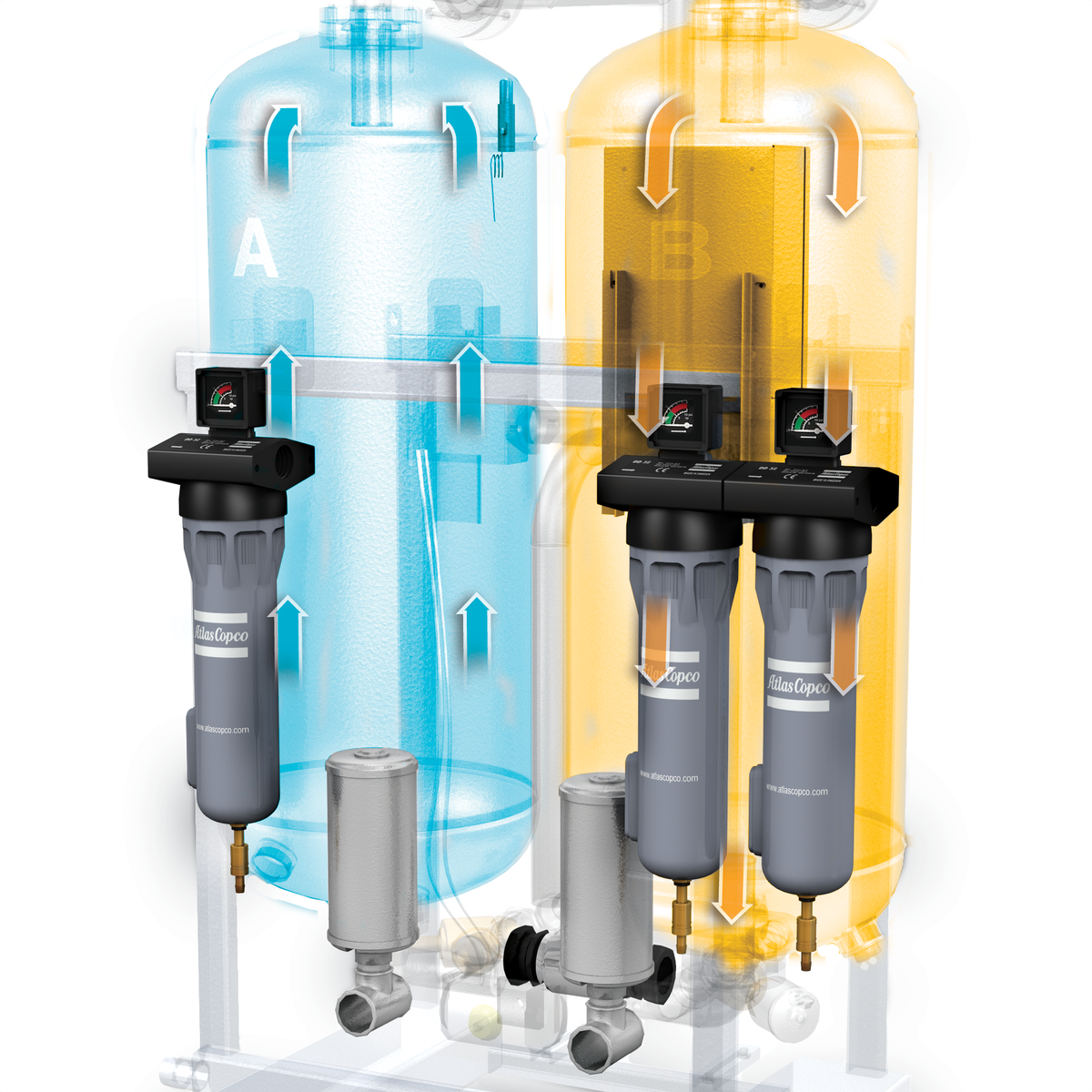
Desiccant. No refrigeration at all. Air passes through a tower packed with a hygroscopic media, usually activated alumina or molecular sieve, and the media adsorbs water vapor right out of the air stream. There are two towers. One dries while the other regenerates, and they swap every few minutes. Because you are pulling vapor out rather than condensing it, there is no freezing limit, which is how you get to minus 40 degrees F and below. We compare the media types in Desiccant Types Compared.
Side by side
| Refrigerated | Desiccant | |
|---|---|---|
| Pressure dew point | 38 to 50 degrees F | Minus 40 to minus 100 degrees F |
| ISO 8573-1 water class | Class 4 to 6 | Class 1 to 3 |
| Energy per 100 CFM | 0.5 to 0.8 kW | Around 3 kW on a heatless unit, counting purge |
| Purge air loss | None | 15 to 20 percent of flow on heatless |
| Purchase price, 50 HP class | Roughly 2,000 to 5,000 dollars | Roughly 8,000 to 20,000 dollars and up |
| Routine maintenance | Clean the condenser, service the drain | Valves, filters, desiccant change every 3 to 5 years |
| Freezing risk downstream | Yes, below about 38 degrees F | No |
Look hard at the energy row, because that is the one people discover after the invoice. A heatless desiccant dryer is three to five times the operating cost of a refrigerated unit at the same flow, and most of that is not electricity. It is purge: dried compressed air you already paid to make, dumped to atmosphere to regenerate the offline tower. Fifteen to twenty percent of your flow, continuously, forever. We put real dollars on that in Desiccant Dryer Purge Air Loss.
When refrigerated is the right call
Most shops, honestly. Refrigerated covers it if:
- Every inch of your air line stays inside a heated building
- You run impact tools, ratchets, sanders, and general pneumatics
- You spray paint in a conditioned booth
- You run a machine shop, a tire shop, a woodworking shop, or a general fab shop
- Your air never contacts product
Within refrigerated there is a second choice worth making. Cycling models modulate to match actual throughput and save 20 to 40 percent over non-cycling units when your demand swings, which it does in nearly every shop. If you run three shifts flat out, non-cycling is fine. Details in Cycling vs Non-Cycling.
When you genuinely need desiccant
- Any line that goes outside or through an unheated space. The most common reason by far, and the one that catches people in October.
- Cold rooms, blast freezers, cold docks. Air going into a minus 10 degree F freezer condenses and then freezes solid in the line.
- Powder coating and critical finishing. A 38 degree dew point is not dry enough when a droplet means a fisheye. Covered in our powder coating piece.
- Breathing air. Grade D compressed air has its own dew point requirement and refrigerated will not get you there.
- Direct food or pharma contact air. Where ISO water Class 1 or 2 is the written target.
- Laser cutting assist gas and instrument air. Both want dew points well below freezing.
- Long buried or overhead outdoor runs. Even in a warm climate, a pipe on a roof at 4 a.m. gets colder than you think.
The setup most shops should actually buy
Here is the part nobody tells you. It is not always one or the other.
If 90 percent of your air is general shop work indoors and 10 percent feeds a powder booth or an outdoor drop, running the entire plant through a desiccant dryer means paying purge losses on all of it to serve a tenth of it. That is an expensive way to solve a small problem.
Put a refrigerated dryer on the main header, then a small point-of-use desiccant dryer on the one branch that needs the low dew point. You get minus 40 where it matters and 0.6 kW per 100 CFM everywhere else. This is the single most common fix we recommend and it usually costs less than upsizing the central dryer.
Sizing, and the mistake everybody makes
Dryer capacity is published at reference conditions, typically 100 degrees F inlet, 100 PSI, 100 degrees F ambient. Your compressor room in August is not those conditions.
Hotter inlet air holds far more water, so a dryer rated 200 CFM at a 100 degree inlet may only handle 150 CFM at 110 degrees. Lower line pressure hurts you too, since air at 80 PSI carries more moisture per cubic foot than at 125 PSI. Size on your worst summer day at your lowest operating pressure, then add headroom for the compressor you will buy in three years, not the one you have now. The full method is in How to Size a Compressed Air Dryer the Right Way.
One more thing that is not the dryer's fault: a desiccant dryer with no coalescing prefilter is a desiccant dryer you will be rebuilding. Liquid oil destroys the media. Put a proper coalescing filter ahead of it and a particulate filter after it to catch desiccant dust, every time.
Frequently Asked Questions
Can a refrigerated dryer get below freezing?
No. The heat exchanger would ice over and choke off flow, so the design floor is right around 35 to 38 degrees F. Any marketing that claims a refrigerated unit hits a below-freezing pressure dew point is describing something else.
Will a desiccant dryer fix my water problem by itself?
Only if the problem is actually dew point. Just as often it is a failed condensate drain, an undersized or dirty aftercooler, or a dryer that is simply too small for the summer heat load. Check those first. Swapping a working refrigerated dryer for desiccant when the real fault is a stuck drain is an expensive lesson.
How long does desiccant last?
Three to five years is typical with clean, oil-free air ahead of it. It goes much faster if liquid oil or bulk water reaches the towers, which is why the coalescing prefilter is not optional. See When to Replace the Desiccant in Your Air Dryer.
Does a desiccant dryer need a bigger compressor?
A heatless one effectively does. If it purges 15 percent of your flow, a 100 CFM demand becomes about 118 CFM at the compressor. Heated and blower purge designs cut that loss substantially and are worth pricing above roughly 200 CFM. That comparison is in Heatless vs Heated Desiccant Dryer.
What about membrane dryers?
They are a good fit for small, specific loads such as a single analyzer or lab bench, where you want a low dew point on a handful of CFM with no moving parts. They do not scale to plant air economically.
Bottom line
Find the coldest temperature any of your air lines will see, then pick the dryer whose dew point sits below it. If that answer is above freezing, buy refrigerated and spend the savings on cycling control. If it is below freezing on only one branch, put refrigerated on the header and a small desiccant unit on that branch. The refrigerated vs desiccant air dryer choice only gets expensive when you treat the whole plant to solve one pipe.


