


A shop outside Greensboro called us last spring convinced their new 30 hp rotary screw "wasn't making enough air." It was making plenty. The problem was 180 feet of 25-year-old black iron running to the far end of the building, packed with enough rust scale to eat roughly a dozen psi before the air ever reached a tool. They didn't need a bigger compressor. They needed pipe.
We get this a lot. The compressed air pipe material you pick decides how much of the pressure you paid to make actually shows up at the drop, how many hours you spend chasing leaks in year seven, and how miserable the install is on day one. Four materials are worth talking about seriously. The one most new systems get built with today is probably not the one your dad used.
Why the Material Matters More Than People Expect
Air leaving a compressor is hot, wet, and depending on the machine, carrying a little oil. It cools inside the pipe, water drops out, and whatever that pipe is made of has to live with the result. Three consequences follow:
- Corrosion. Rust doesn't politely stay where it forms. It flakes, travels downstream, and lands in your filter elements, regulators, and tool valves.
- Bore roughness. A rough or pitted inside surface drags on moving air. That drag is pressure drop, and pressure drop is money you already spent at the compressor and threw away in the ceiling.
- Joint count. Every threaded connection is a candidate leak. Industry figures commonly put leakage in aging threaded steel systems around eight to ten percent of total production, and neglected plants routinely run 20 to 30 percent.
Pipe diameter is a separate conversation and just as important. If you haven't run those numbers, our compressed air pipe sizing guide walks through it. Assume for the rest of this article that you've already picked a size and you're deciding what to make it out of.
Black Iron: Cheap on Day One
Threaded black iron (schedule 40 steel) is the traditional answer and still the cheapest material per foot. It handles pressure far beyond anything a shop compressor will produce, it's available at any supply house, and every pipefitter in the country knows how to work it.
The trouble starts the first time condensate sits in it. Steel and wet air are a bad combination. New black iron already has a fairly rough bore, and as it corrodes it gets pitted, which drives friction and pressure drop up over time. Meanwhile the scale that sloughs off heads downstream to plug things.
Install is the other cost people underestimate. Black iron is heavy, usually needs two people on a ladder, and requires threading equipment plus cutting oil. Any layout change later means cutting and re-threading. If you're running a long main and you plan to move machines around, that inflexibility is real.
Black iron still makes sense for short runs, tight budgets, and shops that already own a threader and have someone comfortable running it. Just know you're trading install cost for maintenance cost.
Copper: Clean Air, Slow Install
Copper solves the corrosion problem. It won't rust, it holds a smooth interior surface for decades, and it's genuinely long-lived (20 to 50 years is a commonly cited service life). For labs, food plants, and anywhere air quality is scrutinized, copper has a strong track record.
Copper is also lighter than steel, which makes overhead work easier, and Type L or Type K handles shop pressures without drama. The catches are cost and labor. Copper is expensive, and every joint gets soldered or brazed, which means a torch, a hot work permit in a lot of facilities, and a skilled hand. Sweating 200 fittings is a long day.
One more note: copper is soft. If your main runs where a forklift mast can reach it, protect it or route it differently.
Stainless Steel: When You Cannot Compromise
Stainless is the longest-lived option on this list and the most corrosion resistant. If you're producing breathing air, running pharmaceutical or high-purity process air, or dealing with a washdown environment that would destroy anything else, stainless is the correct answer and the cost is simply the cost of doing business.
For a general fabrication shop it's overkill. Stainless is the most expensive material here, joints usually mean welding or specialty fittings, and the install is slow. Pick it for a reason, not by default. If your driver is air quality rather than the environment around the pipe, you may get further by putting the money into compressed air filtration and drying rather than into exotic pipe.
Aluminum: What Most New Installs Use Now
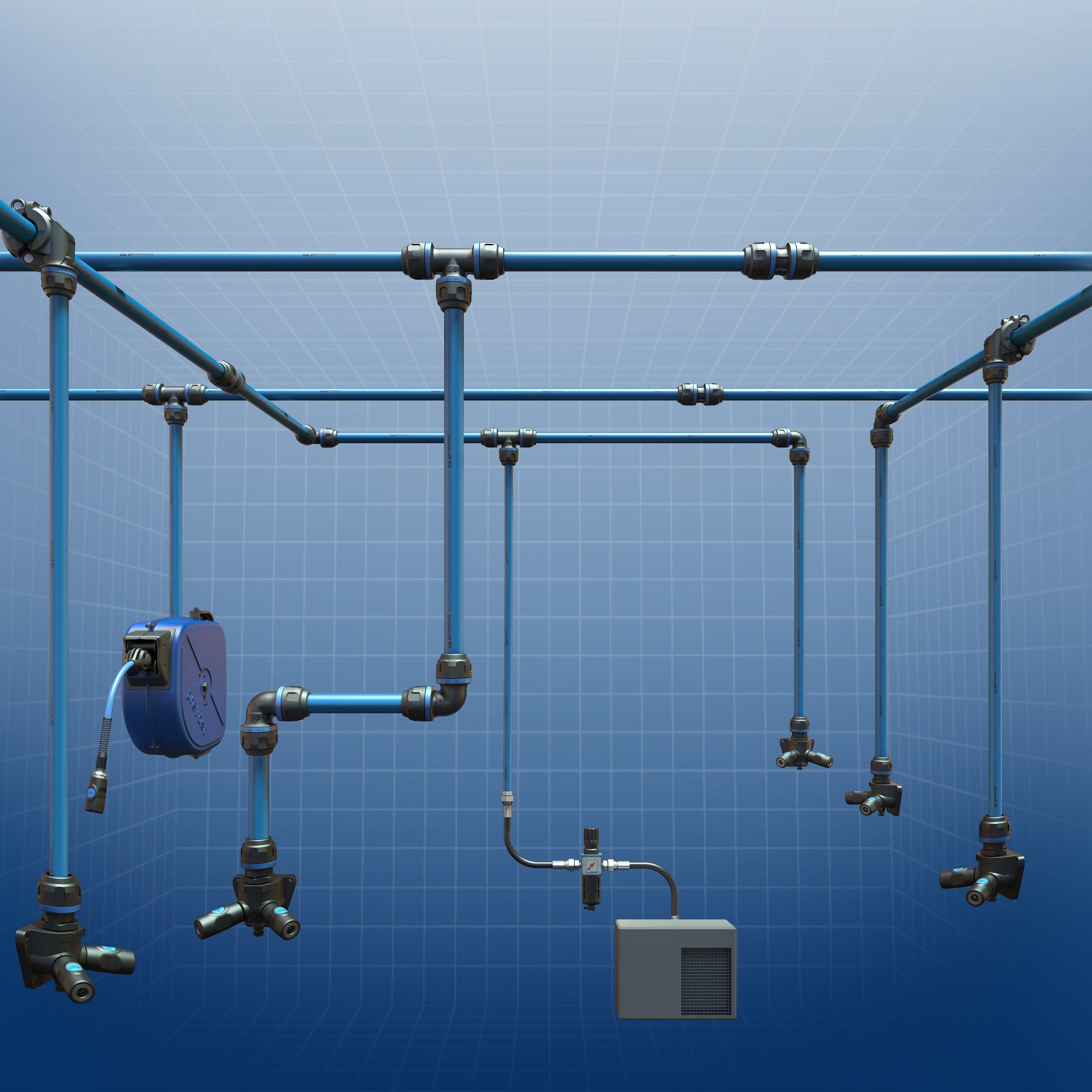
Modular aluminum piping has taken over new and retrofit work for a simple reason: it's the only option that's good at both halves of the problem. Aluminum forms its own protective oxide layer, so it doesn't corrode from the inside like steel. The bore is calibrated and smooth, so pressure drop stays low and stays low. And it goes together with push-to-connect or compression fittings, no threading, no welding, no torch.
Install labor is where the money actually shows up. Reported labor savings versus threaded steel commonly land in the 50 percent range and go higher on complex layouts, which is usually enough to offset aluminum's higher material cost on the total project. It's also light enough that one person can hold a stick overhead, and it comes apart and reconfigures when you rearrange the shop, which threaded steel does not.
The tradeoff is that fittings are proprietary to the system you buy, so you're committing to an ecosystem. Aluminum also costs more per foot than iron. For most shops that math still works out. We stock aluminum air piping systems, and for smaller shops and garages, MaxLine tubing is a lower-cost version of the same idea.
Side by Side
| Material | Material cost | Install labor | Corrosion | Pressure drop over time | Best fit |
|---|---|---|---|---|---|
| Black iron | Lowest | High (threading, heavy) | Rusts | Gets worse as it pits | Short runs, tight budget |
| Copper | High | High (soldering) | Excellent | Stays low | Clean air, long service life |
| Stainless | Highest | Highest (welding) | Best | Stays low | Pharma, food, washdown, breathing air |
| Aluminum | Moderate to high | Lowest (push or compression fit) | Excellent | Stays low | Most new shop and plant installs |
What About PVC and PEX?
Don't. PVC is not rated for compressed air, it degrades with heat and compressor oil, and when it fails it fails by throwing plastic shrapnel instead of splitting. OSHA has cited employers over it. We wrote a whole piece on why PVC pipe does not belong on compressed air. PEX has similar problems with pressure and temperature rating. Neither one is worth the risk for the couple hundred dollars you'd save.
How to Actually Choose
Run through these in order and you'll land in the right place quickly.
- Is your air quality regulated? Food, pharma, breathing air, or medical means stainless or copper, and it means matching filtration and drying to whatever spec you're held to.
- How long is the main? Under about 50 feet, material choice barely moves the pressure-drop needle and cost dominates. Over a couple hundred feet, bore smoothness and long-term corrosion start to matter a lot.
- Will the layout change? If machines move, modular aluminum pays for itself the first time you reroute a drop.
- Who's installing it? If you're doing it yourself on weekends, aluminum or MaxLine will get you finished. If you have a pipefitter on staff with a threader, black iron gets cheaper.
- What's downstream? Good pipe doesn't fix wet air. Sort out your dryer and filtration regardless of the material, because condensate in the line will find every low spot you built.
For most shops upgrading a tired system, the honest answer is aluminum. It's the choice that keeps the pressure you paid for, doesn't shed rust into your tools, and doesn't eat a week of labor. Black iron still wins on pure material cost. Copper and stainless win when air purity or the surrounding environment forces the issue. Pick the compressed air pipe material that matches how the shop actually runs, not the one that's cheapest on the quote sheet.
Frequently Asked Questions
Can I mix pipe materials in one system?
Yes, and plenty of shops do, usually running a new aluminum main and keeping existing steel drops. Watch two things: use dielectric unions or the manufacturer's transition fittings where dissimilar metals meet to avoid galvanic corrosion, and remember that rust from the old steel section will still travel downstream into the new pipe.
Does galvanized steel solve the rust problem?
Partly. The zinc layer slows corrosion compared to black iron, so galvanized generally lasts longer. But the coating can flake into the airstream over time, and galvanized has a higher friction factor that increases pressure drop. It's a middle option, not a fix.
How much pressure drop should I allow across the whole system?
A common design target is holding total drop from the compressor discharge to the point of use to roughly 10 percent of system pressure or less. On a 125 psi system that's about 12 psi. Every psi you give up costs energy at the compressor, so tighter is better if the budget allows.
Is aluminum piping strong enough for a real industrial shop?
Yes. Modular aluminum systems are pressure rated well above typical shop working pressures and are used in plants running large rotary screws. Follow the manufacturer's support spacing and rated working pressure, and don't run it where it can be struck by equipment without protection.
Do I still need drops with drip legs if I use aluminum?
Yes. Corrosion resistance doesn't stop water from condensing in the line. Take drops off the top of the main and put drip legs with drains at low points regardless of material, unless your dryer is holding a dew point low enough that liquid never forms in the distribution system.


