


A commercial printer pulls a 4,000 sheet run off the press and finds a scattering of tiny fisheyes in the varnish across maybe a third of it. The ink is right. The plates are right. The coating is right. What's wrong is that something upstream put a few micrograms of oil onto the substrate, and now that run is scrap and the reprint is on their dime.
That's the defining feature of compressed air for printing and packaging. In most industries, dirty air costs you equipment life. Here it costs you the product itself, immediately and visibly, and the customer is the one who finds it.
Where the air actually goes
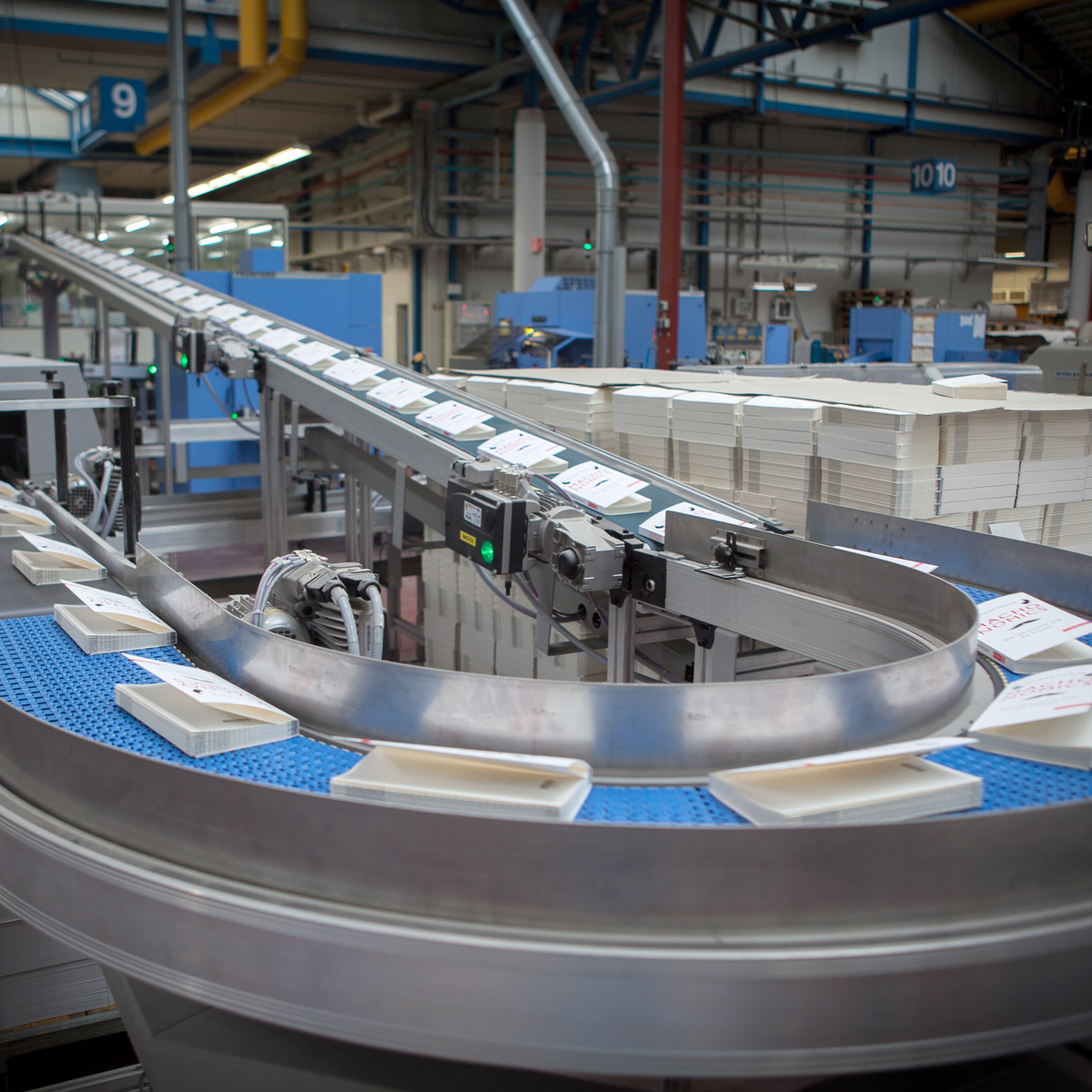
Walk a press room and you'll find air doing more jobs than almost anywhere else in manufacturing.
Sheet handling. The feeder head floats and separates sheets with blown air and lifts them with vacuum. This is continuous, it's high volume, and the air is blowing directly across the substrate you're about to print on. Anything in that air lands on the sheet.
Delivery and anti-setoff. Air blast in the delivery keeps wet sheets from contacting the pile and each other. Same exposure problem, now with wet ink.
Blankets, clutches and cylinder throw-off. Pneumatic actuation all through the press.
Ink and coating systems. Pumps, agitators and spray applicators, some of which put air in contact with the fluid.
Finishing. Folder-gluers, die cutters, stitchers, and the air knives on conveyors that blow off dust and trim before the next operation.
Packaging lines. Form-fill-seal, cartoners, case packers, labelers, palletizers, reject gates. Constant small actuations, and on food or pharma packaging the air quality requirement jumps again.
Notice how much of that is direct contact with product. That's the part that separates a press room from a machine shop.
The air quality spec, and why oil-free usually wins
Nobody hands printers a regulation the way they hand one to a pharmaceutical plant. You write the spec yourself, using ISO 8573-1 as the measuring stick. If those three numbers are unfamiliar, start with ISO 8573-1 air quality classes, decoded.
A reasonable working target for air that touches substrate is something in the neighborhood of Class 2.2.1 or better. Air knives blowing across product are commonly specced right around there. The number that matters most is the last one, oil, because oil is the contaminant that shows up in the finished piece.
| Application | Contact with product | Practical target |
|---|---|---|
| Feeder blow and vacuum | Direct, continuous | Oil-free, dry, filtered |
| Delivery anti-setoff blast | Direct, onto wet ink | Oil-free, dry, filtered |
| Air knives on conveyors | Direct | Around ISO 8573-1 2.2.1 |
| Cylinders, actuators, clutches | None | General plant air, clean and dry |
| Food or pharma packaging contact air | Direct, regulated | Tighter, plus a documented sampling plan |
Can you get there with an oil-flooded screw and good filtration? Technically, often yes. A proper coalescing and carbon train gets oil carryover very low. But two things push most print operations toward oil-free machines anyway.
First, filtration is only as good as its last element change, and a filter that's past due fails quietly. You don't find out from a gauge, you find out from a customer. Second, if your work includes food packaging, the conversation changes from preference to requirement, and the standards there are much more specific. We covered that side in food grade compressed air.
The pragmatic middle ground plenty of shops run: oil-flooded for general plant air and actuation, with a dedicated oil-free machine or a heavily treated leg feeding anything that blows across product. If you're at the point of actually picking that machine, we go deep on screw vs scroll vs piston and how to size it in oil-free air compressors for printing and packaging.
Moisture, and the ink problem nobody connects
Water in the line causes the obvious problems, rust in cylinders and sticky valves. It causes a less obvious one too. Moisture affects paper. Paper is hygroscopic, dimensionally unstable, and a press room that has spent real money controlling humidity does not want its own compressed air system blowing damp air across the sheet at the feeder.
A refrigerated dryer holding a stable pressure dew point in the high 30s to low 50s Fahrenheit handles most press rooms. Go to desiccant if you have unheated space, outdoor piping runs, or a contact-air spec that demands a lower dew point. The comparison is laid out in refrigerated vs desiccant air dryer.
Whichever you pick, size it for your hottest, most humid week, not for catalog conditions. A dryer that keeps up in March and slips in August was never sized right.
Sizing a press room
Printing demand has a shape that catches people out. It is not spiky the way a fab shop is. It is relentlessly, boringly continuous, because the feeder and the delivery are blowing the entire time the press is running.
- Get the real numbers from the press OEM, per unit and at your running speed. Air consumption on a sheetfed press scales with speed, and the number in the manual may assume something slower than you actually run.
- Add the finishing equipment separately. Folder-gluers and die cutters are often forgotten in the original sizing and then added to the same header two years later.
- Air knives are the quiet killer. An open blow-off running continuously consumes a startling amount of air. Engineered nozzles and air knives use a fraction of what an open pipe does, and on a line with several of them the payback is fast.
- Size the compressor for measured peak plus 25 to 30 percent, and put a flow meter on the header before you buy anything, if you already have a system.
- Consider variable speed. A plant that runs two shifts hard and one shift light is exactly the load profile where a VSD machine pays for itself.
Storage matters more than people expect, because a press coming up to speed is a real transient. A generous receiver keeps header pressure flat, and flat header pressure is what keeps feeder performance consistent across a run.
Piping
Black iron rusts. Rust particles blown out of a feeder head onto a sheet is exactly the failure mode you're trying to design out. Aluminum or stainless, sized for the run length, drops taken off the top of the header, and a loop rather than a dead end. Start with pipe sizing and pipe materials.
What press rooms get wrong
Changing filter elements on a calendar instead of on differential pressure. Put gauges across every stage and change on the reading. A loaded element is both a pressure loss and a contamination risk. See when to replace filter elements.
Treating the whole plant to the tightest spec. You're paying to deliver oil-free, bone-dry air to cylinders that don't care. Split the system, treat the contact-air leg properly, and stop buying purity you throw away.
Open pipe blow-off. Besides wasting air, an unregulated open pipe used for cleaning is an OSHA problem, since air used for cleaning is limited to 30 psi at the nozzle with proper guarding. Engineered nozzles solve both at once.
No leak program. A finishing department full of quick disconnects and old actuators leaks badly, and leaks show up as pressure sag at the far end of the plant. A leak survey is the cheapest capacity available.
Ignoring the compressor room heat. A press room is already fighting for temperature and humidity stability. Where the compressor dumps its heat is worth thinking about, and in a lot of plants that heat is recoverable.
Frequently Asked Questions
Does a printing press need oil-free compressed air?
For any air that blows across the substrate, which includes the feeder and the delivery, it should be functionally oil-free. You can reach that with an oil-flooded compressor plus a well-maintained coalescing and carbon train, but a lot of printers go to an oil-free machine because filtration failures are silent and the consequence is scrapped product. If you print food packaging, the requirement gets more specific.
What ISO 8573-1 class should a print shop target?
There's no regulation setting it, so you write the spec. Something around Class 2.2.1 or better is a common practical target for air contacting product, with the oil class being the one that matters most. Non-contact actuation air can run to a looser spec, which is worth doing because treating the whole plant to the tightest number is expensive.
How much air does a sheetfed press use?
It varies enormously by press size, number of units and running speed, so get the figure from your OEM at the speed you actually run rather than off a generic chart. The thing to plan around is that it is continuous rather than intermittent, so unlike a machine shop you get very little help from averaging over a duty cycle.
Do air knives really use that much air?
Yes, and they're commonly the largest single continuous consumer on a finishing line. An open pipe or drilled tube blowing constantly burns far more air than an engineered air knife or nozzle doing the same job. Swapping them is one of the few compressed air projects with a payback measured in months.
Refrigerated or desiccant dryer for a press room?
Refrigerated covers most press rooms, since the environment is conditioned and the dew point requirement is about keeping liquid water out rather than hitting a specific low number. Go desiccant if you have piping through unheated space, a contact-air spec that calls for it, or packaging work with a tighter requirement.
Where to start
Mark every drop on a plant drawing as contact or non-contact. Treat the contact legs to a spec you actually write down, put differential pressure gauges on every filter stage so nobody is guessing, and size the dryer for August. Get compressed air for printing and packaging right at the feeder and most of the mysterious print defects stop being mysterious.


