


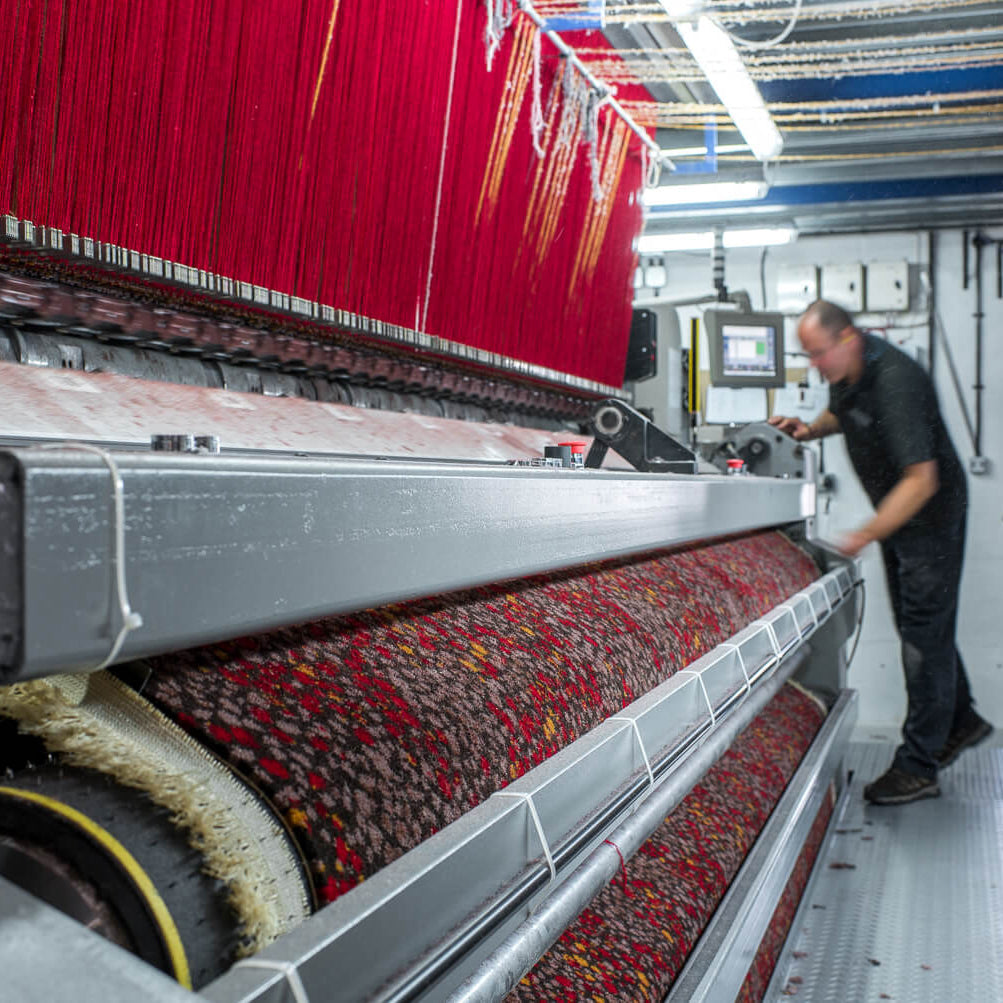
Walk a carpet mill and you hear air before you see it. Interlacing jets hiss on the yarn lines, blow guns clear lint off creels, and pneumatic cylinders clamp, cut and lift all along the finishing end. This guide is about compressed air for carpet mills: where it is used, what the one well-documented big user actually consumes, and how to size and treat the supply without guessing.
A note on honesty before we start. Interlacing consumption has published manufacturer constants we can quote. Tufting machines and carpet finishing lines do not have a public, trustworthy cfm-per-machine figure that we could verify, so we do not invent one. Where a number is a rule of thumb from a general textile source, we say so.
Where a carpet mill uses compressed air
Carpet making has several stages and air shows up in most of them, in very different ways.
Yarn interlacing on BCF lines
Bulked continuous filament (BCF) yarn is made of many fine filaments. To keep them together as one yarn through winding and tufting, the mill runs the bundle through an air jet that tangles the filaments at intervals. This is called interlacing, and it is by far the best documented air use in the whole process. It runs continuously, on every position, for as long as the line runs.
Tufting and backing
Tufting machines are mostly mechanical, but air is used for pneumatic clutches and brakes, yarn threading aids, lint blow-off, and cylinders that move guides and shears. Backing and coating lines use air for tensioning, web guiding and cylinder-actuated rollers.
Finishing, cutting and packaging
Roll-up stations, cutting tables, labeling and strapping equipment all run on small cylinders and air tools. These loads are intermittent. They matter for peak demand, not for the baseline.
Cleaning
Lint and fiber dust build up everywhere. Many mills clean with blow guns. OSHA limits compressed air used for cleaning to 30 psi at the nozzle when dead-ended (29 CFR 1910.242(b)), with chip guarding and PPE. Lint cleaning at the tufting machine should use a regulator and a guarded nozzle, not full line pressure.
What interlacing really consumes
Heberlein, a major interlacing jet maker, publishes a consumption relationship for its PolyJet-BCF TopAir jets. Per thread, air consumption follows k x (pe + 1) in cubic meters per hour, where pe is the overpressure in bar and k is a constant for the nozzle. Their BCF interlacing runs at 4.0 to 10.0 bar overpressure, with winding speeds up to 4,000 m/min.
| Nozzle (Heberlein) | Bore | Main-air constant k |
|---|---|---|
| HN251A | 2.5 mm | 2.905 |
| HN520A | 5.2 mm | 12.568 |
The upper-air constants for the family run from 0.671 to 3.147, and the upper-air pressure is typically about 1 bar above the main-air pressure. Here is our own arithmetic from those published numbers, so you can see how it plays out. For an HN251A at 4 bar main air and 5 bar upper air: 2.905 x 5 is about 14.5 m3/h, plus 0.671 x 6 is about 4.0 m3/h, for roughly 18.5 m3/h per thread. That is around 11 cfm per thread. It is an illustration of the formula, not a measurement from any mill, and your jet, bore and pressure will differ.
The point for sizing is simple. Multiply by the number of threads on the line. Even small jets add up fast on a line with dozens or hundreds of positions, and that load never lets up. Interlacing is a baseline load, which is exactly the kind of load a fixed-speed or variable-speed rotary screw compressor handles well, and exactly the kind a pair of reciprocating compressors cycling on and off handles badly.
Pressure: the cheapest thing to look at
Interlacing air is consumed in proportion to (pe + 1), so every bar you add costs air at the jet and energy at the compressor. A general textile-industry source (an author's 2016 article on fibre2fashion, not survey data) says many mills run 7 to 8 bar where 6 to 6.5 bar would do, that compressor-house pressure drop is often 1 to 2 bar against a target under 0.7 bar, and that leakage commonly passes 30 percent. Treat those as a reason to measure at your own plant, not as your numbers.
The practical steps are the same as in any plant. Log pressure at the compressor, at the header and at the farthest interlacer. If the gap is large, look at filters, undersized piping and clogged dryers before you raise the setpoint. A differential pressure gauge across the filter housings tells you quickly.
Drying and filtering for a fiber plant
Fiber mills are dusty, and interlacing jets have small orifices. Wet or oily air does two things you do not want: it fouls the jets and it stains yarn. The usual treatment train is a coalescing filter, a dryer matched to your lowest ambient temperature, and a particulate filter close to the point of use.
| Stage | Job | What to check |
|---|---|---|
| Aftercooler and separator | Knock out bulk water | Drain works, no standing water |
| Refrigerated dryer | Cut dew point to roughly 38 F | Rated for your inlet temperature and flow |
| Coalescing filter | Remove oil aerosol and fine particles | Differential pressure, element age |
| Point-of-use filter | Protect jets and cylinders | Change before it starts to choke flow |
| Condensate drains | Get water out of the system | Timers or zero-loss drains actually cycling |
If any lines run through cold areas, a refrigerated dryer is not enough on its own, because water can condense downstream when the air gets colder than the dryer dew point. See our air dryers for refrigerated and desiccant options, and size the dryer to flow at your worst-case inlet, not the nameplate on a good day.
Storage and the stop-start problem
Cylinders, cutters and roll-up stations pull air in short bursts on top of a steady interlacing load. A wet receiver sized to the burst keeps pressure from sagging at the interlacers when a cutter fires. If you see pressure dips that match production events, the fix is often storage near the intermittent users, not a bigger compressor. Browse air compressor tanks for vertical and horizontal receivers.
Sizing a compressor room for a carpet line
A sensible way to size it without guessing:
Count the interlacing positions and look up the jet constant and pressure from the jet maker. Multiply to get the baseline load. Add the tufting and finishing loads from the machine manuals or, better, from a short flow measurement during a normal shift. Then add a margin for growth, and plan the compressors as a base unit plus a trim unit rather than one large machine running unloaded.
Rotary screw compressors suit this kind of continuous baseline. Variable-speed models earn their keep when demand swings through the day. For general context on how a similar fiber operation sets up its room, our article on compressed air for textile mills covers looms and spinning, which share the same dust and pressure habits.
What Warthog sells and what it does not
We sell compressors, dryers, filters, tanks, drains and piping components. We do not sell interlacing jets, tufting machines or textile machinery, and we are not going to tell you which jet to buy. Your machine builder or the jet maker specifies that. What we can help with is the air supply behind it: sizing the compressor, matching a dryer and filters, and getting storage in the right place. If you send us your total interlacing air figure and header pressure, we can talk through compressor and dryer sizing from there.
Frequently asked questions
How much compressed air does carpet yarn interlacing use?
It depends on the jet and the pressure. Heberlein publishes consumption as k x (pe + 1) per thread in m3/h, with different constants for each nozzle. Our worked example for an HN251A at 4 bar main and 5 bar upper comes to about 18.5 m3/h per thread, which is a formula illustration and not a plant measurement.
What pressure do BCF interlacers run at?
Heberlein lists 4.0 to 10.0 bar overpressure for its PolyJet-BCF TopAir range. Your actual setpoint depends on the yarn and the jet, so use the jet maker's guidance for your line.
Can I blow lint off tufting machines with full line pressure?
Not if you are following OSHA. Compressed air used for cleaning is limited to 30 psi at the nozzle when dead-ended, with effective chip guarding and personal protective equipment. Use a regulated, guarded nozzle.
Do I need a dryer if my mill is air conditioned?
Usually yes. Air conditioning does not remove the water that comes out of a compressor, and lines that pass through colder spaces can condense water downstream. A refrigerated dryer plus filters is the normal minimum.
Is a rotary screw compressor the right choice?
For a continuous baseline load like interlacing, a rotary screw is a common fit, often with a variable-speed unit to follow demand. Intermittent loads are better served by storage close to the users.


