


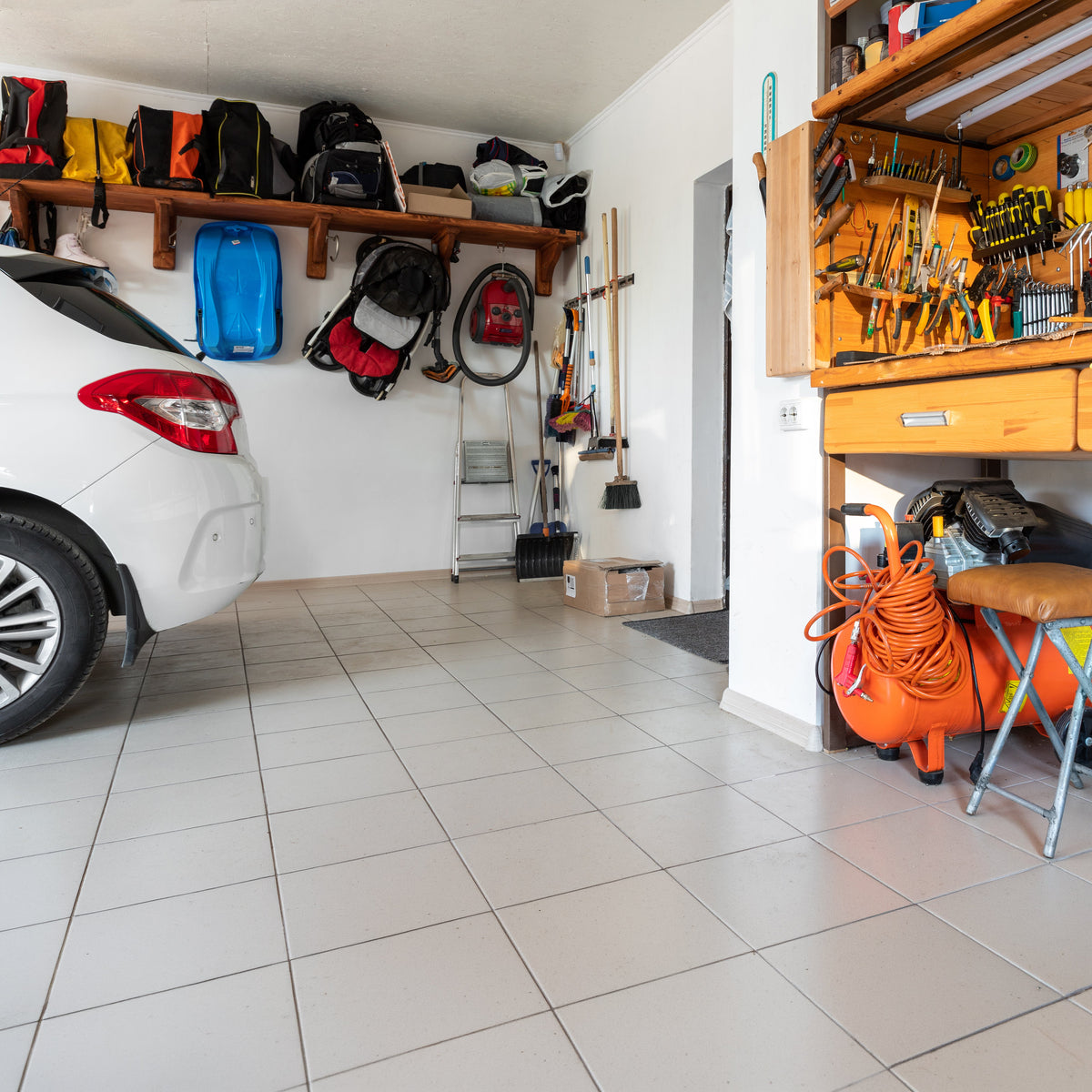
Most garage compressors get bought twice. The first one is whatever was on sale at the big box store the weekend somebody decided to do brakes themselves. The second one shows up about eighteen months later, after the owner spent a year waiting on a pancake tank to catch up with a die grinder.
Picking an air compressor for a home garage is not hard, but almost everybody optimizes the wrong number. People shop tank size. Tank size is the least important spec on the machine.
CFM Is the Number. Everything Else Is Secondary
Your compressor has two jobs: make air, and store air. Tank gallons is the storage. CFM at 90 psi is the making. If your tools consume more CFM than the pump produces, the tank buys you a few seconds and then you are standing there waiting, permanently, forever, no matter how big the tank is.
So start at the tool end. What is the thirstiest thing you actually plan to run for more than thirty seconds at a stretch?
| Tool | CFM at 90 psi (typical) | Duty |
|---|---|---|
| Brad nailer / finish nailer | 0.3 to 2 | Intermittent |
| Framing nailer | 2 to 4 | Intermittent |
| Tire inflation | 1 to 3 | Intermittent |
| Blow gun | 3 to 5 | Intermittent |
| 1/2 inch impact wrench | 4 to 5 | Short bursts |
| Air ratchet | 4 to 6 | Short bursts |
| Cut-off tool | 4 to 6 | Continuous while cutting |
| Die grinder | 5 to 8 | Continuous |
| HVLP touch-up gun | 6 to 10 | Continuous |
| Dual action sander, 6 inch | 11 to 17 | Continuous, and it never stops |
| Media blaster, small cabinet | 8 to 20 | Continuous |
| Full size HVLP spray gun | 12 to 18 | Continuous |
Look at that table and notice the split. Everything above the cut-off tool is an intermittent tool. A modest compressor handles those all day because the tank recovers between uses. Everything from the die grinder down is a continuous consumer, and those are the tools that decide what you buy.
One sander. That is the entire decision for most home garages. If a DA sander is in your future, you need real CFM. If it is not, you can spend half as much. Our air tool CFM chart has a fuller list, and why air sanders run compressors out of air explains the sanding problem specifically.
Sizing Rule That Actually Works
Take the CFM of the single largest tool you will run continuously. Add 30 to 50 percent. That is your target CFM at 90 psi, delivered, not the marketing number on the box.
Why the padding? Pump output falls off as the machine wears and as intake air gets hot. Hose and fitting restrictions eat some. And you will occasionally have two things going at once. A compressor sized exactly to the tool runs 100 percent duty and cooks itself.
Three real examples:
- Tires, nailers, blow gun, occasional impact. Largest continuous load is basically nothing. 3 to 5 CFM at 90 psi is plenty. A 20 to 30 gallon single stage does it.
- General wrenching: impacts, ratchets, cut-off tool, short grinder work. Largest continuous load around 6 CFM. Target 8 to 10 CFM at 90 psi. This is 3 to 5 HP territory with a 60 gallon tank.
- Body work or painting: DA sander, spray gun. Largest continuous load 15 to 17 CFM. Target 20 to 25 CFM at 90 psi. That is a real two-stage machine, 5 to 7.5 HP, 80 gallon.
Where Tank Size Does Matter
Storage is not useless. It just does a narrower job than people think. A bigger tank does three things:
- Rides through short peaks, so a 5 CFM machine can handle a 15 CFM impact gun for the six seconds you are actually on it.
- Cuts cycling. Fewer starts per hour is easier on the motor and the pressure switch.
- Gives condensate a place to cool out and drop, which means less water reaching your tools.
For a home garage, 60 gallons is the sweet spot for general work and 80 is right if you are sanding or painting. Going bigger than 80 in a two-car garage buys very little and takes up real estate. Going smaller than 30 means the compressor is running almost constantly. Compare the two most common sizes in our guides to 60 gallon and 80 gallon compressors.
The Power Question That Stops Most Projects
This is where garage plans die. Check your panel before you shop.
| Compressor | Typical electrical | Realistic in a home garage? |
|---|---|---|
| 1 to 2 HP | 120V, 15 to 20A | Yes, standard outlet |
| 3 to 3.7 HP | 240V single phase, 20 to 30A | Yes, needs a dedicated 240V circuit |
| 5 HP | 240V single phase, 30A | Yes if your panel has room |
| 7.5 HP | 240V single phase, 40 to 50A, or three phase | Possible but check panel capacity carefully |
| 10 HP and up | Usually three phase | Not without a phase converter |
Anything over about 2 HP wants 240 volts. If you do not have a 240V circuit in the garage, budget for an electrician before you budget for the compressor, and size the circuit off motor tables rather than the nameplate. Our guide to wire and breaker sizing walks through the code rules, and single phase vs three phase covers the bigger machines.
Be skeptical of horsepower claims on inexpensive machines. "6.5 peak HP" on a 120V, 15 amp plug is marketing. A 120V 15A circuit physically delivers about 1.8 kW, which is roughly 2 running horsepower at best. Read the CFM at 90 psi and the amp draw. Those do not lie.
Single Stage or Two Stage
Single stage compresses once and tops out around 135 to 155 psi. Two stage compresses, cools, then compresses again, and gets to 175 psi with better efficiency and much better heat management. Two stage machines cost more, last longer under load, and start making sense at 5 HP and up.
For a home garage: single stage for everything up to the general wrenching tier. Two stage if you are doing body work, running a blast cabinet, or you just want the machine to outlive you. Detailed comparison in two stage vs single stage.
Noise, Because You Live There
A garage compressor is not in a plant. It is thirty feet from your kitchen and your neighbor's bedroom window. A standard belt drive cast iron machine runs 75 to 85 dB. A direct drive oil-free pancake can hit 90 dB and up, which is genuinely unpleasant indoors. Quiet-rated units in the 60 to 70 dB range exist and the difference is dramatic, since every 10 dB is roughly a doubling of perceived loudness.
Belt drive with a cast iron pump running at lower RPM is quieter than direct drive, full stop. It also lasts longer. If you can live with the footprint, that is the choice. See our quiet compressor guide and belt drive vs direct drive.
The Stuff Nobody Budgets For
The compressor is maybe 70 percent of the project. Plan for the rest:
- Drying and filtration. A garage compressor makes water. If you paint, a refrigerated dryer or at minimum a good separator plus coalescing filter is not optional. A disposable desiccant snake at the gun is a bandaid, not a system.
- Piping. Do not run PVC. It shatters under pressure and OSHA prohibits it above ground for compressed air. Aluminum kits are easy for a DIYer. See why PVC is a bad idea and how to install shop air lines.
- Hose. A 3/8 inch hose costs you far less pressure than 1/4 inch. On a 50 foot run with a 15 CFM tool, the difference is the tool working or not.
- A real drain. Manual ball valve at minimum, opened after every use. Tank rust from standing water is what kills garage compressors, and a rusted tank is scrap, not a repair.
- Floor space and a pad. An 80 gallon vertical wants about 2 by 2 feet and needs to be level and anchored.
Quick Picks
| What you do | Target CFM at 90 psi | Tank | Type |
|---|---|---|---|
| Tires, bikes, trim nailer | 2 to 4 | 8 to 30 gal | Portable, 120V, oil-free is fine |
| Weekend wrenching, impacts | 7 to 10 | 60 gal | Single stage belt drive, 3 to 5 HP, 240V |
| Serious wrenching plus grinding | 12 to 15 | 60 to 80 gal | Two stage, 5 HP, 240V |
| Body work, sanding, painting | 20 to 25 | 80 gal | Two stage, 5 to 7.5 HP, plus dryer |
| Blast cabinet | 20 to 30 | 80 gal and up | Two stage, 7.5 HP, plus dryer and storage |
Frequently Asked Questions
Is a 60 gallon compressor big enough for a home garage?
For nearly everything short of sanding and painting, yes. Sixty gallons paired with a 3 to 5 HP single stage pump covers impacts, ratchets, cut-off tools and short grinder work comfortably. The limit is CFM, not gallons, so check the 90 psi rating rather than the tank.
Can I run a DA sander on a 30 gallon compressor?
Not continuously. A 6 inch DA wants 11 to 17 CFM and a 30 gallon machine typically makes 5 or 6. You will sand for maybe forty seconds, then wait. If sanding is in the plan, buy for the sander from the start.
Do I need 240 volts?
If you want more than about 5 CFM at 90 psi, yes. A 120V, 15 amp circuit physically caps what the motor can do, and no amount of advertised peak horsepower changes that. Anything 3 HP and up is a dedicated 240V circuit.
Oil-free or oil-lubricated for a garage?
Oil-lubricated with a cast iron pump for anything you plan to keep. They are quieter, they last several times longer, and they handle continuous duty. Oil-free is the right call only for small portables you move around or store in the cold.
How do I keep water out of my spray gun?
Drain the tank after every use, run your drop legs upward off the top of the main with a drip leg below, and put a water separator plus a coalescing filter as far from the compressor as you can get so the air has cooled first. If you paint regularly, add a refrigerated dryer. More in our piece on water separators.
How loud is too loud for a residential garage?
Above about 80 dB you will not want to be in the room with it and your neighbors will know your schedule. Belt drive machines with cast iron pumps typically run 75 to 80 dB, and purpose-built quiet units run 60 to 70 dB, which is conversational.
Pick the air compressor for a home garage by starting at the tool that never lets up, add half again for headroom, confirm your panel can feed it, then choose the tank. Do it in that order and you only buy one compressor.


