


Undersized pipe is a leak you pay for every single day, and you never see a drop of it. The compressor works fine, the tools sort of work, and nobody can figure out why there's never quite enough air at the far end of the shop. Nine times out of ten, the pipe is too small.
Good compressed air pipe sizing is one of the cheapest upgrades you can make and one of the most overlooked. Get the diameter right and you stop throwing away pressure between the tank and the tool. Get it wrong and you'll fight low pressure forever, no matter how big your compressor is.
Why Pipe Size Matters More Than You Think
Every foot of pipe, every elbow, and every fitting adds a little resistance. Push air through a pipe that's too narrow and that resistance turns into pressure drop. The air shows up at your tool at lower pressure than it left the tank, and low pressure means weak tools and slower work.
The rule of thumb the pros use: keep total pressure drop across your whole system under about 10 percent of your line pressure. If you run 120 PSI, that means losing no more than 10 to 12 PSI from the compressor to the farthest drop. In practice, most shops aim to lose just 2 or 3 PSI in the piping itself. The way you hit that target is with bigger pipe, not more pressure.
Here's the part that surprises people. Bumping up one pipe size does far more for flow than cranking the compressor pressure. Cranking pressure just wastes energy and stresses the machine. Sizing the pipe right fixes the problem at the source.

The Two Numbers That Decide Pipe Size
You only need two things to size a main line: how much air is flowing through it (CFM) and how far it has to travel (total length, including the equivalent length of fittings). More CFM or more distance both push you toward a larger diameter.
Here's a practical starting-point guide for a main air line. Treat these as sensible minimums, and when you're between sizes, always go up.
| Airflow (CFM) | Run up to about 50 ft | Run 50 to 150 ft |
|---|---|---|
| Up to 20 CFM | 1/2" | 3/4" |
| 20 to 40 CFM | 3/4" | 1" |
| 40 to 80 CFM | 1" | 1-1/4" |
| 80 to 120 CFM | 1-1/4" | 1-1/2" |
| 120 to 200 CFM | 1-1/2" | 2" |
The longer the run, the bigger the pipe, because pressure drop stacks up over distance. A short jump from the tank to a bench can get away with smaller pipe. A line running the length of a big shop needs room to breathe. When in doubt, go one size up. Larger pipe costs a little more in materials and never once caused a problem. Undersized pipe causes problems every day.
Don't Forget the Fittings
Pipe length isn't just the straight runs. Every elbow, tee, and valve behaves like extra feet of pipe as far as pressure drop is concerned. A single 90 degree elbow can add the equivalent of several feet. If your layout has a lot of turns, count that in and lean toward the larger size. This is also why a smooth loop layout beats a long dead-end run: it feeds air to each drop from two directions and cuts the effective distance in half.
Pick the Right Material (and Skip the One That Can Hurt You)
Diameter is half the decision. What the pipe is made of is the other half.
Never use PVC for compressed air
Let's get the dangerous one out of the way first. PVC pipe has no business carrying compressed air, and OSHA prohibits it for that use. Here's why it matters. PVC gets brittle with age, oil from the compressor attacks it, and when it fails it doesn't just crack and hiss. It shatters and throws sharp plastic shrapnel across the room. Compressor heat makes it worse: PVC loses roughly half its pressure rating by the time it reaches 110 degrees F. It's cheap for a reason. Do not use it.
Good options for shop air
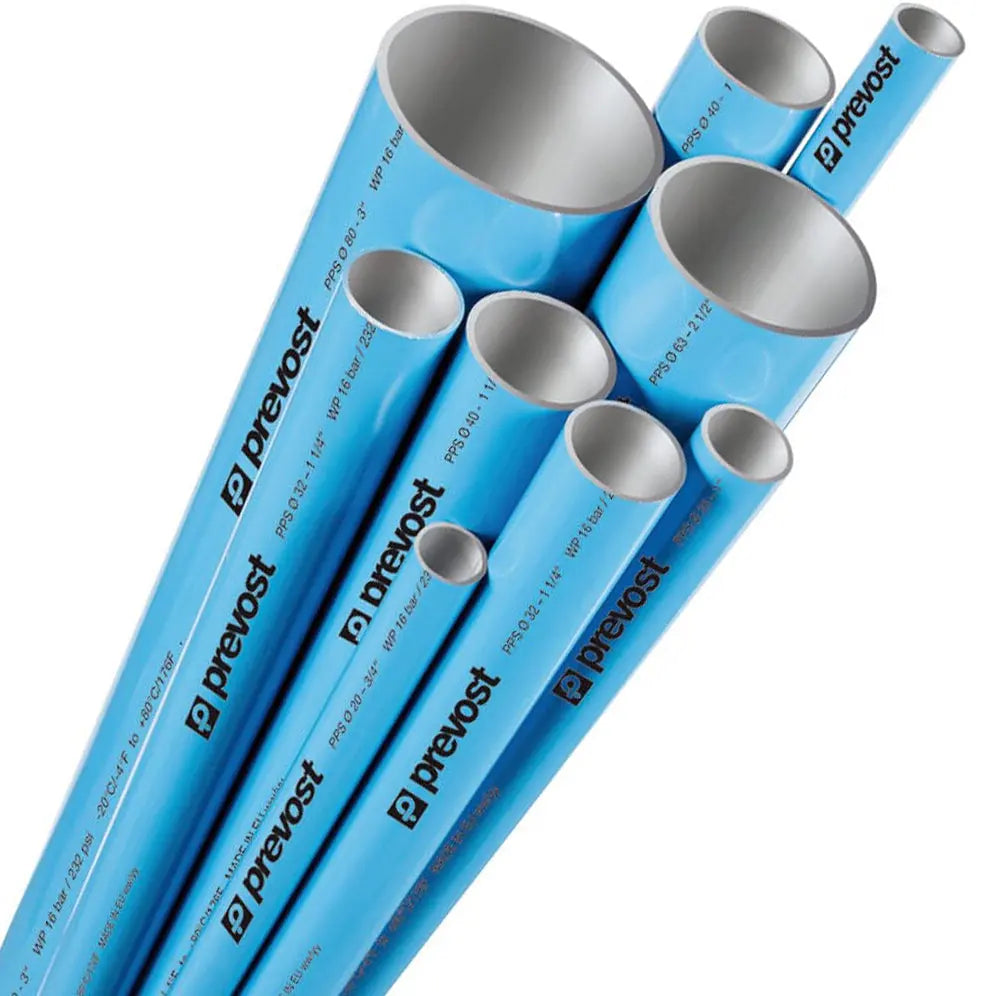
- Aluminum modular pipe. Our favorite for most shops. It's lightweight, corrosion-free, snaps together with push-in fittings, and the smooth bore means very low pressure drop. No threading, no soldering, and you can reconfigure it later. Systems like MaxLine tubing make a professional layout something one person can install in an afternoon.
- Black iron or galvanized steel. Strong and cheap, and a common choice for retrofits. The downsides are weight, the labor of threading every joint, and rust that can flake off into your air over the years.
- Copper. Clean, corrosion-resistant, and popular for food, dental, and lab work where air purity matters. It costs more and every joint has to be soldered.
A Few Layout Habits That Save Air
Sizing is the big lever, but a few layout choices squeeze out the rest of the performance. Slope your main line slightly so condensation drains toward a drop leg instead of pooling. Take branch drops off the top of the main, not the bottom, so water stays in the line and out of your tools. And put a filter and regulator at each point of use rather than trying to treat everything at the compressor. When your piping and your air treatment work together, your air compressor stops working harder than it has to.
Frequently Asked Questions
What size pipe do I need for my air compressor?
It depends on your airflow and how far the air travels. For most home and small shops running under 20 CFM on runs under 50 feet, 1/2" is a reasonable minimum, but 3/4" gives you headroom. Bigger shops with higher CFM or long runs should step up to 1" or larger. When you're between sizes, go up.
Can I use PVC pipe for compressed air?
No. OSHA prohibits PVC for compressed air, and for good reason. It becomes brittle, oil attacks it, and it can shatter under pressure and throw plastic shrapnel. Use aluminum, steel, or copper instead.
Does bigger pipe really improve performance?
Yes. Larger diameter lowers air velocity and pressure drop, so more of your compressor's pressure actually reaches the tool. Going up one pipe size usually helps more than raising the compressor pressure, and it doesn't waste energy.
How much pressure drop is acceptable?
Aim to keep total system pressure drop under about 10 percent of your line pressure, and try to lose only 2 or 3 PSI in the piping itself. If tools at the far end feel weak, undersized pipe is the usual cause.
Is aluminum pipe worth it over black iron?
For most shops, yes. Aluminum modular pipe installs faster, won't rust into your air, has a smooth low-loss bore, and can be taken apart and reconfigured. Black iron is cheaper in raw material but costs you in labor and long-term corrosion.
Size the pipe for the air you actually move, keep pressure drop low, use the right material, and your whole system gets easier to live with. When you're ready to build it right, our MaxLine aluminum piping is a straightforward place to start.


