


The excavation foreman calls on a Monday: the trench filled overnight, the crew cannot start, and the pump he borrowed keeps clogging on silt. He wants to know what to buy so it does not happen again. Our first question is never the horsepower. It is what is in the water.
That one answer sorts the whole Atlas Copco dewatering pumps range we carry. Clean-ish water, silty water and slurry call for three different pump families, and picking the wrong one is the most common mistake we see.
The WEDA letters, decoded
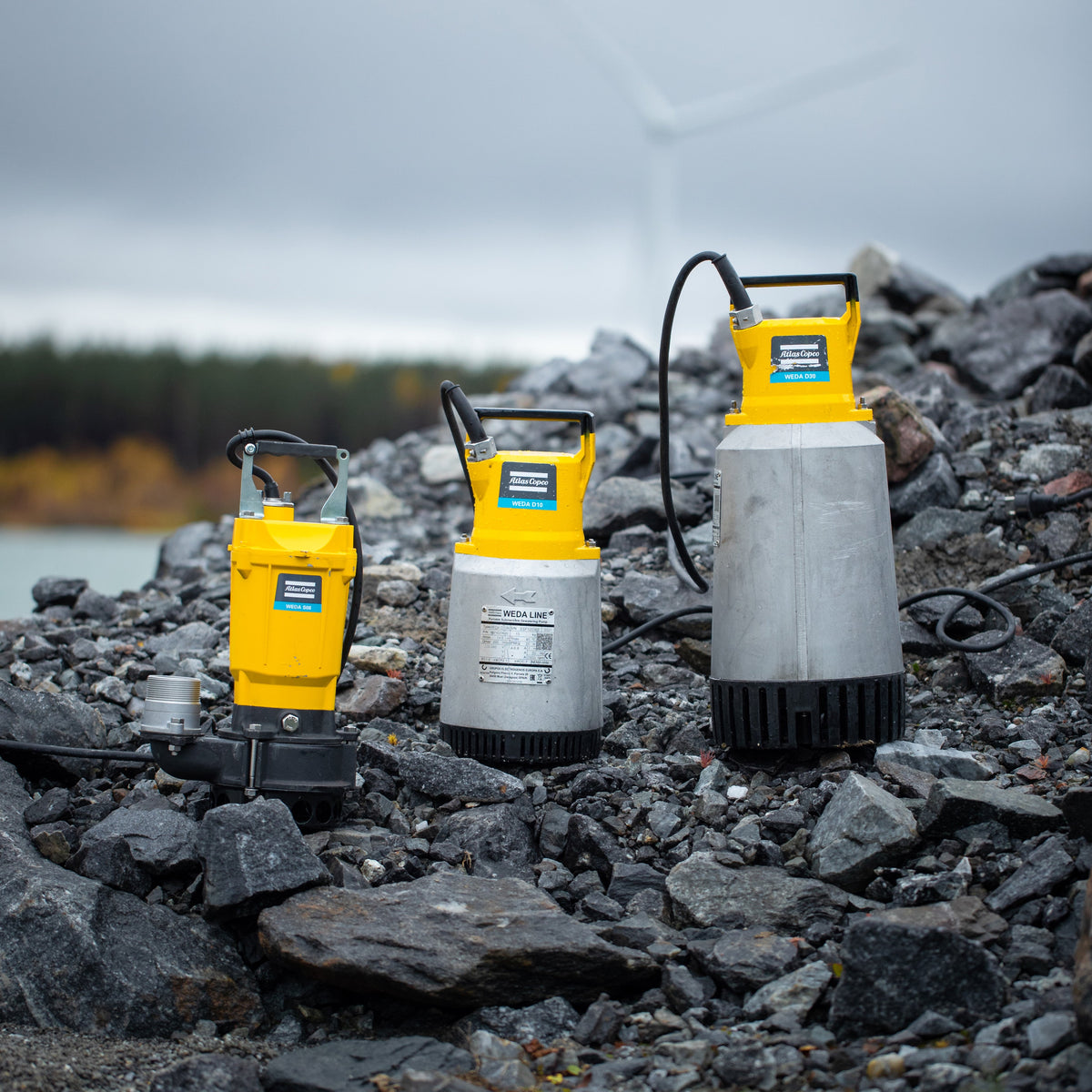
Our dewatering and submersible pump collection is built mainly around the Atlas Copco WEDA electric submersible line. The model names tell you more than they appear to. Reading the product listings:
- D models are drainage pumps, for water with some fine solids, like construction sites, basements, pits and shafts.
- S models are sludge pumps, for thicker, dirtier water, with more and bigger solids.
- L models are slurry pumps, the heavy-duty option for abrasive solids, as in mining, quarries and tailings.
- The number is the size of the pump. Bigger number, bigger motor and bigger discharge.
- The last letters give the head class: N is normal head, H is high head, SH is super high head and L is high flow with low head on the D series.
How the range stacks up
These numbers come straight from the listings we carry. Flow figures are shown only where the listing gives one, and any flow rating depends on head, so use the pump curve for a real design.
| Model | Type | Motor | Discharge | Rated flow in listing |
|---|---|---|---|---|
| WEDA S30N | Sludge | 4 HP, 460V 3-phase (1-phase 3 HP and 230V 3-phase versions also stocked) | 3 in. | 250 GPM (230 GPM on the 1-phase) |
| WEDA S50N | Sludge | 7 HP | 4 in. | 370 GPM |
| WEDA S60N | Sludge | 9.3 HP | 4 in. | 420 GPM |
| WEDA D40N | Drainage, normal head | 4.3 HP | 3 in. | See data sheet |
| WEDA D50N | Drainage, normal head | 8.5 HP | 4 in. | See data sheet |
| WEDA D60N | Drainage, normal head | 11.5 HP | 4 in. | See data sheet |
| WEDA D80N | Drainage, normal head | 31 HP | 6 in. | See data sheet |
| WEDA L40N | Slurry | 5 HP | 3 in. | 220 GPM |
| WEDA L60N | Slurry | 12.1 HP | 4 in. | 480 GPM |
| WEDA L80N | Slurry | 20 HP | 4 in. | 790 GPM |
| WEDA L100N | Slurry | 60 HP | 6 in. | 2,600 GPM |
| WEDA L110N | Slurry | 101 HP | 6 in. | 2,200 GPM |
Notice the L100N moves more water on 60 HP than the L110N does on 101 HP. They are built for different jobs: the L110N is the top-of-range model for higher head, and the L100N is the high-flow one. Horsepower alone will not tell you which pump suits you.
Three numbers decide the pump
1. What is in the water
Be honest about the solids. Muddy trench water, sand and gravel fines, and mine tailings are not the same thing. If the pump will handle abrasive material every day, step up to a slurry model even if a drainage pump moves the right volume. A drainage pump in slurry will clog, wear and fail early, and no brand is immune to that. When you are not sure, send us a sample description and a photo of the site.
2. Total head
Head is how high the pump has to push, plus friction in the hose. A rule that is always true: one psi of pressure equals 2.31 feet of water column. If the discharge is 40 feet above the pump, that is about 17 psi before you count any friction. Then add the friction loss in the hose, which grows fast as hose length goes up and diameter goes down. Under-sizing the hose is how a 6 inch pump ends up delivering what a 3 inch pump should.
The head classes help here. A normal head pump moves a lot of water at modest lift, while a high or super high head pump trades flow for the ability to push farther up or out. Match the class to the lift on your site.
3. Flow at that head
The flow number in a listing is a rated point. Read the pump curve for the model, find your total head on the vertical axis and read across for the flow you will actually get. If the number is short, go up a size or a head class. Do not just buy more horsepower.
Power and setup
Most models in the line are 460V three-phase, with 230V three-phase on some and single-phase on the smallest. That matters on a remote site. A 31 HP drainage pump or a 60 HP slurry pump needs real power, and the starting current is higher than the running current. Before you buy, check the generator, cable size and cable run against the pump's data sheet. Run the discharge through hose sized to the pump outlet, keep it as short and straight as the site allows and do not run a submersible dry. The manual spells out the limits for your model, so read it before commissioning.
Where air comes into it
We are an air compressor store, so why pumps? Because many of the people who buy one of our towable compressors for a jobsite also fight water in the same hole. Our construction contractor guide and our write-up on mining and quarry work show how crews pair air and water equipment. Treatment plants run the same pump families in wet wells and sumps; see compressed air for wastewater treatment.
One more honest note: an electric submersible is not always the best choice. Where there is no power, where the pump may run dry, or where the fluid is very abrasive or has big solids, an air-operated pump can be the safer pick. We sell both, and we will say so when the electric one is the wrong tool.
Mistakes we see
- Buying a drainage pump for a job that is really slurry.
- Choosing by horsepower and ignoring the head class.
- Ignoring hose friction and then blaming the pump.
- Forgetting the generator, and finding out on day one that the site cannot start the motor.
- Running a submersible dry because nobody watched the level.
Frequently Asked Questions
What does WEDA mean on an Atlas Copco pump?
WEDA is Atlas Copco's electric submersible pump line. The letter after it tells you the duty, D for drainage, S for sludge and L for slurry. The number is the size and the last letters are the head class.
What is the difference between a drainage pump and a slurry pump?
A drainage pump is built for water with some fine solids. A slurry pump is built to move abrasive solids and takes more wear. Use the one that matches what is really in the water.
How do I size a dewatering pump?
Work out the total head (lift in feet plus hose friction), pick a model with the right head class, and then read the pump curve to confirm it gives the flow you need at that head.
Will it run on a portable generator?
Possibly, but check the pump's starting and running current against the generator's surge rating and use cable sized for the run. Larger models need a lot of power.
Ready to pick? Browse the full Atlas Copco dewatering pump collection and send us your head, flow and power numbers if you want a second opinion.


