


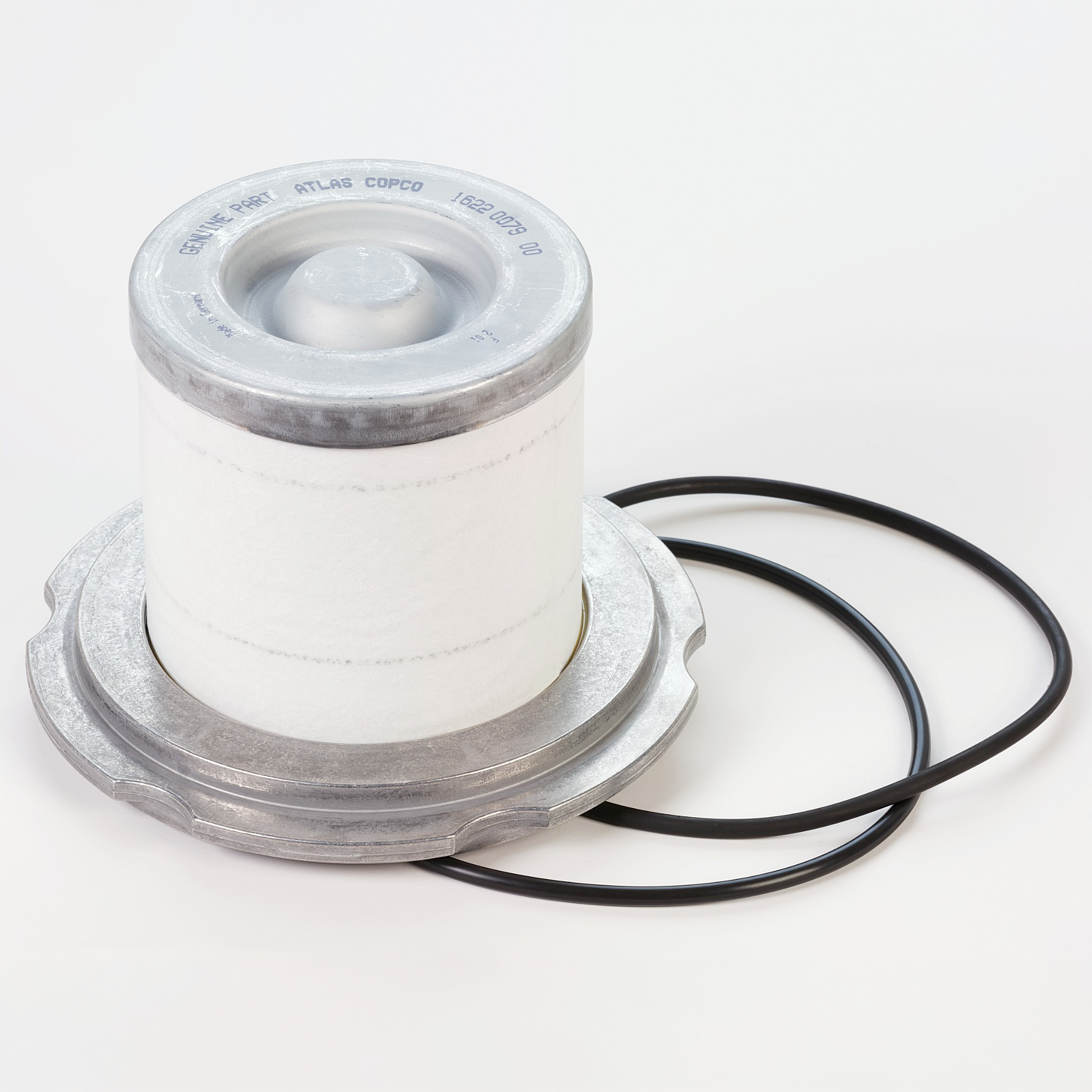
Ask a shop when they last changed their compressed air filter elements and you'll get one of three answers. Some know exactly. Some say "a couple years ago maybe." And a surprising number say "there are elements in those?"
That third group is the reason we wrote this. A filter housing looks like a solid chunk of aluminum bolted to the wall, and nothing about it announces that there's a consumable inside on a clock. But compressed air filter element replacement is real maintenance with a real schedule, and skipping it costs you in two directions at once.
Two ways a neglected element costs you
The first is energy. As an element loads up with dirt and oil, it restricts flow and your pressure drop climbs. Your compressor has to work at a higher discharge pressure to deliver the same pressure at the tool. That's continuous wasted power for as long as you leave it.
The second is contamination, and it's the one that actually bites. A coalescing element that has aged out stops coalescing properly and starts passing oil aerosol downstream. Now you're putting oil into whatever the filter was protecting. Paint jobs with fisheyes, contaminated product, fouled desiccant beds, sticky pneumatic valves. The filter is still there, still installed, and quietly not doing its job.
Which brings us to the part most people have backwards.
Differential pressure is not a service indicator
Nearly every filter housing has a dP gauge or a little pop-up indicator, and nearly everyone treats it as the thing that tells you when to change the element. That's a mistake, and it's worth being precise about why.
Differential pressure tells you about blockage. It's a good early warning that an element has plugged prematurely, usually from a slug of water, a failed drain upstream, or heavy particulate. What it does not reliably tell you is whether a coalescing element still coalesces.
Here's the failure mode that gets people. Coalescing elements can age out and start letting oil mist through without ever developing high differential pressure. The gauge reads fine. The element looks fine. The oil is going straight downstream. If dP is your only trigger, you'll never catch it.
So use both. Change on time as your baseline, and treat dP as an interrupt that says "change it sooner than planned."
| What you observe | What it means | What to do |
|---|---|---|
| Under 3 psid | Normal for a serviceable element | Stay on the time schedule |
| Above 5 psid | Meaningful restriction, wasting energy | Change the element now |
| 6 to 9 psid | Well past useful life | Change immediately, check upstream |
| Climbing fast, weeks not months | Something upstream is failing | Change and find the real cause |
| Reads zero, always | Ruptured element or bypassing gauge | Inspect, do not assume it is fine |
That last row deserves attention. A dP reading of exactly zero is not good news. It often means the element is torn or has blown out of its seat, and unfiltered air is sailing straight through. If a gauge that used to read 2 psid now reads nothing, pull the bowl and look.
The schedule that actually works
Twelve months is the standard interval for coalescing and particulate elements, and it applies whether or not you run around the clock. Elements age chemically as well as mechanically, so a filter in a shop that runs one shift still needs annual attention.
Push to six months when any of these apply:
- The compressor is older or has known oil carryover.
- The environment is dirty, so woodshops, foundries, body shops, grain handling.
- You're running high hours, two or three shifts.
- Ambient temperatures are high, which accelerates oil breakdown.
- The filter protects something expensive or fussy, like a desiccant bed or a paint booth.
The practical move is to pick a date and stop thinking about it. Do all your elements every spring. Buy them as a set, keep one spare of each on the shelf, and write the date on the housing with a marker when you change it. That last trick removes all the guesswork, and it costs nothing.
Change the whole set, not just the one you noticed
Most systems have a filter train: a particulate or general purpose filter, then a coalescing filter, sometimes an activated carbon filter for oil vapor and odor. They wear at different rates but they were all installed on the same day, and pulling one housing while you're already there is 90 percent of the labor.
One caution specific to carbon. Activated carbon elements have no meaningful pressure drop signature at all. They simply saturate, and then oil vapor passes. They are strictly a time-based change, and they always need a good coalescing filter upstream or they'll saturate in a fraction of their rated life. If you have activated carbon filters in your train and you've never changed them, they are almost certainly doing nothing right now.
Doing the change without making a mess
It's a fifteen minute job per housing if you're set up. The order matters more than anything.
- Isolate and depressurize the housing. Close the upstream valve, then bleed the pressure. Do not skip this. These bowls hold a lot of stored energy and people get hurt taking them off live.
- Confirm it's actually at zero. Watch the gauge, crack the drain, and be sure.
- Open the bowl. Some thread off, some are clamped. Expect some oily condensate, so have a rag and a catch pan.
- Note the element's part number before it goes in the trash. Everyone forgets this and then spends twenty minutes cross-referencing.
- Check the O-ring or bowl seal. Replace it if it's flattened, nicked, or hardened. A new element in a housing that leaks past the seal is wasted money.
- Seat the new element properly. Coalescing elements flow inside to out, particulate elements usually outside to in. Backwards installation destroys the element quickly, so match the orientation of what you removed.
- Reassemble hand tight plus a nudge. Do not gorilla it. Overtightening distorts the seal.
- Pressurize slowly and check for leaks, then note the new baseline dP so you have something to compare against next time.
If your housings are old, obsolete, or you can't find elements for them anymore, that's a reasonable moment to replace the housing rather than hunt. Our filter housings and air filter elements cross-reference to most major brands, and it's usually faster to send us the housing model than to decode the label yourself.
The upstream problem you should fix first
If you're changing elements every few months because they keep plugging, the element is not the problem. Something ahead of it is.
In order of likelihood: a condensate drain that has failed and is letting liquid water through, an aftercooler that has fouled and is sending hot saturated air downstream, a compressor with worn rings dumping oil into the air stream, or no water separator at all ahead of the filter train.
Filters are meant to catch aerosols and particulate, not to act as a water trap. Liquid water hitting a coalescing element floods it and collapses its efficiency almost immediately. Get a proper separator and a working drain in front of the train and your elements will suddenly last their rated life.
Frequently Asked Questions
How often should I change compressed air filter elements?
Every 12 months as a default, regardless of run hours, since elements degrade over time and not just with use. Move to 6 months if you run multiple shifts, work in a dirty environment, have a compressor with oil carryover, or the filter protects something sensitive like a desiccant dryer or a paint booth.
Can I just clean the element instead of replacing it?
No, not for coalescing or carbon elements. Their media is a depth structure that traps oil aerosol throughout its thickness, and washing it destroys the structure without removing the contamination. Some coarse particulate and intake filters are cleanable, but if it's a coalescing element it gets replaced.
My differential pressure gauge reads fine, so do I really need to change it?
Yes. Coalescing elements routinely fail by passing oil downstream without any rise in differential pressure. The gauge is there to warn you about premature blockage, not to confirm the element still works. Time-based replacement is the only reliable approach.
What happens if I never change them?
Two things, and both cost money. Pressure drop climbs, so your compressor runs at higher discharge pressure and burns extra power continuously. And the element stops filtering, so oil and particulate go downstream into your tools, your product, or your desiccant bed. The second one is usually the expensive one.
Do I need a carbon filter, or is coalescing enough?
Coalescing removes liquid oil aerosol. It does not remove oil vapor or odor. If you're doing food handling, breathing air, painting, or anything where oil vapor matters, you need carbon after the coalescing stage. For general shop air and running tools, coalescing plus particulate is typically sufficient.
The short of it
Put your elements on an annual calendar, write the date on the housing, keep a spare set on the shelf, and treat the dP gauge as a warning light rather than a permission slip. If elements are plugging early, go looking upstream at your drains, your separator, and your aftercooler instead of buying more elements.
Send us your housing model or your old element part number and we'll get you the right set. Compressed air filter element replacement is one of the cheapest pieces of maintenance in the whole system, and one of the most expensive to ignore.


