


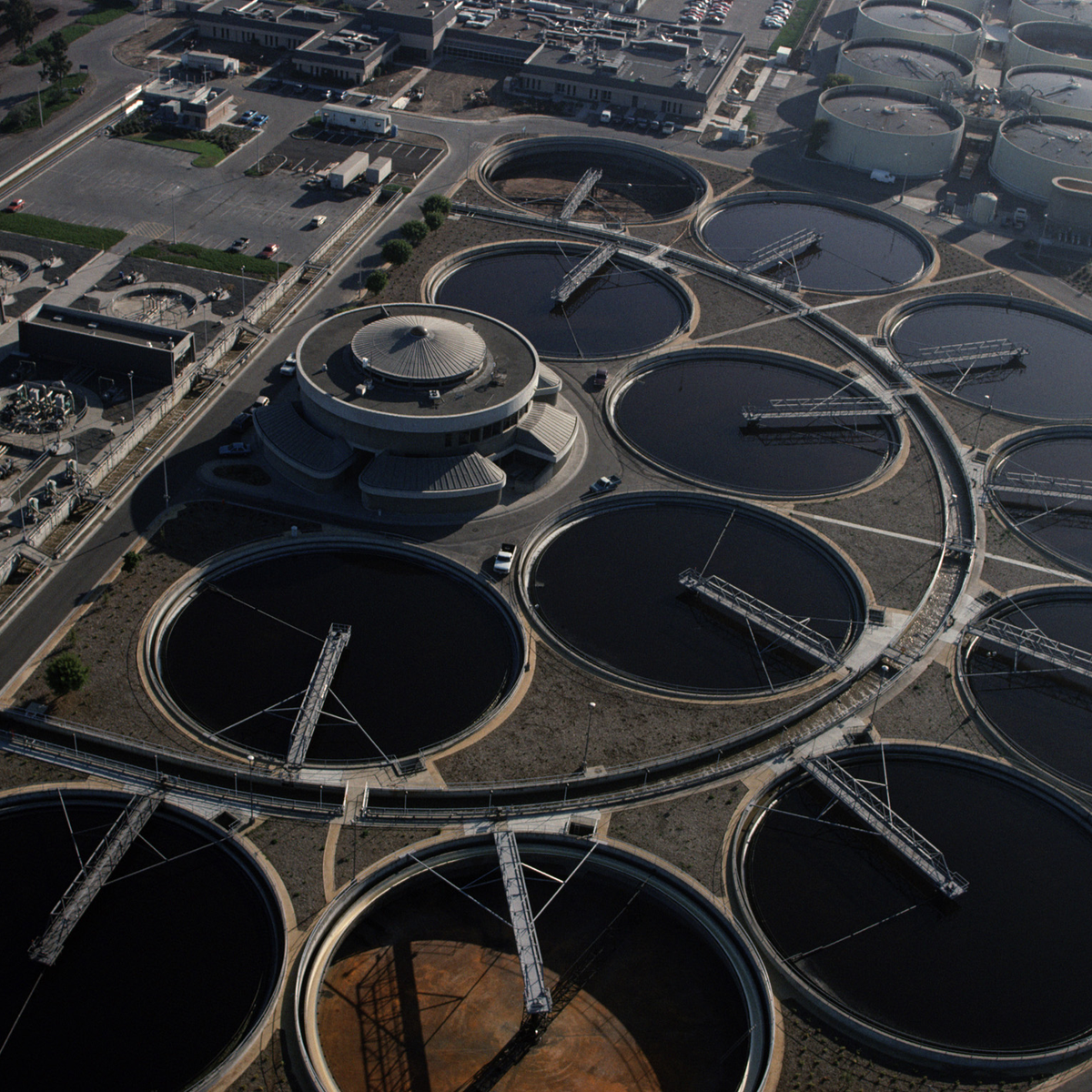
Walk into the blower room at a mid-size treatment plant and the noise tells you what everybody thinks matters. The aeration blowers are eating most of the electric bill and all of the attention. Meanwhile, tucked in a corner behind a chain-link cage, there is a 25 horsepower rotary screw nobody has looked at since the last plant expansion. That little machine is the one holding the whole automated valve train together. When it goes down at 2 a.m., the aeration basins keep humming and the plant still goes to manual.
That is the thing operators learn the hard way. Compressed air for wastewater treatment is really two separate systems that people keep lumping together, and only one of them is a compressed air system at all.
Aeration Air Is Not Instrument Air
Aeration is low pressure, high volume. You are pushing somewhere between 6 and 12 psi into a diffuser grid under 15 feet of water, and you are pushing thousands of SCFM to do it. That is blower territory: positive displacement, multistage centrifugal, or turbo. A rotary screw compressor is the wrong tool and it will cost you a fortune trying.
Instrument and utility air is the opposite. It is high pressure, low volume, and it has to be clean. You are running 90 to 125 psi to pneumatic valve actuators, chemical feed diaphragm pumps, filter air scour headers, membrane blowback, sampler purges, and the shop air drops in the maintenance bay. Total plant draw for instrument air at a 10 MGD facility often lands somewhere between 40 and 150 CFM depending on how many actuated valves you have and whether the plant was designed pneumatic or electric.
Roughly 30 percent of treatment plants went pneumatic on their valving instead of electric. If yours is one of them, your instrument air compressor is a process-critical asset, not a utility.
The Air Quality Target You Actually Have to Hit
The governing document is ANSI/ISA-7.0.01, the Quality Standard for Instrument Air. It is short and it is specific:
| Parameter | ISA-7.0.01 limit | What that means in practice |
|---|---|---|
| Pressure dew point | At least 18 degrees F below the lowest ambient temperature any part of the system sees, and never above 39 degrees F at line pressure | A refrigerated dryer covers you indoors. Outdoor headers in a northern plant need desiccant. |
| Particle size | 40 micron maximum | Easy. A general purpose filter clears it. Most positioners want far tighter, so you add point-of-use filtration. |
| Oil content | 1 ppm w/w maximum, "as close to zero as possible" | An oil-lubricated screw with a good separator and coalescing filter gets there. Sloppy maintenance does not. |
| Contaminants | No corrosive or hazardous gases | Do not put the intake near the headworks, the digester, or the chlorine room. |
That last row gets ignored constantly and it is the one that is unique to your industry. A plant pulls intake air from wherever the compressor happens to sit. If that air is loaded with hydrogen sulfide off a wet well, you are compressing it, concentrating it, and then feeding it into brass positioners and stainless actuator internals. H2S plus moisture makes sulfuric acid. Actuators start sticking, solenoid valves green up inside, and nobody connects it to a compressor that sits 80 feet from a scum pit.
Duct the intake to clean outside air. It is a few hundred dollars of pipe and it will save you a valve rebuild program.
Why the Dew Point Rule Is Written the Way It Is
The 18 degree margin is not arbitrary. Instrument air headers at a treatment plant almost always run outdoors or through unheated galleries at some point, out to a basin deck, up a filter gallery, into a headworks building that is technically heated but really is not. If your dryer delivers a 38 degree dew point and the header runs through a 20 degree space in January, you get liquid water in the line. Liquid water in a solenoid valve at 20 degrees is ice, and ice is a valve that will not stroke. You find out during a wet weather event.
If any part of the header sees ambient below about 50 degrees F, spec a desiccant dryer for a minus 40 dew point and stop thinking about it. If the whole system is indoors and heated, a refrigerated dryer is fine and cheaper to run. Our guide on refrigerated vs desiccant dryers walks the tradeoff in detail, and if you have already decided the answer is desiccant, our deeper write-up on desiccant dryers for wastewater instrument air covers sizing, purge loss and the filtration that keeps the beads alive.
Sizing the Instrument Air Compressor
Plant instrument air demand is spiky and mostly small. A single actuator stroke pulls a puff. A filter air scour cycle pulls a lot, for two or three minutes, a few times a day. Sizing on peak instantaneous demand gets you a machine that spends 95 percent of its life unloaded and burning money.
Better approach: size the compressor on average demand, then put storage behind it to cover the scour and backwash peaks.
- Count your actuators. A typical 4 inch pneumatic actuator uses somewhere around 0.1 to 0.3 standard cubic feet per stroke. Even a plant with 200 actuated valves cycling a few times an hour is only a handful of CFM averaged out.
- Find the air scour load separately. This is the big one. A filter air scour header can want 3 to 5 SCFM per square foot of filter area during the scour step. A 400 square foot filter bed is asking for well over 1,000 CFM. If your scour runs off the instrument air compressor, that is a design error, and it is a common one. Scour air belongs on its own blower.
- Add shop air. Maintenance bay impacts, grinders and blow guns are real load. Budget 25 to 50 CFM if the shop shares the header, or give the shop its own small machine so a mechanic with a die grinder cannot drag plant pressure down.
- Size storage at 4 to 10 gallons per CFM. Treatment plants lean toward the high end because the loads are so intermittent. Big storage is what lets a 25 HP machine behave like a 50.
For most plants under 20 MGD, a 15 to 30 HP rotary screw air compressor with a 240 to 400 gallon receiver covers instrument and utility air with margin. If you want the sizing math in more depth, see how to size an air compressor.
Redundancy Is Not Optional Here
This is where wastewater differs from a machine shop. A machine shop that loses air sends people home. A treatment plant that loses instrument air loses automated control of influent gates, chemical feed, and sometimes disinfection, while flow keeps arriving whether you are ready or not. You cannot tell the sewershed to hold on.
Standard practice is N+1: two compressors, each sized for full plant demand, with automatic lead-lag alternation. Duplex with alternating duty gets you even hour accumulation on both machines and an automatic failover. A sequencer or a simple alternating pressure switch handles it.
Beyond that, the things that actually bite plants:
- Single point dryer failure. Two compressors feeding one dryer means one dryer failure takes the plant. Either dual dryers or a manual bypass with a valved path around it.
- No backup power on the compressor. If the instrument air compressor is not on the standby generator, your pneumatic valves are on borrowed air the moment the utility drops. Check the load schedule. This gets missed on plants that converted to pneumatic after the generator was sized.
- Fail-safe actuator position. Every actuated valve should have a documented fail position on loss of air. If nobody in the control room can tell you which way the influent gate goes when air bleeds off, that is a bigger problem than the compressor.
Condensate Is a Discharge Problem, Even Here
Here is an irony operators enjoy. You run a facility whose entire purpose is treating water, and the compressor room is quietly making oily wastewater that is not legal to dump on the floor drain, which at your plant goes straight back to the headworks.
Technically the plant can treat it. Practically, oil-laden condensate hitting your own influent is a slug load on a biological process, and if you are on a combined system the state may have opinions. The clean answer is an oil/water separator on the compressor and dryer drains, which knocks oil down to the low single-digit ppm range before the water goes anywhere. More on the rules in our piece on compressed air condensate disposal.
The Mistakes Plants Make Over and Over
- Running the whole plant off one compressor because "it's only instrument air." It is the control system's muscle. Treat it like a process asset with a spare.
- Intake in a corrosive space. Covered above. Look at where your intake actually is, today, before you finish this sentence.
- Undersized header for a long plant. Treatment plants sprawl. A 1 inch header running 600 feet to the far clarifier will drop 20 psi and your positioner at the end never sees enough air to stroke clean. Size the main generously and loop it. See compressed air pipe sizing.
- Timer drains left open. An open timer drain on a header at a sprawling plant is a leak nobody hears over the blowers. Electronic zero-loss drains pay for themselves fast here.
- Buying a machine that cannot be serviced in place. Compressor rooms at plants are often below grade with a 36 inch door and no hoist. Measure the path before you buy.
- Skipping filtration downstream of an oil-lubricated screw. ISA says 1 ppm oil maximum. Get there with a coalescing filter after the dryer, and change the element on schedule.
A Reasonable Starting Spec
| Plant size | Instrument air CFM (typical) | Compressor | Storage | Drying |
|---|---|---|---|---|
| Under 2 MGD | 10 to 25 | Duplex 7.5 to 10 HP | 120 to 240 gal | Refrigerated, desiccant if outdoor header |
| 2 to 10 MGD | 25 to 75 | Duplex 15 to 25 HP rotary screw | 240 to 400 gal | Desiccant, minus 40 dew point |
| 10 to 30 MGD | 75 to 150 | Duplex 30 to 50 HP rotary screw, consider VSD lead | 400 to 660 gal | Desiccant, dual tower with dew point demand control |
| 30 MGD and up | 150+ | N+1 50 HP and up, sequenced | 660+ gal, distributed | Desiccant, redundant |
Treat these as a starting point for a conversation, not a purchase order. Pneumatic-heavy plants blow past the middle column and all-electric-valve plants come in under it.
Frequently Asked Questions
Can I use my aeration blower for instrument air?
No. Aeration blowers put out 6 to 12 psi. Pneumatic actuators and positioners need 60 psi minimum and are usually set for 80 to 100 psi. They are different machines for different jobs and neither substitutes for the other.
Does instrument air at a treatment plant have to be oil-free?
Not necessarily. ISA-7.0.01 allows up to 1 ppm oil, which a well-maintained oil-lubricated rotary screw with a proper separator and coalescing filter will meet. Oil-free is the easier path if you have it in the budget or if you are also feeding anything with tight instrument tolerances, but it is not a code requirement the way it is in food or pharma.
How often should I be changing filter elements at a plant?
Annually at a minimum, regardless of what the differential pressure gauge says. Plants run dirty ambient air and elements load up faster than the gauge admits. See our write-up on when to replace filter elements.
My actuators are slow and sticky. Is that an air problem?
Usually, yes. Three suspects in order: pressure at the actuator (measure it there, not at the compressor), moisture in the line, and corrosive intake air. If several actuators across the plant went sticky over the same few months, look at the compressor intake location and the dryer before you start rebuilding valves.
Should the instrument air compressor be on standby power?
If any part of your automated control depends on it, yes. Verify it is actually on the generator load schedule. Plants that converted to pneumatic control after the generator was specified frequently find out during an outage that it is not.
What does a wastewater plant need that a generic industrial shop does not?
Three things: intake air that is not pulling H2S off your own process, redundancy because flow does not stop, and a dew point spec that accounts for headers running through unheated outdoor space. Everything else is ordinary industrial compressed air practice.
Compressed air for wastewater treatment does not need to be complicated. Separate the blower job from the instrument air job, put the intake somewhere clean, hit the ISA dew point with real margin, buy two compressors instead of one, and put the whole thing on the generator. Do that and the corner machine stops being the plant's quietest single point of failure.


