


That cloudy, gray water dripping out of your tank drain is not shop water. It is industrial wastewater, and in most of the country it is illegal to pour it on the gravel out back or dump it down a floor drain. Plenty of shops have been doing exactly that for thirty years without hearing a word about it. That does not make it legal, and it does not help much when an inspector finally walks the property.
Compressed air condensate disposal is one of those topics nobody thinks about until somebody makes them think about it. Here is what the water actually is, how much of it you are making, and the handful of ways to deal with it that will hold up.
What is in the condensate
Air going into your compressor carries water vapor. Squeeze that air to 125 PSI and cool it back down, and the water has nowhere to go but liquid. That part is unavoidable physics.
The problem is what comes along for the ride. On a lubricated compressor, whether rotary screw or piston, a small amount of oil carries over into the air stream and ends up in the condensate. The air itself also brings in whatever is floating around your building: dust, hydrocarbons off the shop floor, welding fumes, solvent vapor. What collects in the drain bucket is an oily, sometimes emulsified mix that a wastewater treatment plant does not want to see.
Untreated compressed air condensate commonly tests above 300 ppm oil. For scale, the number most often cited as a federal reference point for discharge into a public sewer is 40 ppm, and a great many municipalities set their local limit far below that, often 15 ppm and sometimes 10. Your local publicly owned treatment works sets the limit that actually governs you, so that is the number to go find. Call the pretreatment coordinator at your water authority and ask. It takes ten minutes and it is the only way to know where you stand.
How much are you making?
More than you would guess. The worst-case rule of thumb the industry uses is roughly one gallon per horsepower per day, assuming the compressor runs 24 hours in hot, humid conditions. That is deliberately pessimistic, but it shows the scale of the problem.
A more realistic figure: a 45 HP compressor running in a shop at about 68 degrees F and 50 percent relative humidity produces somewhere in the neighborhood of 23 gallons of water a day. Push the ambient temperature and humidity up, as happens in a Southern summer, and that climbs fast.
| Compressor | Typical condensate, mild conditions | Worst case, hot and humid |
|---|---|---|
| 10 HP | 3 to 5 gal/day | up to 10 gal/day |
| 25 HP | 8 to 13 gal/day | up to 25 gal/day |
| 50 HP | 18 to 26 gal/day | up to 50 gal/day |
| 100 HP | 35 to 55 gal/day | up to 100 gal/day |
Those are running-hour numbers, so a machine that only loads half the shift makes proportionally less. Still, a 50 HP shop is generating a 55 gallon drum of oily water every week or two. That is a real disposal problem, not a nuisance.
Your three real options
| Option | How it works | Good fit for | Watch out for |
|---|---|---|---|
| Haul it away | Collect in drums, licensed waste hauler picks it up | Small shops, low volume, occasional use | Cost per drum adds up fast at volume; you still hold generator liability |
| Evaporator | Heats condensate, water goes off as vapor, oil residue stays behind | Sites with no sewer connection or very strict local limits | Electricity cost, air permit questions in some jurisdictions |
| Oil/water separator | Gravity separation plus oleophilic media and carbon polishing; clean water to drain, oil to a collection cup | Most shops with a sewer connection | Element replacement schedule; emulsified oils need the right unit |
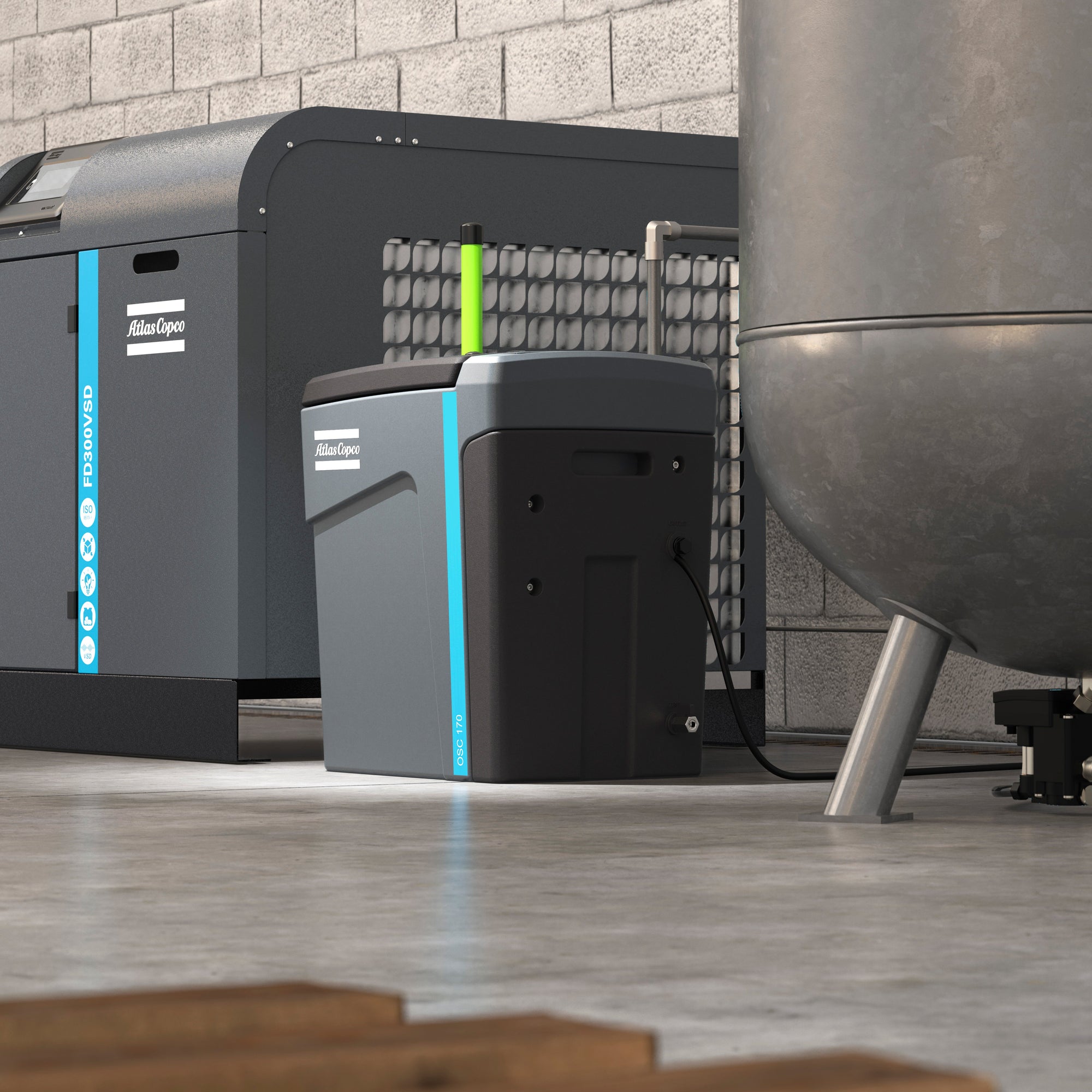
For the large majority of shops the separator is the answer. It is a passive box on the wall with no moving parts, it costs a fraction of hauling, and a properly sized and maintained unit brings the effluent down into the 10 to 20 ppm range, which clears most local limits. Our oil/water separators and broader condensate treatment lineup cover the common sizes.
How a separator actually works
Condensate enters a depressurization chamber, which knocks the velocity down and lets the air separate from the liquid without spraying oil everywhere. The mixture then moves slowly through a settling chamber where free oil, being lighter, rises and gets skimmed into a collection cup. What is left passes through oleophilic media, which is engineered to grab oil and pass water, and finally through activated carbon that polishes out the last of the dissolved hydrocarbon. Clean water leaves through the outlet and goes to your drain.
The whole thing works on residence time. That is why sizing matters: push more condensate through than the unit was designed for and the water does not sit long enough for the oil to rise, so oil goes out the outlet with it. Size on your compressor's total horsepower plus a margin, and account for the dryer, which produces its own condensate load.
The emulsified oil trap
This is the part that catches people. A standard gravity separator works because oil and water want to separate. Some lubricants do not cooperate. Polyglycol fluids and certain synthetic and food-grade lubricants emulsify with water, meaning the oil disperses into microscopic droplets that will not rise no matter how long you let them sit.
Run an emulsifying lubricant through a standard separator and it will pass oil straight through, and you will not know until someone samples the discharge. If your compressor uses a polyglycol or synthetic that lists demulsibility as poor, you need a separator specifically built for emulsions, which usually means a membrane or a chemical splitting stage rather than plain gravity. Check the lubricant data sheet before you buy the separator, not after. If you are unsure what is in your sump, our compressor oil listings spell out the base stock on every product.
Do not overlook the drains themselves
A separator is only as good as what feeds it. Two things go wrong upstream more often than anything inside the separator.
First, manual drains that nobody opens. If the operator forgets, water sits in the tank and rusts it from the inside, then dumps a slug of accumulated sludge when someone finally cracks the valve. Second, timer drains set too aggressively, which blow a huge volume of compressed air out with every cycle. That wasted air costs real money and it also shocks the separator with a burst of high-velocity flow.
Zero-loss electronic drains solve both. They sense the liquid level and open only when there is actually water to dump, so you get reliable draining without throwing away compressed air. Our electronic drains and full condensate drain range cover retrofits for most tanks, dryers, and filter housings.
Maintenance, which is minimal but not zero
- Empty the oil collection cup on a set schedule. Monthly is typical, more often on a hard-working machine.
- Replace the media and carbon elements per the manufacturer, generally annually or when the outlet water starts looking or smelling off.
- Take a periodic sample from the outlet. Some authorities require it; even where they do not, it is the only way to prove your system is working.
- Keep the documentation. Element receipts, disposal manifests, and sample results are what turn an inspection into a short conversation.
Frequently Asked Questions
Is compressed air condensate considered hazardous waste?
In most cases it is regulated as oily wastewater rather than hazardous waste, but the classification depends on the oil content and on your state. What is consistent is that discharging it untreated to a sewer, a storm drain, or the ground is a violation nearly everywhere. Treat it as regulated wastewater and confirm the specifics with your local authority.
Can I put condensate from an oil-free compressor down the drain?
Often yes, but not automatically. An oil-free compressor does not add lubricant to the air, so the condensate is much cleaner. It still contains whatever the intake pulled out of your building's air, which in an industrial setting can include hydrocarbons and particulate. Sample it before you assume it passes.
How do I size an oil/water separator?
Size on the total connected horsepower feeding into it, including the dryer, and then add margin for hot and humid conditions. Manufacturers publish HP ratings for each model. If you are near the top of a model's range, step up. Undersizing is the most common reason a separator fails a discharge test.
How much oil is actually in the condensate?
Untreated condensate from a lubricated compressor commonly exceeds 300 ppm oil. A correctly sized and maintained separator typically brings that down to roughly 10 to 20 ppm, which meets most municipal limits. Your local limit is the one that counts, so get that number before you specify equipment.
What are the penalties for getting this wrong?
They vary by jurisdiction and by whether the violation is treated as negligent or knowing, but figures in the tens of thousands of dollars per day are commonly reported for Clean Water Act violations. The practical cost is usually the cleanup order and the ongoing monitoring requirement rather than the headline fine.
Where to start
If you have never dealt with this, do two things this week. Call your local water authority and get your oil discharge limit in writing. Then look at what is coming out of your drains and figure out roughly how many gallons a day you are producing. Those two numbers tell you whether you need a small wall-mount separator or a full treatment setup, and they turn compressed air condensate disposal from a vague worry into a line item you can actually solve.
Send us your compressor horsepower, your dryer, and your local ppm limit, and we will tell you what size unit clears it.


