


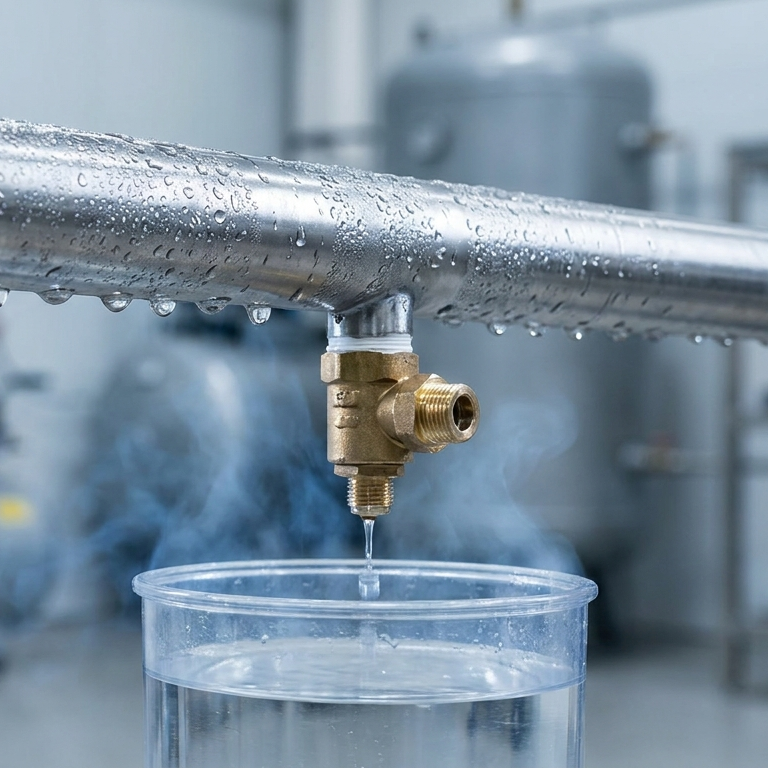
Two shops buy the same dryer. One is thrilled, the other is furious that his lines still freeze up in winter. Same dryer, same air, totally different result. The reason almost always comes down to a number nobody explained to them: dew point.
If you've ever wondered why your air treatment isn't keeping water out of your tools, understanding compressed air dew point is where the answer lives. It's the single spec that tells you how dry your air actually is, and it's the one that decides which type of dryer you need.
What Dew Point Actually Is
Dew point is just the temperature at which the water vapor in your air starts to condense into liquid. Cool the air below its dew point and moisture drops out as droplets. Keep the air above its dew point and the water stays as harmless vapor.
So when a dryer is rated for a 38 degree F dew point, it means the air leaving that dryer won't form liquid water until something chills it below 38 degrees. As long as everything downstream stays warmer than that, your lines stay dry. Let the air get colder than the dew point, say a line running outside on a cold morning, and water condenses right there in the pipe.

Pressure Dew Point vs Atmospheric Dew Point
Here's where a lot of confusion starts, and it's worth slowing down for. There are two ways to state dew point, and mixing them up leads to buying the wrong dryer.
Pressure dew point is the dew point measured while the air is still compressed and sitting in your system at working pressure. This is the number that matters to you, because your air lives under pressure. It's the honest, real-world figure.
Atmospheric dew point is measured after the air has expanded back to normal atmospheric pressure. It always reads much colder (better) than the pressure dew point for the same air, which is why some spec sheets like to quote it. When you compare dryers, make sure you're comparing pressure dew point to pressure dew point. Otherwise you're comparing apples to a photo of an orange.
How Much Drying Do You Actually Need?
The right dew point depends entirely on what you do with your air and where your pipes run. Over-drying wastes money and energy. Under-drying lets water wreck your tools and finishes. Here's how the common targets line up.
| Typical Pressure Dew Point | Dryer Type | Good For |
|---|---|---|
| About 38 degrees F (3 C) | Refrigerated | General shop air, painting, most air tools in a heated building |
| Around -40 degrees F (-40 C) | Desiccant | Lines exposed to freezing temps, outdoor runs, blasting outdoors |
| Down to -100 degrees F (-73 C) | Desiccant (specialty) | Critical uses like electronics, pharma, and instrument air |
The pattern is simple. If your air stays indoors in a heated space, a refrigerated dryer holding around 38 degrees F is plenty and it's the most economical choice to run. If any part of your system sees temperatures near or below freezing, a 38 degree dew point won't save you. The air will condense the moment it hits that cold pipe. That's when you step up to a desiccant dryer and its much lower dew point.
Refrigerated vs Desiccant, in One Breath
A refrigerated dryer works like a small air conditioner for your compressed air. It chills the air, condenses the water out, and reheats it. Simple, reliable, and cheap to run, but it physically can't get below the freezing point of water, so about 38 degrees F is its floor.
A desiccant dryer passes the air over a bed of material that grabs moisture right out of it. No freezing limit to worry about, so it reaches those deeply negative dew points. It costs more to buy and run, but for freezing environments or critical air, it's the only thing that will do the job.
Why the Right Dew Point Saves You Money
Water in your air isn't just annoying. It rusts the inside of your tanks and pipes, it ruins paint jobs with fisheyes and blushing, it freezes and blocks lines in winter, and it washes the lubrication out of air tools so they wear out early. Matching your dryer's dew point to your real conditions stops all of that at the source. It also keeps you from overspending: there's no reason to run a -40 degree desiccant system if your air never leaves a warm shop, and no point installing a refrigerated dryer on a line that runs across a freezing yard.
Dryers work best as part of a treatment train. Pair the dryer with proper filtration and drainage and your whole air drying setup does its job without you thinking about it.
Frequently Asked Questions
What is a good dew point for compressed air?
For general shop air in a heated building, a pressure dew point around 38 degrees F from a refrigerated dryer is the standard target. If your lines see freezing temperatures, you need a desiccant dryer that reaches around -40 degrees F so the air won't condense in cold pipe.
What's the difference between pressure and atmospheric dew point?
Pressure dew point is measured while the air is still compressed at working pressure, and it's the number that matters for your system. Atmospheric dew point is measured after the air expands to normal pressure and always reads colder. Always compare dryers using pressure dew point.
Can a refrigerated dryer freeze up?
A properly working refrigerated dryer holds around 38 degrees F and won't freeze itself. The problem is the air it produces will still condense if it later travels through pipe colder than 38 degrees, such as an unheated or outdoor run. For those conditions you need a desiccant dryer.
Do I need a desiccant dryer?
You need one if any part of your air system runs below freezing, or if your application demands very dry, clean air like electronics, pharmaceutical, or instrument work. For everyday air tools and painting inside a heated shop, a refrigerated dryer is usually enough and cheaper to run.
Does a dryer replace a water separator?
No, they work together. A separator and drains knock out the bulk liquid water first, then the dryer removes the vapor to hit your target dew point. Sending slugs of liquid water straight into a dryer overwhelms it, so bulk removal comes first.
Once you know the dew point your work demands, choosing a dryer stops being a guessing game. Figure out how cold your air gets, pick the dew point that keeps it dry, and match the dryer to it. Browse our full range of air dryers when you're ready to dial it in.


