


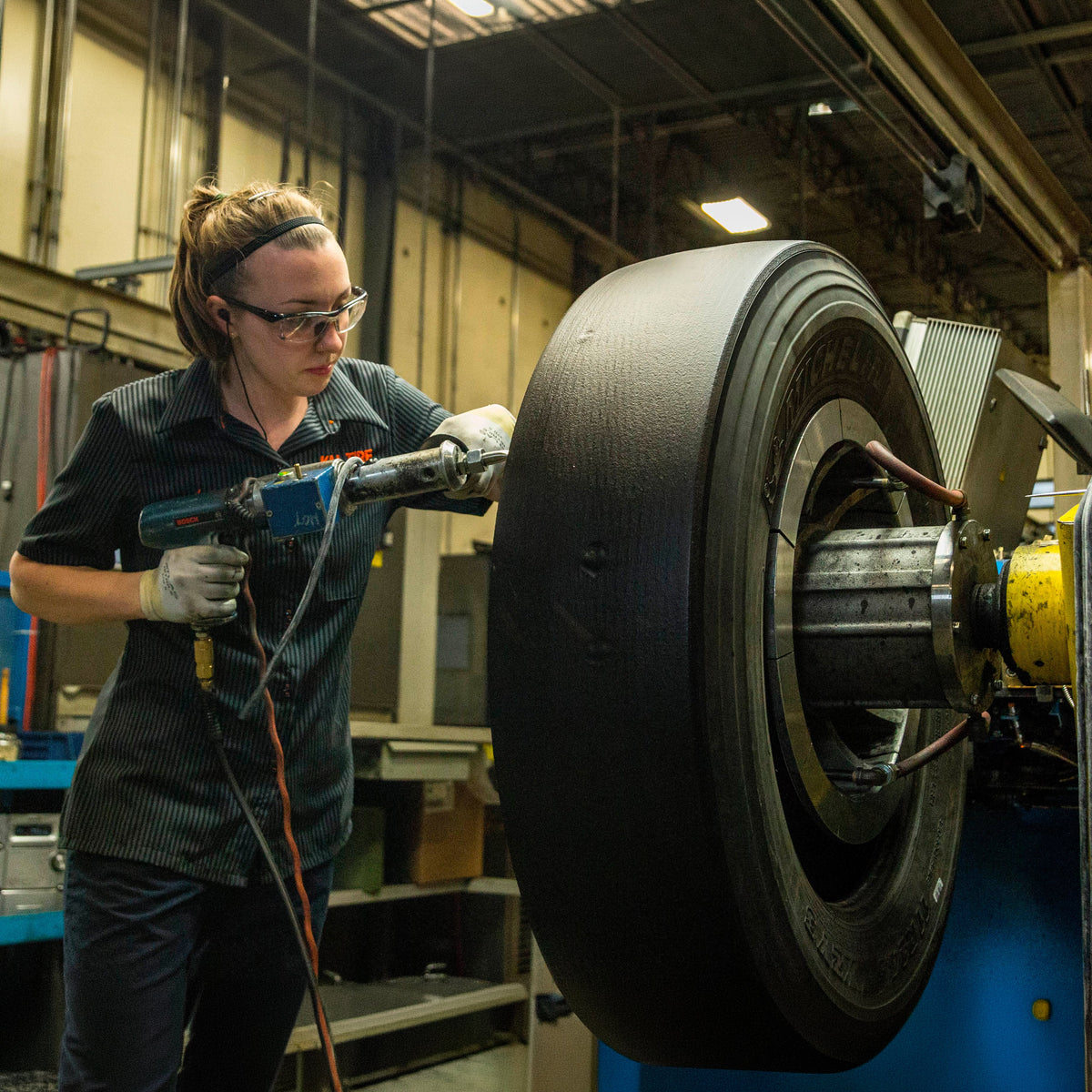
Stand in the middle of a retread plant for ten minutes and you will hear three completely different demands on the same air system. A buffer screaming through a casing. A stitcher snapping. And over in the corner, a chamber quietly holding eighty-five pounds for the next two and a half hours while nobody thinks about it at all.
That last one is the load that gets sized wrong, because it does not make any noise.
Compressed air for tire retreading is an unusual problem. Most shops have either a bunch of intermittent tools or one big steady process. A retread plant has both at once, plus a buffing room full of rubber dust that is actively trying to get into the compressor, plus an adhesion process that fails quietly if there is oil in the air. Get any one of those wrong and you find out in the warranty returns.
The Loads, and How Different They Are
| Operation | Demand character | What it cares about |
|---|---|---|
| Buffing and rasping | Steady while running, plus the dust collector behind it | Volume. Dust collection pulse air |
| Skiving and repair | Intermittent, small | Nothing special |
| Cement and solvent spray | Intermittent, small volume | Clean and dry. This is the critical one |
| Extruder and cushion gum application | Light, steady | Dry air |
| Stitching and tread application | Intermittent | Nothing special |
| Envelope seating and leak check | Short bursts, plus vacuum | Repeatable low pressure |
| Curing chamber fill | Large draw at the start of every cycle | Storage or capacity, depending on fill time |
| Curing chamber hold | Small continuous makeup for hours | Reliability |
| Shop and tire service air | Intermittent | Nothing special |
Notice the split in the middle of that chamber row. Filling a chamber is one of the biggest single draws in the building. Holding it is almost nothing, just enough to make up leakage. People size for one and forget the other, usually by looking at the average and concluding the chamber barely matters.
The Curing Chamber Is Usually a Storage Problem
A typical envelope cure runs the chamber somewhere around 85 psig at roughly 210 degrees F, with the envelope held at a lower back pressure, commonly in the 70 psi range, and the whole thing sits there for hours. Before that, the envelope gets evacuated to check for leaks and then taken to something like 10 to 15 psi to seat it.
The fill is what hurts. You are pressurizing a large vessel from atmosphere, and if that fill pulls straight off the plant header, every tool in the building sags while it happens. In a two-chamber plant where the operators naturally load and start both at shift change, you get the two biggest transients in the plant landing on top of each other, twice a day.
The fix is the same one we give asphalt plants and anyone else with a big short demand: put the air near the demand.
- Dedicated receiver near the chambers, sized so a fill comes mostly out of the tank rather than out of the plant.
- Stagger the chamber starts if you can. This is free and it is often the entire fix.
- Size the compressor for the hold plus everything else, and let storage cover the fill. Buying horsepower to cover a transient you could have covered with a tank is the expensive route.
One important qualifier, because it decides whether any of that works: how much of the fill a tank can realistically cover depends entirely on how long your fill takes. A chamber that comes up in a minute is a storage problem. A chamber throttled to come up over twenty minutes is a capacity problem, and no practical tank will touch it. We walk that arithmetic, with the numbers, in curing chamber air for tire retreading. Time your fill before you buy anything.
The receiver math is in properly sizing your compressed air storage, and air receiver tanks covers the hardware.
One safety note worth making plainly
Curing chambers and the air systems feeding them are pressure equipment, and the retread industry has had fatal compressed air incidents. Relief devices, door interlocks, and the inspection regime on your chambers and receivers are not paperwork. If your chamber relief valve has been painted over or your receiver has not had an external inspection in years, deal with that before you deal with anything in this article.
Oil in the Air Is an Adhesion Problem
Here is the thing that separates retreading from general manufacturing, and it is the argument we lead with when a plant is choosing filtration.
Retreading is a bonding process. Buffed casing, cement, cushion gum, tread, heat and pressure. Every one of those interfaces depends on clean surfaces. Oil carryover in the air that sprays your cement, or in the air that blows off a buffed casing before the gum goes on, puts a release agent exactly where you need adhesion.
What that does not look like is an obvious failure in the plant. It looks like a slightly higher return rate six months later, tread separations that get blamed on the casing or the customer's maintenance, and an argument nobody can settle. That is the worst kind of problem because it never traces back to the compressor room.
So: a proper filtration train on the air that touches the bonding process. Water separator, particulate filter, coalescing filter, and an activated carbon stage if your machine is lubricated and your spray air comes off the same header. Our coalescing air filter guide covers what sits where.
Dry matters too. Water in the spray air blushes solvent cement and water on a buffed casing is the same adhesion problem as oil. A refrigerated dryer is usually enough here since nothing goes outdoors or below freezing, but confirm that before you assume it. Refrigerated vs desiccant walks the choice.
You do not need food-grade or Class 0 air to retread a tire. You do need air that is genuinely dry and genuinely oil free at the point of use, which is a filtration and dryer question more than a compressor question.
Rubber Dust and the Compressor Intake
Buffing produces a large volume of fine rubber crumb and dust, and it travels. If your compressor sits in or near the buffing room, or draws its intake from plant air that passes through it, the machine is inhaling that dust every hour it runs.
What follows is predictable. Intake filters load fast, restriction climbs, capacity quietly drops, and on a lubricated machine the fines that get past the element end up in the oil and then in the separator. Plants in this situation often think their compressor is undersized when what they actually have is a choked intake and a fouled cooler.
- Pull the intake from clean outside air, away from the buffing room exhaust and away from the dust collector discharge.
- Put a restriction indicator on it and go by that rather than the calendar.
- Keep the compressor room itself out of the dust path, or put it under slight positive pressure with filtered makeup air.
- Clean cooler and aftercooler fins on a schedule. Rubber-dusted fins are why the machine trips on high temperature in August.
More in the air compressor intake filter guide.
Don't Forget the Dust Collector
The baghouse or cartridge collector on your buffing operation cleans itself with pulses of compressed air, and that is a real load that rarely appears on anyone's demand list. Each pulse is short and violent, which means it wants storage close by rather than compressor capacity.
It is also a classic hiding place for leaks. A pulse valve diaphragm that fails open can pass a very large continuous flow, and because a collector is already noisy nobody hears it. Walk the collector and listen at each valve between pulses. That check is free and it finds real money more often than you would expect. See compressed air leak detection.
Sizing Starting Points
| Plant | Typical demand | Common setup |
|---|---|---|
| Single chamber, one buffer, light volume | 40 to 80 CFM | 15 to 25 HP rotary screw, refrigerated dryer, 240 to 400 gal with storage near the chamber |
| Two to three chambers, multiple buffers | 100 to 250 CFM | Two screws in lead/lag, full filtration train, 500 to 1,000 gal plus a dedicated chamber receiver |
| High volume plant with heavy dust collection | 250 CFM and up | Multiple screws, duplex drying, separate storage at the chambers and at the collector |
Treat those as a place to start a conversation, not a spec. The honest method is to get the chamber fill volume and cycle time from your equipment manufacturer, count the buffers and the collector pulse load, and then decide how much of the transient you are covering with storage.
Two machines in lead/lag is worth real consideration here, because a retread plant with a chamber mid-cycle does not have the option of waiting for a service call. Background in our rotary screw compressor guide.
What Retread Plants Get Wrong
- Sizing the compressor on average demand. The average says the chambers barely matter. The chamber fill says otherwise.
- No storage at the chambers. So the fill pulls the whole plant down twice a shift.
- Compressor breathing buffing dust. Cheapest problem in this article to fix and the most commonly ignored.
- Thin filtration on spray and blow-off air. The failure shows up as returns months later, not as a problem in the plant.
- Nobody has walked the dust collector for leaking pulse valves.
- Chamber and receiver inspections out of date. This is a pressure equipment business whether anyone calls it that or not.
- Running plant pressure up to fix a chamber fill time. Every psi costs roughly half a percent in energy, continuously, to solve a problem that is about storage.
Frequently Asked Questions
How much compressed air does a retread plant need?
It depends almost entirely on how many curing chambers you run and whether you have storage near them. A single chamber plant with one buffer usually lands somewhere in the 40 to 80 CFM range, and a multi-chamber plant with heavy dust collection can be several times that. The number that actually drives the decision is the chamber fill volume and cycle time, which your equipment manufacturer can give you.
Do we need an oil-free compressor for retreading?
No. This is not food or pharmaceutical air and you do not need Class 0. What you do need is a real filtration train on the air that touches the bonding process, meaning a water separator, particulate and coalescing filtration, and carbon if your spray air comes off a lubricated machine. Oil at the cement or blow-off stage is an adhesion risk, and good filtration on a lubricated compressor handles it for far less money than an oil-free machine.
Why does our plant pressure crash when we start a cure?
Because you are filling a large vessel out of the plant header instead of out of a tank. Put a dedicated receiver near the chambers so the fill draws from stored air, and stagger the chamber starts so two fills do not land together. Both of those are cheaper than the bigger compressor you are probably being quoted. If your fill takes many minutes rather than seconds, time it first, because past a certain point storage stops helping and the answer is capacity instead.
Our compressor keeps overheating in the summer. Is it undersized?
Check the intake restriction and the cooler fins first. In a retread plant, rubber dust loads intake filters and coats cooler fins far faster than in a normal shop, and both show up as high temperature trips and apparent loss of capacity. A machine that is actually undersized behaves differently, it just runs loaded all the time without the temperature climb.
How do we find leaks in a plant this noisy?
Ultrasonic detection, because it listens at frequencies above the plant noise floor and works with everything running. Start at the dust collector pulse valves, then the envelope and chamber connections, then quick-disconnects at the buffing and repair stations. Those three areas account for most of what we find.
Where to Start
Two checks this week. Walk your dust collector listening for a stuck pulse valve, and look at where your compressor is drawing its intake air. Those two cost nothing and they are the most common findings in this industry.
Then, before anyone sells you more horsepower, time your chamber fill and get the fill volume, so you know whether a tank next to the chambers will actually solve it.
Browse rotary screw air compressors, or send us your chamber count, fill volume and cycle time along with your buffer count, and we will size the compressor, the storage and the filter train together.


