


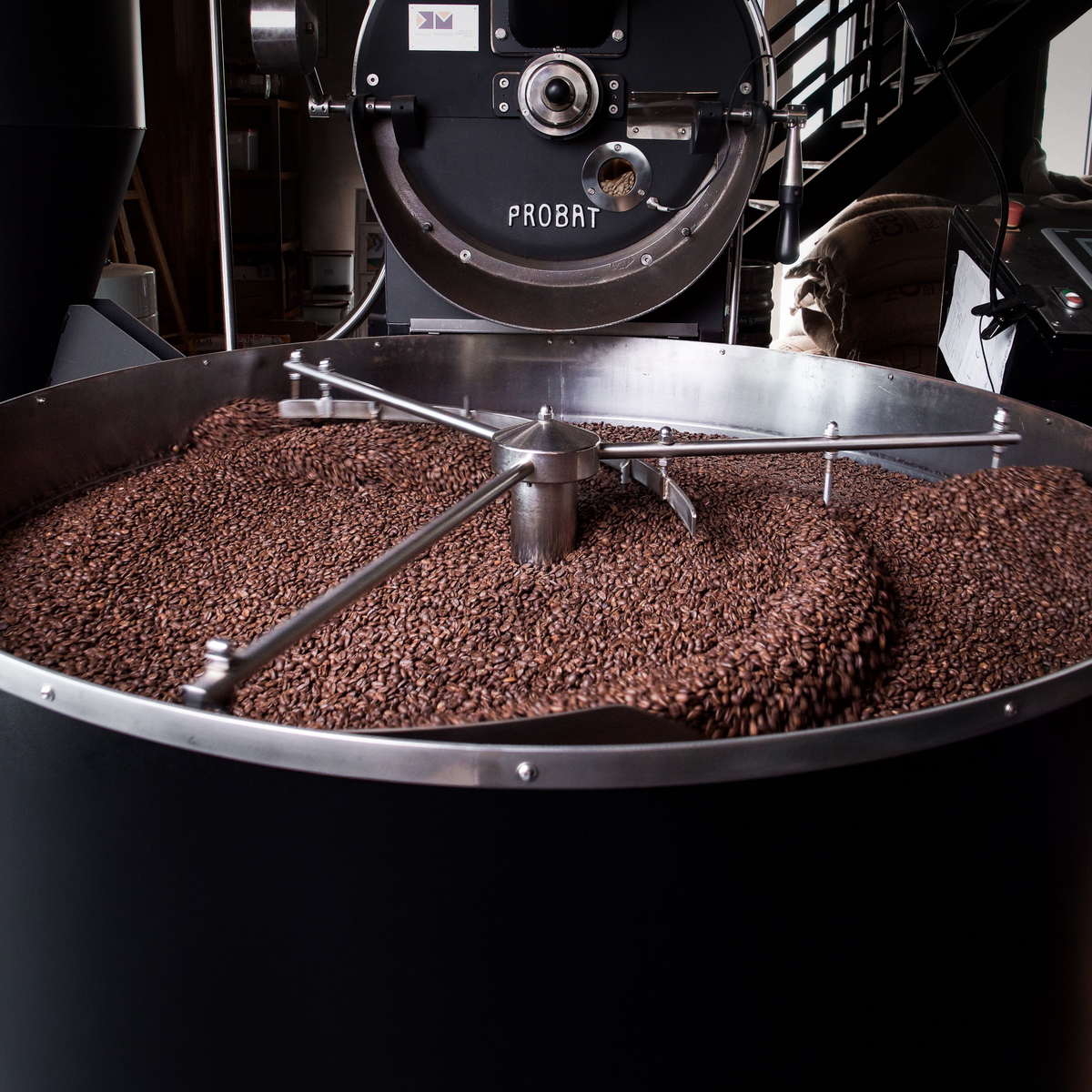
A roaster called us last spring because his color sorter had started throwing out good coffee. Reject rate crept from two percent to nine over about three weeks. He had the sorter manufacturer on the phone twice, swapped the camera calibration, and was getting quoted a service visit from four states away.
The ejector valves were sticking. There was water in the line feeding them, because the only air treatment in the building was the moisture trap that came bolted to a twenty gallon piston compressor in the corner of the packaging room. Nine percent of his production was going into the reject bin because nobody had ever thought of the compressor as production equipment.
That is the short version of compressed air for coffee roasters. The roaster itself barely needs air. Everything you buy after the roaster does, and the quality spec is set by whichever machine is fussiest, which is almost never the roaster.
Your Roaster Needs Less Air Than You Think
Start with the honest part, because it saves people money. A drum roaster uses compressed air for a handful of small jobs: the discharge door or drop gate actuator, the sampling trier on some machines, the cooling tray flap, and on gas machines the damper positioners. That is it. These are short strokes a few times per batch.
Look at what the roaster OEMs ship. Coffed, for example, pairs a 6 liter compressor with its SR5 through SR30 machines and a 24 liter, 750 watt unit rated around 132 liters per minute at 8 bar with the SR60 and SR120. Translated, a 120 kilogram roaster comes with roughly a one horsepower compressor making under 5 CFM. If someone is trying to sell you a 25 horsepower screw because you bought a 60 kilo roaster, ask them to show their work.
Two more things are usually not compressed air at all, and people get sold the wrong machine over this constantly:
- Green bean conveying from the silo or the bag dump to the roaster hopper runs on a regenerative or positive displacement blower, not on a compressor. High volume, low pressure. Different machine entirely.
- Destoners are mostly vacuum or blower driven for the same reason. They move a lot of air at very little pressure.
So if your roastery is a roaster, a destoner, and a scale, you need a small compressor and a moisture trap, and you can stop reading. Everything below starts mattering the moment you add a sorter, a bagger, or nitrogen.
The Color Sorter Sets the Whole Spec
Optical sorters fire a bank of tiny solenoid ejector valves, often hundreds of them, at rates measured in milliseconds. Each valve puts a precise puff of air behind a single defect bean traveling down a chute at speed. They are the most pressure sensitive and the most contamination sensitive device in a roastery.
Three things kill them, in this order:
- Water. Condensate reaches a valve seat, the valve hangs open or fails to seat, and the sorter either sprays continuously or misses the bean. Your reject rate moves and nobody suspects the air.
- Oil. Carryover from a lubricated compressor coats the valve internals and gums them up over months. It also puts oil mist where roasted coffee is traveling, which is a food safety problem you do not want to explain at an audit.
- Pressure swing. These valves need stable pressure at the manifold. If the bagger kicks in and the header sags 15 psi, ejection changes.
Sorter manufacturers typically call for clean, dry, oil free air at a specified pressure, and they will tell you the dew point they want if you ask. Give them a dedicated receiver near the machine with a regulator, not a long run off whatever the shop is doing.
Air Quality: It Is a Food Plant
Roasted coffee is food, and anything that blows on it, pushes it, or shares headspace with it is product contact air. The reference people cite is BCAS Best Practice Guideline 102, which points at ISO 8573-1:2010 purity classes. Direct contact is commonly specified as Class 2:2:1, indirect contact at 2:4:2, and some auditors and certification schemes write the tighter 1:2:1 into their requirement. Check what your scheme actually says rather than guessing, because the filtration you buy follows from that number.
What it means on the floor:
| Where the air goes | Quality it needs | What that takes |
|---|---|---|
| Color sorter ejectors | Oil free in practice, dry, fine filtered | Oil free compressor or lubricated plus coalescing and carbon, refrigerated dryer, point of use filter |
| Bagger, filler, one way valve applicator | Product contact | Same as above, with a final filter at the machine |
| Nitrogen generator feed | Clean and dry, the generator will specify | Dryer plus coalescing filtration ahead of the generator |
| Roaster actuators, dampers, gates | Dry general plant air | Refrigerated dryer, particulate filter |
| Grinder and hopper blow off | Product contact | Treated air and a properly rated nozzle |
The practical answer for most roasteries under about 25 horsepower is an oil free scroll or oil free piston machine for everything, because the premium at that size is small and it removes the whole oil question from your food safety plan. Above that, a lubricated screw with coalescing and activated carbon filtration is normal and defensible, provided you test it. Our piece on food grade compressed air covers what an auditor actually asks to see, and ISO 8573-1 air quality classes decodes the numbers.
On drying, a refrigerated dryer holding roughly a 38 to 45 F pressure dew point is enough for an indoor, heated roastery. You only need desiccant if pipe runs outdoors or through an unheated space in a cold climate. The refrigerated vs desiccant comparison walks the decision.
Nitrogen Is Where the Money Is
If you are flushing bags, you are buying nitrogen, and you are probably buying it in cylinders on somebody else's delivery schedule.
The target is residual oxygen in the sealed bag. Common practice is to get under about 3 percent, with specialty roasters pushing considerably lower for premium and extended shelf life programs. Purity tiers follow from that: roughly 99.5 percent nitrogen covers typical whole bean and ground retail bags, and 99.9 percent is what gets specified for single origin, pods, and long shelf life. Both of those are comfortably inside what an on site generator produces.
That matters because purity and cost climb together, steeply. Generating 95 percent nitrogen is cheap. Generating 99.999 percent costs a great deal more air per unit of nitrogen. Coffee sits in the easy part of that curve, which is why roasteries are good candidates for their own generator. The economics are in the nitrogen generator guide, and the PSA vs membrane comparison covers which technology fits which purity.
One honest limit, and we say this to every roaster who asks: a nitrogen generator is a real load on your compressor. Making nitrogen consumes compressed air, and at 99.5 percent purity you are looking at several standard cubic feet of air per cubic foot of nitrogen depending on the technology. If your compressor is already working hard on packaging days, the generator is a two part purchase and you need to plan for both.
Sizing It Without Overbuying
Build the number from the equipment list, not from a rule of thumb. Roastery air demand is small and lumpy, and the peak is almost always a packaging day.
| Roastery | Typical demand | Common setup |
|---|---|---|
| Single roaster under 30 kg, hand bagging | 2 to 6 CFM | 2 to 5 HP oil free, 30 to 60 gallon tank, moisture trap or small refrigerated dryer |
| Roaster plus sorter plus semi auto bagger | 10 to 25 CFM | 5 to 10 HP oil free scroll or screw, 80 to 120 gallon, refrigerated dryer, filtration |
| Multi roaster wholesale with auto packaging and nitrogen | 40 to 120 CFM | 15 to 30 HP, 240 to 400 gallon, dryer and three stage filtration, nitrogen generator with its own receiver |
Treat that as a starting point. The right way is to pull published air consumption for the sorter, the bagger, the valve applicator, and the roaster, add 15 to 25 percent for leaks if you have not surveyed, then handle the packaging line's start and stop behavior with storage rather than horsepower. Our writeup on sizing compressed air storage covers that, and scroll air compressors explains why that design keeps coming up in small clean air applications.
One note specific to roasteries: adding a nitrogen generator later puts a continuous load on a system sized for intermittent ones. Leave headroom or plan on a second machine.
The Compressor Room and the Chaff Problem
A compressor is an extremely effective dust collector, and a roastery makes a specific kind of dust. Chaff, the silverskin that comes off during roast, is light, dry, and combustible, and it travels. Every fire prevention guide written for roasteries says the same thing about chaff: empty the collector every batch and keep it away from heat.
Two consequences for your air system.
- Do not put the compressor intake where chaff or grounds travel. Not next to the cyclone, not in the grinding room, not downwind of the chaff collector dump. An intake eating chaff loads filters fast, drives discharge temperature up, and on a lubricated machine the fines end up in the oil.
- Do not blow chaff down with an air hose. It puts combustible dust into suspension, and it is the most common compressed air finding in a food plant. Vacuum it.
We sell the hardware and we will size it with you. Your fire protection plan, your afterburner permit, and your dust housekeeping program belong to your fire marshal and your insurer, not to a compressor vendor.
What Roasteries Get Wrong
- Running the sorter off the shop compressor with no dryer. The most expensive mistake on this list, because the cost shows up as yield loss rather than as a repair bill.
- Buying a lubricated machine and then discovering the audit. Easy to avoid at purchase, expensive to fix after the fact.
- Sizing the compressor for the roaster. The roaster is the smallest load in the building.
- No regulator or receiver at the sorter. Every other machine in the room gets to steal pressure from the one that cares most.
- Intake in the production room. Cheap to move, expensive to ignore.
- Adding a nitrogen generator to a compressor with no headroom. The generator works and the packaging line starts hesitating.
- Never draining the tank. Until a neglected tank rusts through, it feeds water straight to your valves. Put a timer drain on it.
Frequently Asked Questions
What size air compressor does a coffee roastery need?
Most small roasteries are fine on 2 to 5 horsepower. A roastery with a color sorter and a semi automatic bagger usually lands at 5 to 10 horsepower, and a wholesale operation with automated packaging and a nitrogen generator typically runs 15 to 30. Build the number from published air consumption on your sorter and bagger rather than from roaster capacity, because the roaster uses almost nothing.
Do I need an oil free compressor for a coffee roastery?
If air touches the beans, the bags, or the inside of the sorter, yes in practice. At the sizes most roasteries buy, an oil free scroll or piston machine costs little enough over a lubricated one that it is the easy call, and it takes the oil carryover question off your food safety plan entirely. Larger operations can run a lubricated screw with coalescing and activated carbon filtration, but then you own a testing and element change regime to prove it.
Why is my color sorter rejecting good beans?
Check the air before you call the sorter manufacturer. Water or oil at the ejector valves causes exactly this, and so does pressure sagging when another machine cycles. Look for condensate at the manifold, confirm the dryer is actually running and not bypassed, and put a gauge on the sorter inlet while the bagger runs to see what the pressure does.
Can I make my own nitrogen for coffee packaging?
Usually yes, and roasteries are better candidates than most. Coffee needs roughly 99.5 to 99.9 percent nitrogen, which is in the economical range for both membrane and PSA generators, and it removes a delivery dependency from your packaging schedule. The catch is that the generator runs on compressed air, so confirm your compressor has spare capacity before you commit.
Does green coffee conveying run on the compressor?
No. Green bean transfer and most destoners use blowers or vacuum, which move high volume at low pressure. That is a different machine from a compressor and sizing one as if it were the other is a common and expensive mix up. Your compressor handles actuators, sorting, packaging, and nitrogen.
Where to Start
Look at two things this week. Find out whether the air reaching your sorter and your bagger is dry, and find out what your compressor is breathing. Those two answers cover most of what goes wrong in a roastery air system, and both are cheap to fix compared to the yield you lose while they stay broken.
Browse air compressors, or the refrigerated air dryers and nitrogen generators that usually go with them. Send us your roaster size, whether you sort, and how you package, and we will put a package together with you.


