


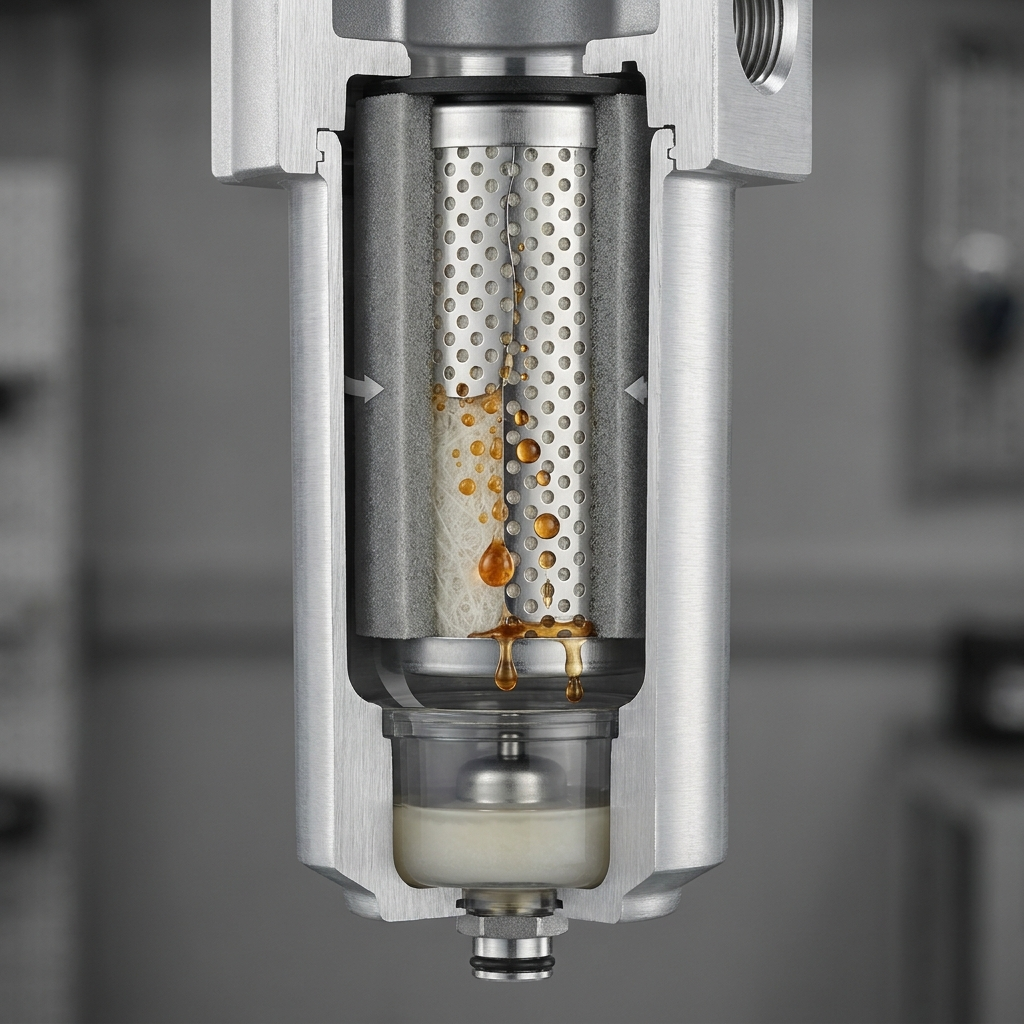
Oil in your air line shows up in the worst way. A blistered paint job. A pneumatic valve that gums up and sticks. A bed of desiccant that quit pulling moisture because it drowned in oil mist. Nine times out of ten the fix is a part most shops overlook until something downstream fails, the coalescing filter. If your compressor is oil lubricated and you care what comes out the other end, a coalescing air filter is not optional, it is the piece standing between your compressor's oil and everything you make.
What a coalescing air filter does
A regular particulate filter catches solid junk, rust flakes, pipe scale, dust. It does nothing for the fine oil mist a lubricated compressor throws into the air stream, and that mist is measured in droplets small enough to sail right through. A coalescing filter is built for exactly that problem.
The name tells you how it works. Air flows through a dense bed of fine media, usually from the inside out. The tiny oil and water droplets crash into the fibers, stick, and merge with other droplets. Coalesce just means they join together. Once enough small droplets combine into a big one, gravity takes over and it drains down to the bowl where a drain lets it out. What leaves the filter is air with the oil aerosol stripped out of it, down to a fraction of a part per million.
One thing to be clear about: a coalescing filter is not a water separator. It will pull out oil mist and fine water aerosol, but it is not made to handle slugs of liquid water. If you have bulk water in the line, knock that out first with a water separator, then let the coalescing filter do the fine work.
The grades, and the numbers that matter
Coalescing filters come in grades, and the grade is really two numbers: how fine a particle it stops, in microns, and how much oil it lets through, in parts per million. Here is how the common grades stack up.
| Grade | Particle removal | Oil carryover | Typical use |
|---|---|---|---|
| General purpose | Down to about 1 micron | Around 0.4 PPM | Prefilter, general shop air, protecting a dryer |
| High efficiency | Down to about 0.01 micron | Around 0.01 PPM | Paint, instruments, critical tools |
| Ultra high efficiency | Down to about 0.001 micron | Trace | Labs, food, medical, breathing air stages |
The mistake here is buying more filter than you need and then buying it wrong. A finer filter costs more, drops more pressure, and clogs faster if you throw it at dirty air with no prefilter in front of it. Match the grade to the job. Blowing off parts does not need lab grade air. Spraying a clear coat does.
Where a coalescing filter goes in your air system
Placement is where a lot of setups go sideways, so let me lay out the order that works. Coming off the tank, the air is hot, wet, and carrying oil mist. The standard train is aftercooler and separator first to drop the bulk water, then a general purpose coalescing filter as a prefilter, then your dryer, then a high efficiency coalescing filter to polish the air before it hits the drops.
Why a coalescing filter on both sides of the dryer? The prefilter protects the dryer. Oil mist that reaches a desiccant dryer soaks the desiccant beads and kills their ability to grab moisture, and once desiccant is oil fouled you are replacing it. Put a general purpose coalescing filter ahead of it and the dryer lives a long life. The high efficiency filter after the dryer catches anything fine that slipped through and delivers clean, dry air to the tools. Skip the prefilter and your expensive high efficiency element clogs in a fraction of its normal life, because it is doing two jobs instead of one.
When to change the element
A coalescing element does not last forever, and a plugged one quietly robs you. As it loads with oil and dirt, pressure drop across it climbs, and every PSI of drop is air pressure you paid to make and threw away. The two ways to know it is time:
Watch the pressure drop. Most good coalescing filters have a differential gauge or a pop up indicator. When the drop across the filter climbs past what the maker calls out, usually somewhere around 8 to 10 PSI, change the element. That gauge pays for itself in saved energy.
Go by time as a backstop. Even if the gauge looks fine, coalescing elements are usually rated for about a year of service because the media degrades whether it looks dirty or not. Once a year, swap it, drain and clean the bowl, and move on. It is a ten minute job that protects thousands of dollars of equipment downstream.
Ready to set yours up right? Match the grade to your work on our coalescing air filters collection, or see the full lineup of air filters if you need particulate and adsorption stages too.
Frequently Asked Questions
What does a coalescing filter remove?
It removes oil aerosol and fine water mist from compressed air, along with fine particulate. It works by merging tiny droplets into large ones that drain out. It is not built to handle bulk liquid water, so use a water separator ahead of it for that.
What micron rating do I need?
For general shop air and protecting a dryer, a general purpose element around 1 micron with about 0.4 PPM oil carryover is plenty. For paint, instruments, or critical tools, step up to a high efficiency element around 0.01 micron.
Where does a coalescing filter go, before or after the dryer?
Both, ideally. A general purpose coalescing filter goes before the dryer to protect it from oil, and a high efficiency coalescing filter goes after the dryer to polish the air. Bulk water separation comes first, ahead of everything.
How often should I change a coalescing element?
Change it when pressure drop across the filter climbs past the maker's limit, often around 8 to 10 PSI, and replace it at least once a year regardless, because the media degrades over time.
Is a coalescing filter the same as a water separator?
No. A water separator spins out bulk liquid water. A coalescing filter captures fine oil and water aerosol that a separator cannot catch. Most shops need both, in that order.
Bottom line: a coalescing air filter is the part that keeps compressor oil out of your paint, your tools, and your dryer. Match the grade to the job, put a prefilter ahead of the fine one, and watch the pressure drop, and your whole air system stays clean and cheap to run.


