


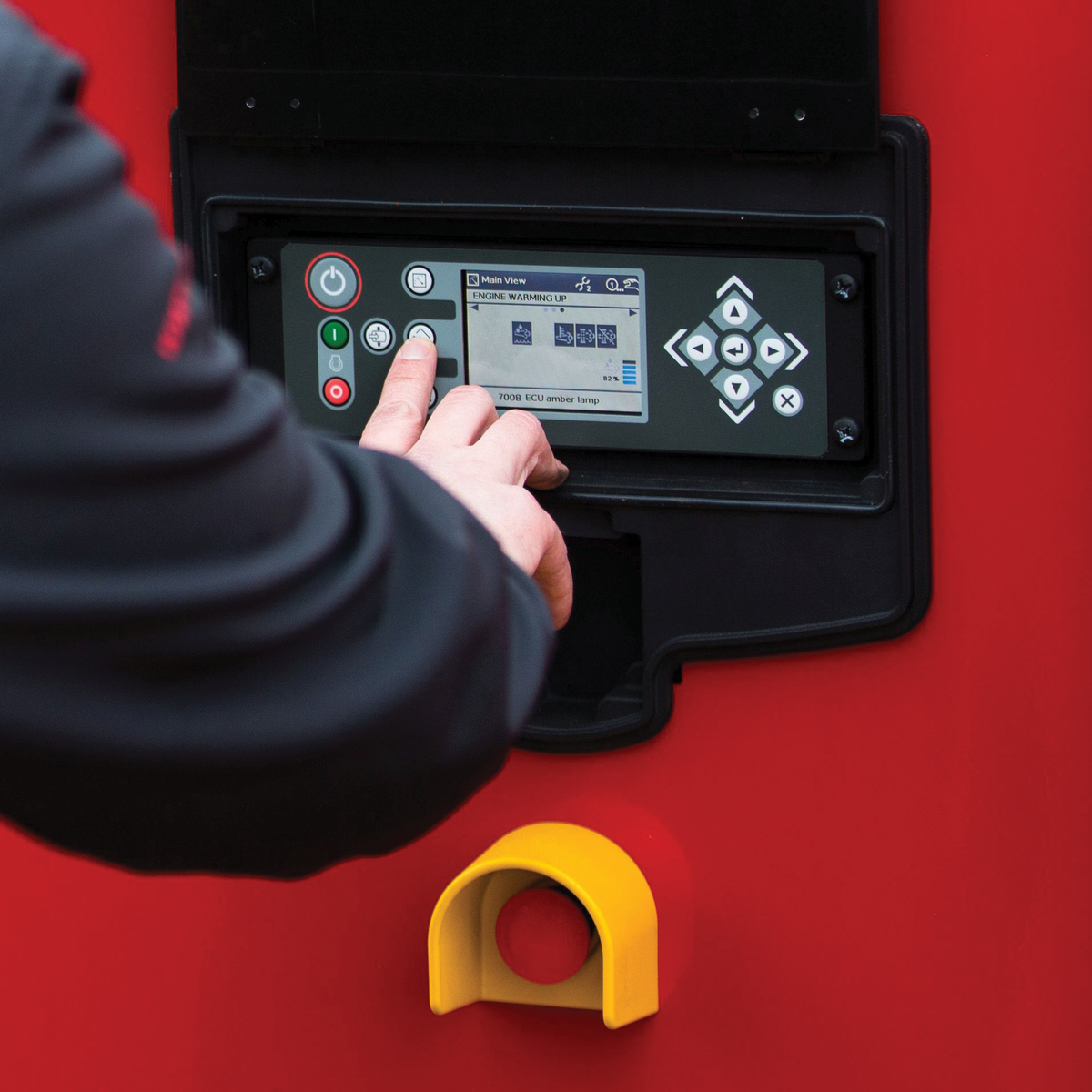
There is a screen on the front of your rotary screw that almost nobody reads past the pressure. Scroll one layer in and it is quietly keeping the most useful record anyone has of how your air system actually behaves.
An audit we have seen quoted makes the point better than any argument. A 20 horsepower machine was found running loaded 2 percent of the time and unloaded 26 percent. The owner had no idea, because the only number anyone ever looked at was discharge pressure, and discharge pressure was fine.
Learning to read air compressor controller data costs you twenty minutes and no money, and it will usually tell you something you were about to pay a consultant to find out.
The Three Hour Counters
Almost every screw compressor keeps at least two and usually three.
| Counter | What it counts | What it is for |
|---|---|---|
| Total run hours | Motor turning, loaded or not | Machine age, warranty, resale |
| Loaded hours | Actually compressing air | The number that matters for sizing |
| Service hours | Countdown to the next interval | Maintenance scheduling, usually resettable |
Divide loaded hours by total run hours and you have your load percentage. That one ratio answers more questions than anything else on the panel.
What Load Percentage Tells You
A fixed speed screw running at 70 to 90 percent load is close to its sweet spot. Outside that band, something is worth looking at.
- Above 90 percent sustained. You have little headroom. One tool added, one leak worse, or a hot week and you are below setpoint. Time to plan capacity rather than react to it.
- Between 70 and 90 percent. The machine is sized about right for the way you run.
- Between 40 and 70 percent. Oversized for most of the day. Worth looking at whether a smaller machine carries the base and the big one trims, or whether a variable speed unit fits. See when the variable speed premium pays back.
- Under 40 percent. Significantly oversized. An unloaded screw still draws roughly 15 to 35 percent of full load horsepower while producing nothing at all, so this is money leaving continuously.
That last figure is the one that surprises people. Unloaded is not free. A 50 horsepower machine sitting unloaded is still pulling the equivalent of something like 8 to 17 horsepower to spin an airend that is doing no work.
The Cycle Count Nobody Looks At
Many controllers log load and unload events, or let you watch them live. Stand in front of the machine for ten minutes with a stopwatch if yours does not.
If a fixed speed screw is loading for 30 seconds and unloading for 30 seconds, it is spending half its running time consuming power and making no air. That is a storage problem, not a compressor problem, and the fix is usually a receiver rather than a new machine. Our piece on sizing compressed air storage covers how much you need, and short cycling covers the diagnosis.
Rapid cycling is also mechanically expensive. Every load event is a pressure transient through the inlet valve, the minimum pressure valve and the separator, and motor starts on a machine that start-stops carry their own wear.
Temperature Trends Are an Early Warning
Discharge temperature on the panel is more useful as a trend than as a number. Write it down weekly, same time of day, same production conditions.
- Slow creep over months usually means heat transfer going away. Cooler fins fouling, a thermal valve starting to stick, oil past its life, or ambient conditions in the compressor room changing.
- A step change points at something specific. A fan, a blocked cooler, a restricted inlet.
- Seasonal swing is normal, and that is exactly why the trend matters more than the reading. A machine that runs 15 degrees hotter every August is telling you the room ventilation is marginal.
Most high temperature trips are not sudden. They are a trend somebody could have seen six weeks earlier. The overheating guide covers the causes once you see the creep.
Separator Differential Pressure
If your controller shows separator differential, that is the best replacement signal you have and it beats a calendar comfortably.
Differential rises as the element loads. Change on the manufacturer's differential threshold rather than on hours, because a clean environment stretches element life and a dirty one shortens it, and neither one knows what the calendar says. A loaded separator costs you energy continuously, because every psi of differential is pressure the machine has to make and then throw away.
The same logic applies to the inlet filter restriction indicator if you have one. Our guides on the air oil separator and the intake filter cover the thresholds.
Alarm and Warning History
Most controllers keep a log of faults and warnings, and most of them are never opened unless the machine is already down.
Read it on a slow Friday. What you are looking for is pattern, not the single event that stopped production.
- Repeated high temperature warnings that cleared themselves mean the machine is operating near the edge. The trip is coming.
- Low pressure warnings clustered at a time of day point at a specific load, not at the compressor.
- Motor overload or phase faults that have cleared are an electrical issue that has not finished happening yet.
- Dryer dew point alarms that come and go are usually ambient driven and tell you the dryer is undersized for summer.
A Twenty Minute Routine
- Write down total hours, loaded hours and service hours. Same day each month.
- Calculate load percentage for the month, not for the life of the machine. Divide the change in loaded hours by the change in total hours.
- Note discharge temperature and separator differential under normal production.
- Open the fault log and read everything since last month.
- Watch it cycle for ten minutes at a typical production moment.
Five lines in a notebook or a spreadsheet. After three months you have a trend, and after a year you have better data than most audits start with. If you want the deeper version, a proper compressed air audit adds flow and power logging, but you should know your own numbers before you pay for that.
What the Controller Will Not Tell You
Being straight about the limits, because this is not a substitute for measurement.
- It does not know your actual CFM. Loaded hours tell you how long it made air, not how much. For that you need a flow meter.
- It does not know your leak rate. Though a high load percentage at 2am with nobody in the building is a strong hint.
- It does not know pressure at the far end of the plant. Discharge pressure and point of use pressure can be twenty psi apart.
- It does not know your energy cost. It knows hours. You supply the rate.
One of those is worth doing tonight. Note loaded hours at the end of the shift, come back in the morning before anyone starts, and note them again. Whatever the machine loaded overnight with no production running is your leak load, measured for free.
Frequently Asked Questions
What is a good load percentage for an air compressor?
A fixed speed rotary screw running around 70 to 90 percent loaded is close to its efficient band. Sustained above 90 means you have no headroom and should plan capacity. Below about 40 percent the machine is significantly oversized, which matters because an unloaded screw still draws roughly 15 to 35 percent of full load horsepower while delivering no air at all.
How do I calculate load percentage from my compressor controller?
Divide loaded hours by total run hours. Do it on the change over a month rather than over the life of the machine, because lifetime figures average out every production change you have made since it was installed. Record both counters on the same day each month and work from the difference.
My compressor loads and unloads every thirty seconds. Is that bad?
Yes, on two counts. It is spending half its running time drawing power without producing air, and every cycle is a mechanical transient through the inlet valve, the minimum pressure valve and the separator. Rapid cycling is nearly always a storage problem rather than a compressor problem, and additional receiver capacity usually fixes it for a fraction of the cost of a new machine.
How often should I change the air oil separator?
On differential pressure rather than hours, if your controller shows it. The element loads at a rate set by your environment, not by the calendar, and differential is a direct measurement of how loaded it is. Every psi of differential is pressure the compressor makes and then discards, so a late change costs energy every hour it is left in.
Can I find my air leak rate from the controller?
Roughly, and for free. Note loaded hours at the end of a shift and again before anyone starts in the morning. Anything the machine loaded overnight with no production running is going into leaks. It is not a precise CFM figure, but it tells you quickly whether a leak survey is worth scheduling.
Where to Start
Go and write down five numbers: total hours, loaded hours, service hours, discharge temperature and separator differential. Then do it again in a month. Most of what an outside audit would tell you about sizing and cycling is already on that panel, and it has been recording while nobody watched.
Browse service kits for when the hours say it is time, or the receivers that fix a cycling problem. Send us your hour counts and what the machine is and we will tell you honestly whether it is sized right for you.


