


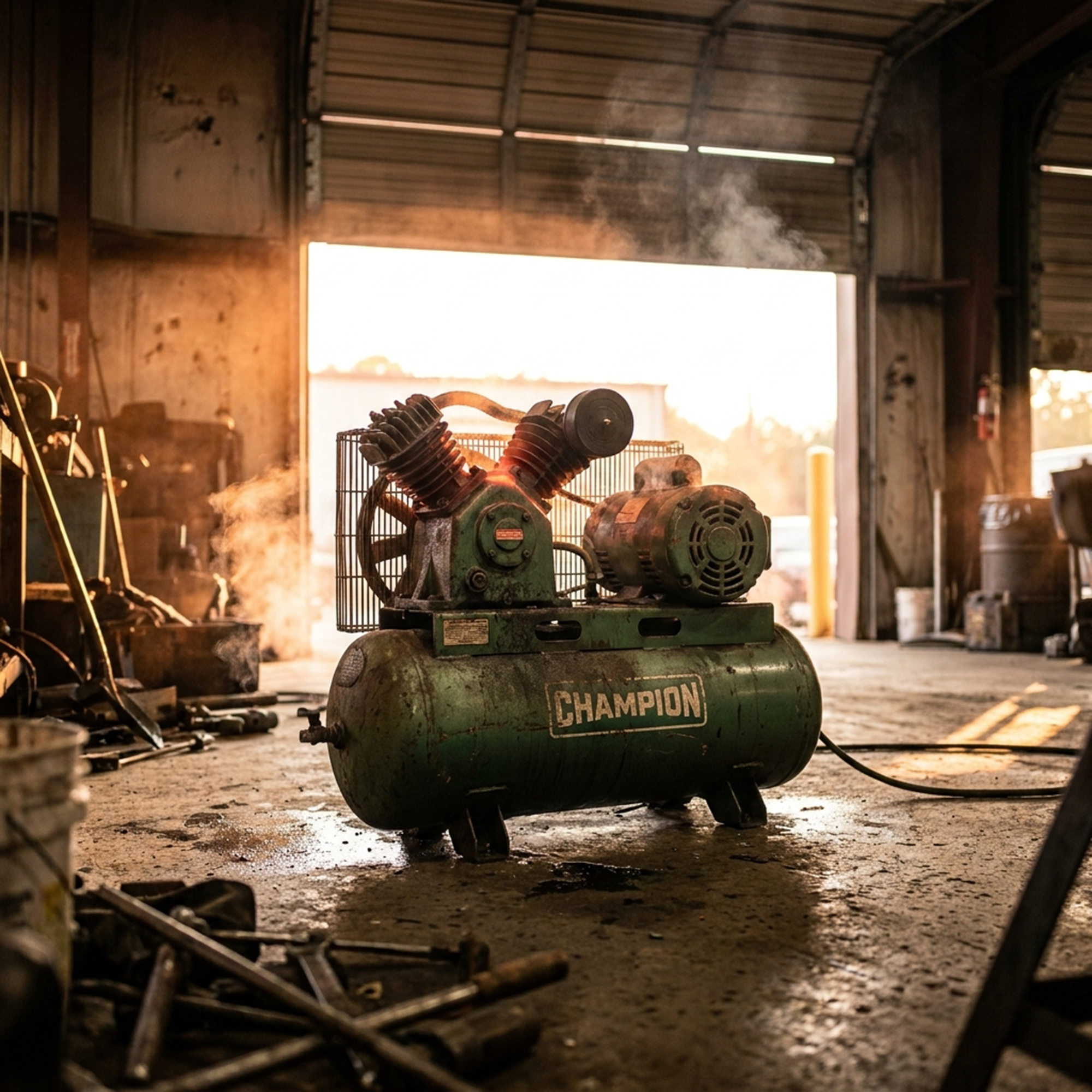
Your compressor was running fine, then it quit mid-job and will not restart for twenty minutes. Sound familiar? Nine times out of ten that is heat, and the machine is protecting itself. An air compressor overheating is not a random failure. It is the unit telling you something is wrong, and if you catch it early it is almost always a cheap fix. Ignore it and you can cook a pump or an airend, which is not cheap at all.
We field this call constantly, especially once summer hits and shop temperatures climb. The good news is that overheating traces back to a short list of causes, and you can work through them yourself with basic tools. Here is how to track it down.
First, understand what is actually happening
Most piston compressors have a thermal overload built into the motor. When the windings get too hot, it trips and cuts power so the motor does not burn up. Rotary screws use a high-temperature shutdown that does the same thing based on discharge air temperature. Either way, the machine shutting itself off is a safety feature, not the problem. The problem is whatever is making it run hot in the first place.
One quick tell: if the unit trips, sits for twenty or thirty minutes, and then restarts and runs normally, nothing is damaged yet. That is your window to fix the cause before it costs you a pump. If it trips again within a minute or two of restarting, stop running it and start diagnosing.
The usual causes of air compressor overheating
Work through these roughly in order. Most overheating comes from the first three.
1. Low or dirty oil
Oil does more than lubricate. It carries heat away from the moving parts. Low oil, old oil, or the wrong oil all let temperatures climb. Check the level first, because it is the easiest thing on the list. If the oil is dark, thin, or past its interval, change it. Use the oil your manufacturer specifies, never motor oil, and get the grade right. Our air compressor oil guide covers what to use and how often.
2. A clogged intake filter
A dirty intake filter chokes the air coming in, so the pump works harder and runs hotter to make the same pressure. A blocked filter can raise discharge temperature enough on its own to trip a shutdown on a hot day. This is a five-dollar fix that people overlook constantly. Pull the filter, hold it up to the light, and if you cannot see through it, replace it. Browse replacement air compressor filters to match your unit.
3. Poor ventilation and high room temperature
A compressor crammed into a hot corner with six inches of clearance is going to overheat, period. These machines dump a lot of heat, and they need room to breathe and cool air to pull in. The same unit that runs all day in a 70-degree ventilated space will trip constantly in a 110-degree closet. Give it clearance on all sides, add a fan or a vent if the room runs hot, and keep it out of direct sun.
4. Blocked or dirty cooling fins
Piston pumps and rotary screw coolers shed heat through fins, and fins pack with dust, oil mist, and shop grime. Once they are coated, they cannot release heat. Blow them out with compressed air and wipe off the oily film. On a rotary screw, a clogged oil cooler is a classic cause of high-temperature shutdowns.
5. Failed thermal or bypass valve (rotary screw)
Rotary screws use a thermostatic valve to route oil through the cooler once it warms up. If that valve sticks, oil skips the cooler and temperature runs away. This one is less common and a bit more involved, but it is a known culprit when the easy stuff checks out.
6. Overworking a compressor that is too small
If the unit runs nonstop because it cannot keep up with your air demand, it never gets a chance to cool. That points to a sizing problem, not just a heat problem. A piston compressor run past its duty cycle will overheat as a matter of course. If yours never shuts off, you may need a bigger unit or one built for continuous duty.
A simple diagnostic sequence
| Step | Check | Fix if wrong |
|---|---|---|
| 1 | Oil level and condition | Top up or change with the correct oil |
| 2 | Intake filter | Clean or replace |
| 3 | Clearance and room temperature | Add space, add a fan, vent the room |
| 4 | Cooling fins and cooler | Blow out dust, wipe off oil film |
| 5 | Cooling fan turning freely (screw units) | Free or replace the fan |
| 6 | Thermal / bypass valve (screw units) | Test and replace if stuck |
| 7 | Duty cycle vs demand | Right-size the compressor |
Run through those top to bottom and you will catch the cause the vast majority of the time. Most overheating cases end at step one, two, or three.
How to keep air compressor overheating from coming back
Prevention is mostly the maintenance you should already be doing. Change the oil on schedule, keep the intake filter fresh, blow out the cooling fins, and give the unit room and airflow. A steady routine catches the small stuff before it turns into a hot-day shutdown, and our maintenance schedule lays out exactly what to do and when.
Heat and moisture also travel together. A compressor running hot pushes hot, wet air into your lines, which then dumps water downstream. An aftercooler knocks that discharge temperature down and drops out a lot of the moisture before it reaches your tools, which helps both your air quality and your heat load. If your air compressor overheating problem comes with water in the lines, cooling the air is doing double duty.
One more thing. If the unit trips and will not build pressure afterward, heat may not be the whole story. Our guide on an air compressor that will not build pressure walks through that separate set of causes.
Frequently Asked Questions
Why does my air compressor shut off when it gets hot?
A thermal overload or high-temperature switch is cutting power to protect the motor or airend from heat damage. It is a safety feature. The fix is to find why the unit is running hot, usually low or dirty oil, a clogged intake filter, or poor ventilation, and correct that so the switch stops tripping.
Is it normal for an air compressor to get hot?
Warm is normal. Compressing air makes heat, so the pump and discharge lines will be hot to the touch during use. Too hot to keep your hand near, along with repeated shutdowns or a burnt smell, is not normal and means something needs attention.
Can I damage my compressor by letting it overheat?
Yes. Repeated overheating breaks down the oil, wears the pump or airend faster, and can eventually seize or burn out the unit. The shutdown protects you in the short term, but running a compressor that keeps tripping will cause real damage over time. Fix the cause rather than resetting and running again.
How long should I let an overheated compressor cool down?
Give it at least twenty to thirty minutes with the power off before restarting. If it runs fine after cooling, use that window to find and fix the cause. If it trips again within a minute or two, stop and diagnose before running it further.
Does room temperature really affect overheating?
A great deal. A compressor pulls in and is cooled by the surrounding air, so a hot, cramped room raises operating temperature significantly. The same unit that runs all day in a cool, ventilated space can trip constantly in a hot closet. Clearance and airflow are among the cheapest fixes there are.
The bottom line
An air compressor overheating is usually a simple problem waving a red flag. Check the oil, check the intake filter, and give the machine room to breathe, and you will solve most cases in an afternoon. Stay on top of maintenance and cooling and it will not come back. If your hot-running unit is also dumping water into your lines, an aftercooler is worth a look to tackle both at once.


