


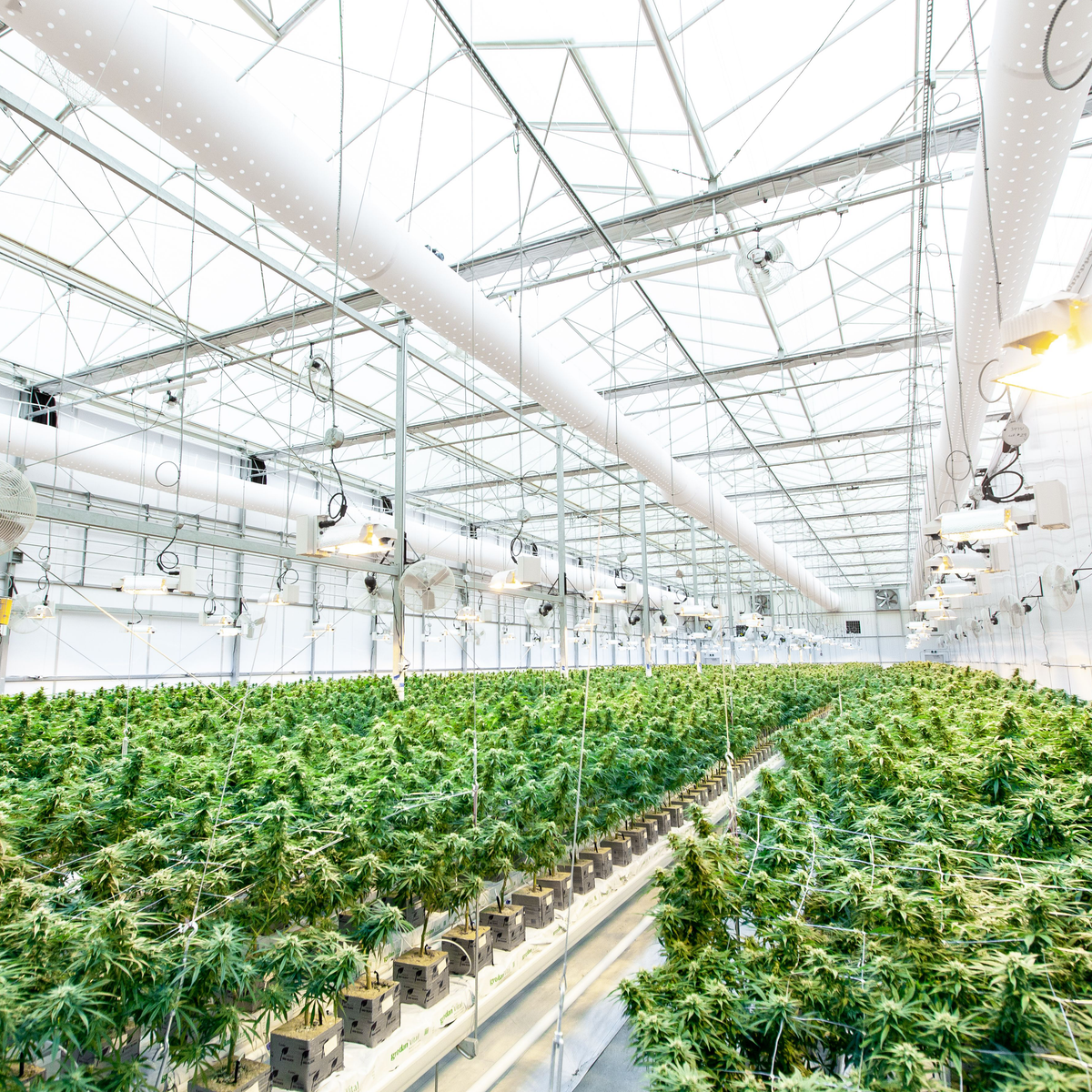
A cultivator calls because the bucker in the trim room keeps bogging down in the afternoon. The machine is fine. The compressor is a 5 HP piston sitting in the corner of a flower room that runs 75 degrees and 55 percent humidity, and by two o'clock it has been running near continuously for four hours, pushing hot wet air down a half inch line to a machine that wanted dry air at 90 psi. There is standing water in the drop. The vendor will tell you to buy a bigger compressor. The actual problem is where that compressor is breathing.
That is the signature mistake with compressed air for cannabis facilities. These buildings are deliberately warm and humid on purpose, for the plants, and then somebody puts an air compressor inside that environment and is surprised by what comes out the other end.
Four Rooms, Four Different Requirements
A cannabis operation is not one air system. It is four, and they rarely get designed together.
| Area | What air does there | What it needs |
|---|---|---|
| Cultivation | Pneumatic valves on fertigation, dosing pumps, blow-off, light movers | Small flow, but reliable and dry. The room fights you on dry. |
| Harvest and trim | Buckers, trimmers, destemmers, blow-off, pneumatic conveying of biomass | The biggest continuous load in most facilities |
| Extraction lab | Valve actuation, diaphragm pumps, vessel pressurization, vacuum ovens | Clean, dry, and usually inside a classified area |
| Packaging and vault | Fillers, cappers, labelers, and nitrogen flush | Product contact air quality, plus a nitrogen supply |
One compressor can serve all four. What cannot be shared is the treatment, because the extraction lab and the packaging line care about things the trim room does not.
The Grow Room Humidity Problem, Which Is Yours Alone
Every compressor concentrates whatever moisture is in the air it inhales. That is just physics. In a machine shop at 40 percent relative humidity it is an annoyance. In a cultivation facility deliberately held at 50 to 60 percent and 75 to 80 degrees, it is a flood. A 10 HP machine working hard in those conditions can put several gallons of liquid water a day into your lines.
Three fixes, in order of how much they buy you:
- Put the compressor outside the conditioned envelope. A mechanical room, a lean-to, a dedicated closet with its own ventilation. Not the flower room, not the dry room, not the trim room. This is free at design time and expensive later.
- If it has to live inside, duct the intake out. Pull makeup air from outside or from the driest space in the building. You are also doing the HVAC a favor, because that compressor is rejecting its entire input power into a room somebody is paying to cool.
- Then size the dryer for the real inlet conditions. Dryer capacity ratings assume a reference inlet temperature. Feed one hot, humid air and its actual capacity drops well below the nameplate. Oversize deliberately.
For most facilities a refrigerated dryer to roughly a 38 degree F pressure dew point is the right call, because everything stays inside a heated building. You only need desiccant if a line runs through an unconditioned space or feeds a cold room. Our air dryers category covers both, and refrigerated vs desiccant air dryer walks the choice.
Sizing: The Trim Room Writes the Check
Harvest is where the compressor earns its living. Everything else is intermittent. A trim room in production is a continuous duty load for eight or ten hours at a stretch, which is exactly the duty cycle that kills piston compressors.
| Equipment | Typical demand | Notes |
|---|---|---|
| Pneumatic bucker or destemmer | 3 to 8 CFM at 90 to 100 psi | Use the data plate, these vary a lot by maker |
| Blow-off gun at a sorting table | 4 to 10 CFM while open | Biggest hidden draw in the building |
| Fertigation and dosing valve actuation | Under 1 CFM average | Tiny flow, but it cannot be allowed to fail |
| Diaphragm pump, extraction lab | 3 to 8 CFM | Check duty, some run nearly continuously |
| Packaging line actuators | 2 to 6 CFM | Spiky, wants local storage |
| Nitrogen generator feed air | Varies widely with purity | See below, this is the one people forget |
A single room operation with one bucker and a couple of blow-off guns is honestly a 7.5 HP machine. A multi-room facility running harvest in parallel with packaging usually lands at 10 to 20 HP, and at that scale a rotary screw is the cheaper machine over five years because it is built for continuous duty and it will not carry oil into your product stream the way a hot, over-cycled piston does.
Nitrogen Is the Part Nobody Budgets For
Two places cannabis facilities use nitrogen, and both are growing:
- Flush packaging. Displacing oxygen in the headspace slows oxidation, which is what degrades cannabinoids and terpenes on the shelf. Most packaging flush applications are satisfied in the 99 to 99.5 percent purity range.
- Vacuum oven purge and vessel blanketing in extraction. Higher purity, usually 99.9 percent or better, at low flow.
The thing to understand before you buy: a nitrogen generator is not a nitrogen source, it is an air separator. It runs on compressed air, and the feed air ratio climbs steeply with purity. Going from 99 percent to 99.9 percent can multiply the compressed air you need for the same nitrogen output. Facilities buy the generator, bolt it onto an already-maxed compressor, and wonder why the packaging line started starving the trim room.
Spec the purity you actually need for each use, not the highest number on the brochure, and add the generator's feed air to your compressor load list before you size anything. Browse nitrogen generators and read nitrogen generators: make your own N2 from compressed air for the payback math against renting cylinders, which is where most facilities start and most facilities overpay.
The Extraction Lab and the Classified Area
If you run closed loop hydrocarbon extraction with butane or propane, your extraction room is very likely a classified area under NEC Article 500, typically Class I Division 1 or Division 2 depending on the engineering evaluation, with ventilation, gas detection and equipment ratings to match. Your fire marshal and your professional engineer determine the classification. We do not, and neither does any equipment vendor.
Where compressed air comes into it: inside a classified room, an ordinary electric motor is a problem. Air motors have no electrical ignition source, which is why pneumatic drives show up on mixers, agitators, pumps and hoists in these rooms. That is a genuine advantage and it is why the oil and gas industry has used them for decades, covered in air motors: when air beats an electric motor.
Be clear about the limits, though. Pneumatic does not mean automatically compliant. Static bonding and grounding still apply, the exhaust still has to go somewhere acceptable, and the installation still has to be approved by the authority having jurisdiction. Buy the air motor because it solves the ignition source problem, not because somebody told you it exempts you from an engineering review.
Ethanol and CO2 extraction change the picture. Ethanol is still flammable and usually still classified. Supercritical CO2 is not flammable, so the room classification question largely goes away, but you have a high pressure vessel and an asphyxiation hazard instead.
What we do not sell, plainly
We sell compressors, dryers, filtration, receivers, air motors and nitrogen generators. We do not sell extraction equipment, CO2 enrichment systems for grow rooms, bulk CO2, grow room HVAC or dehumidification, or the gas detection and ventilation packages your classified room needs. If somebody quotes you all of that on one piece of paper, read it twice. We can spec the air and nitrogen side and tell you honestly where our scope ends.
Air Quality: There Is No Federal Standard, So Pick One
This part is genuinely different from food or pharma, and it is worth being straight about. Because cannabis remains federally illegal in the United States, there is no FDA or USDA compressed air framework over it. State regulations vary widely and most say nothing about compressed air specifically.
That does not mean the question goes away. It means you choose the standard, and increasingly your buyers and your state testing regime make the choice for you in practice. The sensible approach is to borrow from food practice: treat any air that touches product or product contact surfaces as food grade air, and leave the rest at general industrial quality.
| Where the air goes | Sensible target |
|---|---|
| Buckers, trimmers, general shop | Dried and filtered, roughly ISO 8573-1 Class 1.4.2 |
| Blow-off on product, packaging line, nitrogen feed air | Add a coalescing stage and activated carbon, roughly Class 1.4.1 |
| Extraction lab actuation | Dry and clean, keep moisture out of valve pilots |
Two reference pieces worth reading: ISO 8573-1 air quality classes, decoded and food grade compressed air. An oil-free compressor removes the oil question entirely for product contact air, which some operators find worth the premium purely for how it reads in an audit.
What Facilities Get Wrong
- Compressor inside the conditioned space. You pay twice: once in water in the lines, once in cooling load you did not need.
- Buying the nitrogen generator without checking the feed air. The generator is only half the purchase.
- Specifying 99.999 percent nitrogen for packaging flush. You will pay for that purity in compressor horsepower every hour, forever, for no shelf life benefit.
- A piston compressor on a production trim room. Pistons are typically honest for a 50 to 75 percent duty cycle and harvest will hold you above it all day.
- Blow-off guns zip tied open. Ten CFM of continuous loss is a third of a 10 HP machine, spent on nothing.
- No local receiver at the packaging line. Then blaming compressor size when the filler stutters during a run.
- Assuming pneumatic equals explosion proof. It removes one ignition source. It does not replace an engineering evaluation.
Frequently Asked Questions
What size air compressor does a cannabis facility need?
Harvest sets the number. A single room operation with one bucker and a couple of blow-off guns is usually a 7.5 HP machine. A multi-room facility running harvest alongside a packaging line typically lands between 10 and 20 HP, and a rotary screw is the better buy at that scale because trim rooms are a continuous duty load.
Why is there so much water in my air lines?
Almost certainly because the compressor is breathing cultivation air. A building held at 50 to 60 percent relative humidity and 75 degrees for the plants hands the compressor far more moisture than a normal shop would. Move the machine outside the conditioned space or duct its intake out, then size the dryer for real inlet conditions rather than the nameplate rating.
Do I need a nitrogen generator or should I keep renting cylinders?
Depends on volume and purity. A generator stops the cylinder rental, delivery and demurrage cycle and pays back on steady usage, but it runs on your compressed air, and the feed air requirement climbs sharply as you ask for higher purity. Spec the purity each application truly needs, then add the generator's feed air to your compressor load before deciding.
Can I use air powered equipment in a C1D1 extraction room?
Air motors are commonly used in classified areas precisely because they have no electrical ignition source, and that is a real advantage over an ordinary electric motor. It is not a compliance shortcut. Bonding and grounding, exhaust routing, ventilation, gas detection and the overall classification are determined by your engineer and your authority having jurisdiction.
Is there a compressed air standard for cannabis?
Not a federal one, because cannabis remains federally illegal in the United States, so the FDA and USDA frameworks that govern food and pharmaceutical air do not apply. State rules vary and most are silent on compressed air. The practical approach is to borrow food practice: treat product contact air as food grade, and leave the rest at general industrial quality.
Where to Start
Walk the building and answer two questions. Where is the compressor breathing from, and what is the trim room actually pulling during harvest? Those two answers solve most of what goes wrong. After that, if nitrogen is in your future, work out the feed air before you sign for the generator. Getting compressed air for cannabis operations right is mostly about location and honest load math, not about buying more horsepower.


