


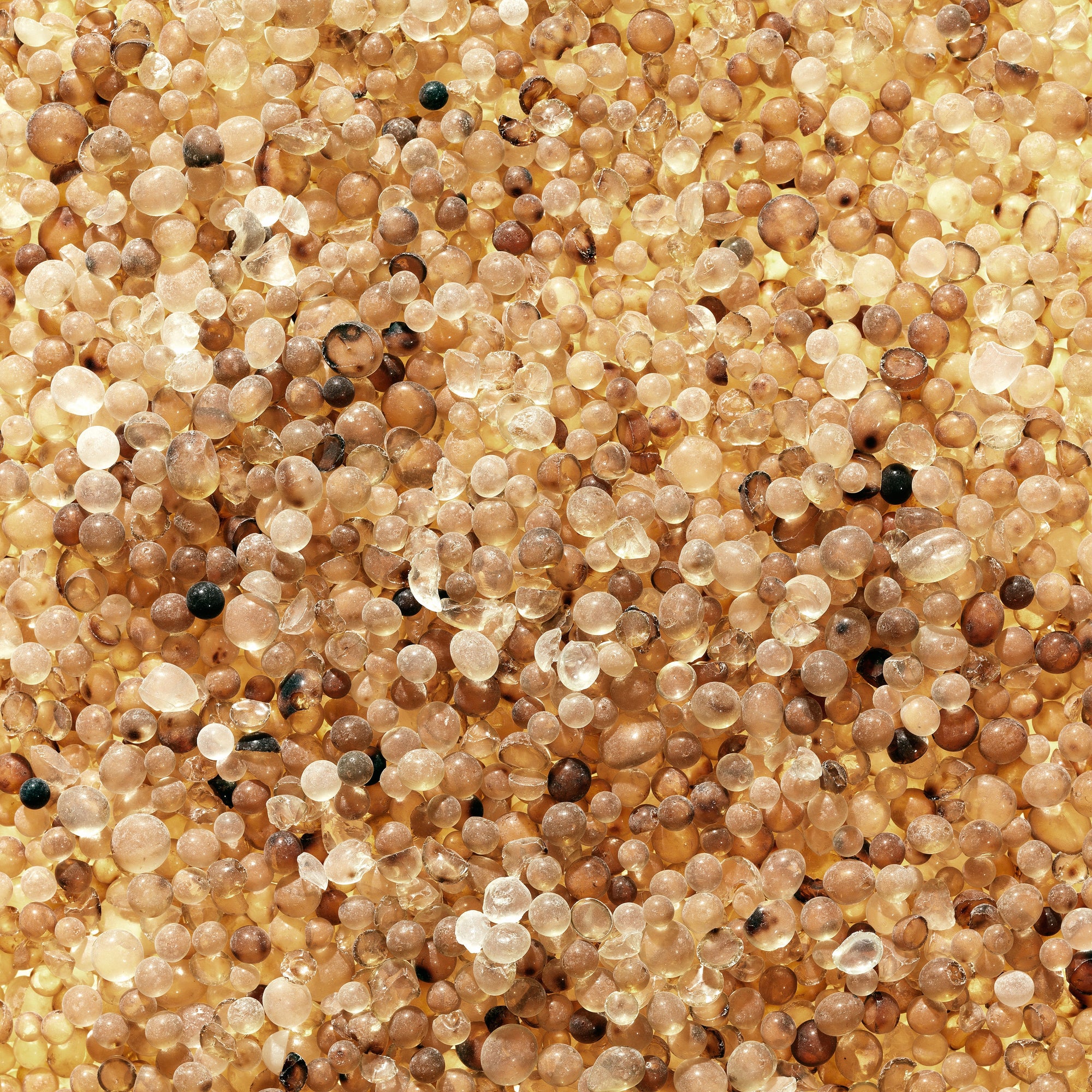
Somebody ordered replacement desiccant by the pound last week, picked the cheapest listing, and dumped it into a dryer that had been holding a minus 40 dew point for years. Now it holds about minus 10 and he thinks the dryer is broken.
The dryer is fine. He put the wrong beads in it. The desiccant types used in compressed air dryers are not interchangeable, and the one you pick sets the floor on how dry your air can get, no matter how good the vessel and valves are.
Three materials do almost all the work
Walk into any plant and the desiccant in the towers will be one of three things, or a layered combination of them.
Activated alumina
A highly porous aluminum oxide. This is the workhorse of general industrial compressed air drying and what most heatless dryers ship with. It handles moderate to low dew points, tolerates liquid water contact better than the alternatives, and it's the cheapest of the three per pound of real capacity.
Under normal conditions activated alumina will get you into the minus 40 range comfortably, and under good conditions somewhat lower. Push it toward the extremes and its capacity falls off.
Silica gel
High capacity by weight, and cheap. At full saturation silica gel holds 30 to 40 percent of its own weight in water, which is more than the others, so it's attractive where you have a lot of moisture to grab and you don't need extreme dryness.
The catch is that silica gel is the most vulnerable to liquid water. Slug a bed of standard silica gel with liquid and the beads can fracture and turn to dust, which then packs down, channels the airflow, and migrates downstream. If your separator and prefilter are not doing their job, silica gel will tell you about it in an expensive way.
Molecular sieve
A synthetic zeolite with a precisely sized pore structure, usually 3A for compressed air work. This is the specialty material, and it does one thing far better than the others: it holds onto water at very low concentrations and at elevated temperature.
Molecular sieve routinely reaches minus 100 F pressure dew points and can go lower, into the single digit parts per million. Activated alumina generally tops out around minus 75 F even under ideal conditions. Below roughly 100 ppmv of moisture, alumina's capacity drops off sharply while 3A sieve keeps working at close to full capacity. Sieve also holds meaningful water loading at 200 F where alumina has essentially given up.
Side by side
| Activated alumina | Silica gel | Molecular sieve 3A | |
|---|---|---|---|
| Practical dew point | To about minus 40 F, minus 75 F at best | Moderate, higher dew points | Minus 100 F and below |
| Water capacity by weight | Moderate | Highest, 30 to 40 percent | Lower, around 21 percent |
| Liquid water tolerance | Good | Poor, beads can shatter | Moderate |
| Performance when hot | Drops off | Drops off | Holds capacity |
| Regeneration energy | Lower | Lower | Highest |
| Cost per pound | Low | Lowest | Highest |
Notice the tradeoff in the capacity row. Molecular sieve holds less total water than the others but holds it far more tightly. That's the whole point of it. High capacity is useful when you have bulk moisture to remove. Tight binding is what gets you to a very low dew point.
Which one belongs in your dryer
Pick off the dew point your process actually needs, not the lowest number available.
- General shop and plant air, minus 40 F target. Activated alumina. This covers the large majority of heatless desiccant air dryers in service and there's no reason to spend more.
- Bulk moisture removal, moderate dryness. Silica gel, provided your upstream separation is solid.
- Minus 100 F and below, instrument air, breathing air, gas generation feed. Molecular sieve, or a layered bed.
- Warm inlet air you can't fix. Molecular sieve holds up where the others fade.
Layered beds are common and they're not a compromise
A lot of low dew point dryers use a layer of activated alumina at the inlet end and molecular sieve after it. The alumina takes the brunt of the incoming moisture and shields the sieve from liquid carryover, and the sieve polishes the air down to the target dew point. You get the durability of one and the performance of the other, and you use less of the expensive material.
If you're recharging a layered dryer, the layers and their proportions matter. Dumping one homogeneous material into a vessel designed for two layers will not give you the original performance.
What ruins any of them
Desiccant does not really wear out from adsorbing and releasing water. It gets killed by things that should never have reached it.
Oil. The big one. Oil coats the pore structure and it does not come off during regeneration. A single failed coalescing filter element can poison a full charge of desiccant, and no amount of extra regeneration time brings it back. This is why a desiccant dryer needs a proper coalescing filter ahead of it, maintained on schedule.
Liquid water slugs. Hardest on silica gel, but bad for all of it. Attrition from wet beads creates dust, dust creates channeling, and channeling means air finds a path through the bed without being dried.
Mechanical attrition. Fast pressurization and depressurization grinds beads against each other. If your dryer's repressurization is too aggressive, you'll find dust in the outlet filter and your bed will settle.
Overheating during regeneration. On heated units, running the regen temperature above what the material is rated for damages the structure permanently.
An afterfilter downstream is not optional either. Beds shed some dust no matter how careful you are, and you do not want alumina fines in your instruments.
Before you order replacement beads
Check the dryer's manual or nameplate for what it was designed to hold, including layer configuration and total charge weight. Match the material and the bead size, because bead diameter affects pressure drop and flow distribution through the tower. Then look at why the old charge died. If it was oil fouled, replacing the desiccant without fixing the filtration is throwing money away twice.
Getting the desiccant types right is cheap insurance on a dryer that probably cost real money. Match the material to your dew point target, keep oil and liquid water out of it, and a charge will last you years.
Frequently Asked Questions
Can I use silica gel instead of activated alumina in my air dryer?
Sometimes, but not as a straight swap if you need a low dew point. Silica gel holds more water by weight and costs less, but it does not reach the dew points alumina does and it is much more easily damaged by liquid water. Check what your dryer was designed for before substituting.
What desiccant gives the lowest dew point?
Molecular sieve, typically 3A for compressed air. It routinely achieves minus 100 F pressure dew points and can go into the single digit ppm range, where activated alumina generally tops out near minus 75 F under ideal conditions.
Why does molecular sieve hold less water but dry better?
Total capacity and binding strength are different properties. Molecular sieve has lower water uptake by weight, around 21 percent, but its uniform pore structure holds water molecules very tightly even at very low concentrations and elevated temperatures. That tight binding is what produces an extremely low dew point.
Does oil ruin desiccant?
Yes, and permanently. Oil coats the internal pore structure and regeneration does not remove it, so capacity is lost for good. A properly maintained coalescing filter upstream of the dryer is the only real protection, and a failed element can poison an entire charge.
Can I mix desiccant types in one tower?
Layered beds are a standard design, usually activated alumina at the inlet with molecular sieve after it, so the alumina absorbs the bulk moisture and protects the sieve. But the layers and their proportions are engineered. Do not improvise a mix, and match the original configuration when recharging.


