


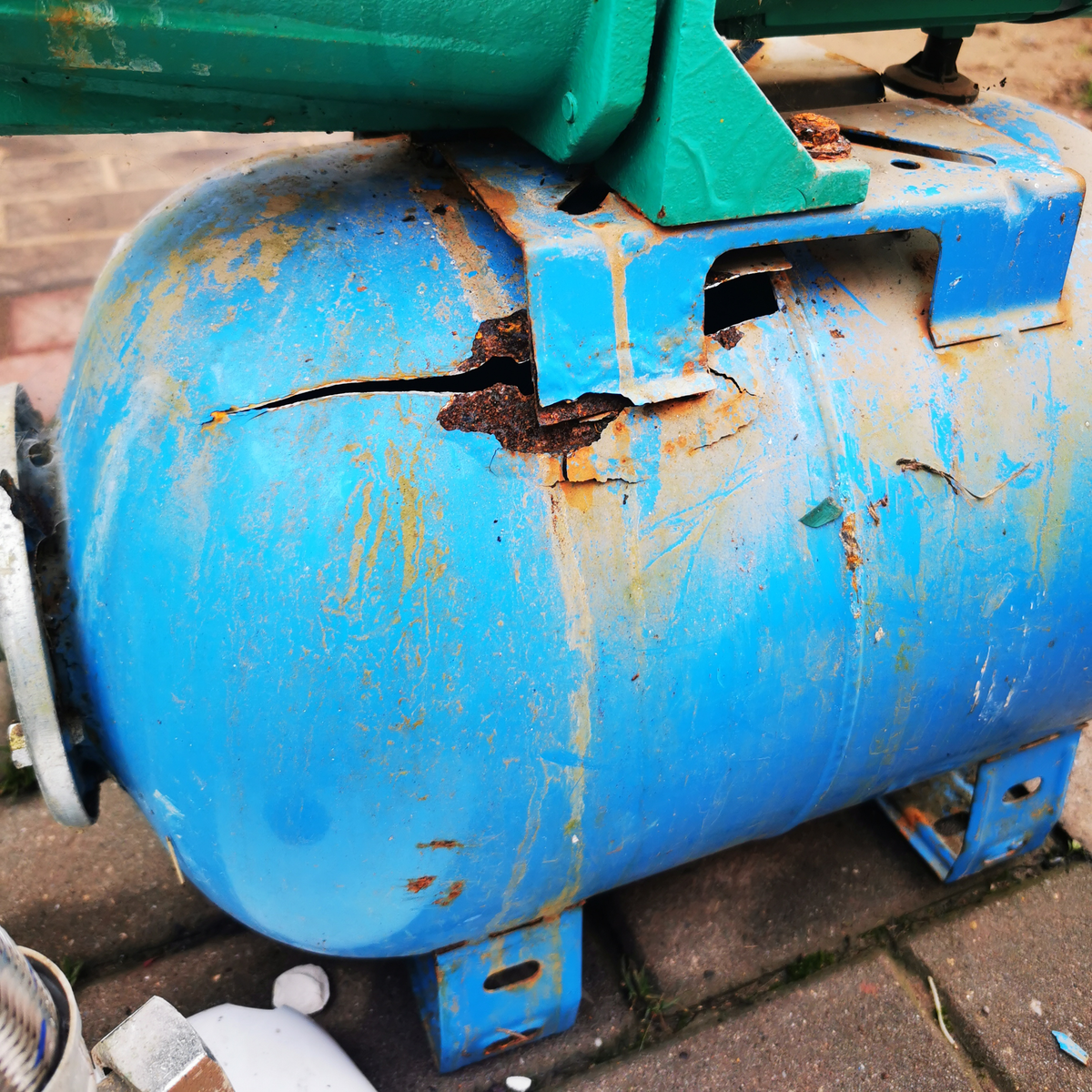
The scary part about a rusted air receiver is that it looks fine. Paint's good, no drips, holds pressure all day. Meanwhile the bottom third of the shell has been sitting in a puddle of acidic condensate since the Clinton administration, and the steel that's supposed to be a quarter inch thick is now considerably less than that.
Air compressor tank rust is an inside job. That's what makes it dangerous, and it's why "it looks okay" is not an inspection.
Where the Water Comes From
Your compressor pulls in ambient air, and ambient air carries water vapor. Compressing it squeezes that vapor into a much smaller volume, so the air comes out of the pump saturated and hot. As it cools in the tank, the water drops out as liquid. A 5 HP compressor in a humid shop can make a couple of gallons of condensate a day.
Most of it should leave through the drain. What doesn't leave sits in the bottom of the tank, mixed with a little carryover oil and whatever came in through the intake filter. That mixture is mildly acidic, and it attacks the steel from the inside along the bottom of the shell and around the drain boss. There is no coating in a standard receiver protecting you from it.
Two things make it worse fast. One is never draining. The other is draining only occasionally, which lets the wetted surface go through repeated wet-dry cycles, and wet-dry cycling corrodes steel faster than steel that stays submerged.
How to Actually Inspect a Tank
Do this with the tank fully depressurized. Not "mostly." Fully, gauge at zero, drain open.
1. Read the data plate
You want the ASME code stamp, the National Board number, the maximum allowable working pressure, and the year built. No ASME stamp on a tank in a commercial workplace is a problem on its own in most jurisdictions, separate from any rust question. If the plate is gone or unreadable, the tank is effectively unrated and should be retired.
2. Look outside, carefully
You're hunting for bulges, dents, weld seam cracks, and rust that has broken through the paint. Pay attention to:
- The bottom of the shell, especially where it sits in the saddles or on the feet, because water collects there on the outside too
- Around the drain fitting, which is the single most common failure location
- Any place a bracket, foot, or compressor mount is welded to the shell
- Under the pump on a tank-mount unit, where oil and dirt hide the steel
Blistered or flaking paint over a soft spot is not cosmetic. That is metal loss pushing the paint off.
3. Look inside
Pull the drain valve out entirely, or if the tank has an inspection port, open it. Get a borescope or a cheap inspection camera in there, or at minimum a flashlight and a mirror. What you want to see is a light even film of surface oxide. What you don't want is heavy scale, pitting you can catch a fingernail in, or flakes falling off when you tap the shell.
Blow the loose scale out and look again. Deep isolated pits are worse news than uniform light rust, because pitting concentrates the loss in one spot and that spot is where it lets go.
4. Measure, if it matters
If the tank runs a critical process, or it's over about twenty years old, or you found real pitting, get an ultrasonic thickness reading. A UT gauge measures remaining wall thickness without cutting anything, and any decent tank shop or boiler inspector has one. Compare it to the original thickness. When remaining wall drops below the code minimum for that vessel's MAWP, the tank is finished. Not repairable. Finished.
What a Hydrostatic Test Proves, and What It Doesn't
A hydrostatic test fills the vessel completely with water and pressurizes it above working pressure while inspectors watch for leaks and permanent deformation. Water is nearly incompressible, so if the vessel fails during the test it splits rather than explodes. That's the whole point of using water instead of air.
What it proves: the tank held that pressure today, and there is no through-wall leak.
What it doesn't prove: that the tank has meaningful life left. A vessel that's lost forty percent of its wall can pass a hydro and still be a bad bet. That's why a thickness reading tells you more about remaining life than a pressure test does. Use hydro as a pass/fail gate and UT as the real decision tool.
One firm rule: never pressure test a suspect tank with compressed air. Air stores enormous energy. A tank that fails on air does not leak, it comes apart, and people have been killed by it.
Replace It When Any of These Are True
| Finding | Verdict |
|---|---|
| Any bulge, blister, or visible deformation of the shell | Replace, do not repair |
| Crack in a weld seam or in the shell | Replace |
| Measured wall below code minimum for the MAWP | Replace |
| Deep pitting or heavy flaking scale inside | Replace |
| Weeping or leaking at the drain boss | Replace |
| Failed hydro test | Replace |
| No ASME stamp, used commercially | Replace |
| Data plate missing or illegible | Replace |
| Previously welded or patched shell | Replace, unless the repair was done by a certified R-stamp shop and documented |
That last line trips people up. Welding a patch on a pressure vessel is not a job for the guy who welds your trailer hitches. Pressure vessel repair requires a National Board R stamp and documentation, and outside of that, welding on a receiver makes it scrap. Grinding out a pit and filling it with weld changes the metallurgy around the repair and does not restore the design.
The good news is that a receiver is one of the cheaper things in a compressed air system. A new ASME air receiver tank costs a fraction of a compressor, and it's the one component where there is no upside to gambling.
Making the Next Tank Last Thirty Years
A properly drained ASME receiver routinely lasts three decades. Here's how they get there:
- Automatic drain, not a manual petcock. Manual draining depends on somebody remembering, every day, forever. They won't. A timer drain or a zero-loss electronic drain removes the human. This is the single highest-value thing on this list, and a drain valve upgrade is cheap.
- Dry the air ahead of the tank. An aftercooler and separator knock out most of the moisture before it ever reaches the receiver. Adding a dryer keeps it out of the rest of your piping too.
- Pitch the tank toward the drain. A horizontal tank sitting dead level holds water across the whole bottom. A slight slope toward the drain end means the drain actually gets it all.
- Drain a vertical tank from the true bottom. Sounds obvious. Plenty of vertical receivers are plumbed with the drain teed off a side port an inch up, and that inch of standing water never leaves.
- Keep the intake filter clean. Dust and abrasives pulled through the intake end up in the tank sludge and accelerate the pitting.
- Put an inspection on the calendar. Annual external look, internal borescope every three to five years, UT at twenty years and then periodically after. Write it down somewhere that survives staff turnover.
Frequently Asked Questions
How long does an air compressor tank last?
A well-maintained ASME receiver that gets drained regularly and sees dry air can run 30 years or more. One that is never drained can be structurally compromised in under 10. Age alone is not the criterion, condition is, but past about 20 years it is worth paying for a thickness reading rather than guessing.
Can I sandblast the inside and coat it?
Some shops do this on large receivers and it can slow further corrosion, but it does not put back steel that is already gone. Coating a tank that has already lost significant wall just hides the problem behind a nice-looking surface. Measure the wall first. If the thickness is good, a coating is a reasonable life extension. If it is not, coating it is money spent on a vessel that still needs replacing.
Is a little surface rust inside normal?
Yes. Every carbon steel receiver that has ever held compressed air has a light oxide film inside. What matters is the difference between a uniform brown film and scale you can flake off with a screwdriver or pits deep enough to catch a fingernail. The first is normal, the second is metal loss.
Do I legally have to have an ASME tank?
Requirements vary by state and by insurer, and many jurisdictions adopt the ASME code for pressure vessels in commercial and industrial use, sometimes with a registration or periodic inspection requirement above a certain size. Check your state's boiler and pressure vessel authority and ask your insurance carrier, because a non-ASME vessel can void coverage after an incident even where no inspector ever visits. For a workplace, buy the ASME tank and skip the question.
My tank leaks a little at the drain. Can I just replace the fitting?
Not usually, and this is the finding people most want to talk themselves out of. Leakage at the drain boss almost always means corrosion has eaten through the shell at the lowest point, which is exactly where it corrodes first. A new fitting threaded into thinned metal does not fix thinned metal. Pull the fitting, look inside with a camera, and be prepared to replace the tank.
The short version: drain it, inspect it on a schedule, measure the wall before you trust an old one, and never weld a patch on a pressure vessel. Tanks are cheap and the failure mode is not survivable. When the evidence says replace, replace.


