


A cabinet shop called us last spring because their power bill had crept up and nobody could figure out why. The compressor checked out fine. Their air dryer, though, had been humming along at full tilt since 2011, including nights and weekends when the building was empty and not a single CFM was moving. That dryer never took a break, because it was never built to.
That is the whole argument in a nutshell. Choosing between a cycling vs non-cycling refrigerated air dryer is really a choice about what happens when your shop goes quiet. One design keeps running no matter what. The other one notices and backs off.
What a refrigerated dryer is actually doing
Every compressor pulls in ambient air, and ambient air carries water. Squeeze it and the water comes along for the ride. A refrigerated dryer chills that hot, wet air down close to freezing, the moisture drops out as liquid, a separator dumps it through a drain, and the air gets reheated on the way out so your pipe does not sweat on the outside.
The number that matters is pressure dew point. A refrigerated dryer sized correctly lands in the 35 to 50 degree F range. Dry enough for shop air, general plant air, most paint work, and pneumatic tools. Not dry enough for outdoor lines in winter or for instrument air, which is where desiccant dryers take over. Neither a cycling nor a non-cycling refrigerated unit changes that ceiling. Both live in the same dew point neighborhood. The difference is entirely in how they get there.
Non-cycling dryers: simple, cheap, always on
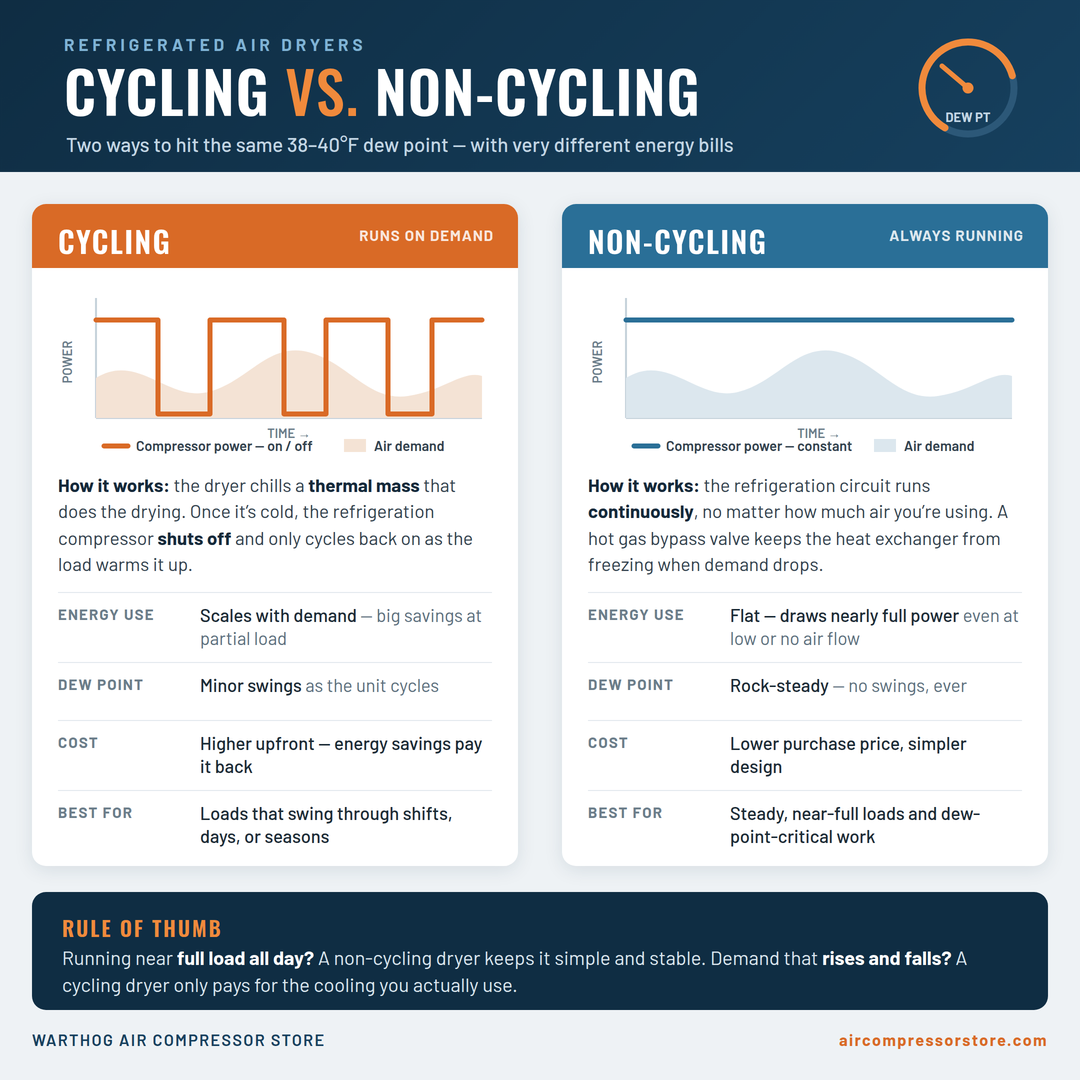
A non-cycling dryer runs its refrigerant compressor continuously the entire time the unit has power. When your air demand drops, the dryer does not shut anything down. Instead a hot gas bypass valve routes refrigerant around the evaporator so the coil does not freeze solid. The valve protects the dryer, but it does nothing for your electric bill. The refrigerant compressor and the condenser fan keep drawing the same current whether you are running six sanders or nothing at all.
That sounds wasteful, and at low load it is. But there are real reasons these still sell:
- Lower purchase price, often noticeably lower on small and mid sized units.
- Rock steady dew point. There is no thermal mass to charge or discharge, so the outlet dew point barely moves.
- Fewer parts to go wrong. No glycol loop, no circulating pump, no thermal mass tank, no variable speed drive.
- They are the right answer when the dryer really does run near full load all day, which describes a lot of production plants.
If your compressor loads up at 7 a.m. and does not let go until 5 p.m., a cycling dryer has very little idle time to save you money in. Paying extra for cycling in that shop is buying a feature you never use.
Cycling dryers: the refrigerant compressor gets to rest
A cycling dryer watches the load and shuts the refrigeration off when it is not needed. There are two common ways to pull that off, and they behave differently enough that you should know which one a quote is describing.
Thermal mass cycling
This is the common approach. The dryer chills a mass, usually a glycol and water mixture or an aluminum block, and your compressed air gets cooled by that cold mass instead of directly by the refrigerant coil. Once the mass is cold, the refrigerant compressor shuts off entirely and coasts on stored cold. When the mass warms back up past a setpoint, the refrigerant compressor kicks back on.
The savings come from the refrigerant compressor and condenser fan sitting idle. The catch is the circulating pump, which usually keeps running even at very low load. So a thermal mass dryer at zero flow is not at zero watts. It is at a small fraction of full draw, not nothing.
Variable speed cycling
Instead of switching the refrigeration fully off and on, a variable speed unit slows the refrigerant compressor down to match the load. Power draw tracks demand more closely and there is no cycling shock on the refrigeration circuit. These generally show the lowest part load power of the three types, and they carry the highest price tag. On larger systems they can be worth it. On a 25 CFM dryer for a two bay garage, they rarely are.
Cycling vs non-cycling refrigerated air dryer, side by side
| Non-cycling | Thermal mass cycling | Variable speed cycling | |
|---|---|---|---|
| Refrigerant compressor at low load | Runs continuously | Shuts off | Slows down |
| Power draw at zero flow | Essentially full | Low, but not zero (pump runs) | Lowest |
| Purchase price | Lowest | Middle | Highest |
| Dew point stability | Very steady | Swings slightly with the cycle | Steady |
| Moving parts | Fewest | Adds pump and mass loop | Adds a drive |
| Best fit | Steady, near full load | Shifts, weekends off, seasonal swings | Large systems with wide swings |
How to tell which one fits your shop
Forget the brochures for a minute and look at your own load profile. You want an honest answer to one question: what percentage of the hours the dryer is powered up is it actually seeing meaningful flow?
- Count the powered hours. If the dryer is energized 168 hours a week but the shop runs 45, you already know most of those hours are idle.
- Check the compressor duty. A compressor that loads and unloads all day is telling you demand swings. A compressor pinned at full load is telling you it does not.
- Look at the seasons. Cooler ambient air means less moisture to pull out, which means a cycling dryer gets more off time in winter.
- Do the arithmetic. Take the dryer full load kW off the nameplate, multiply by idle hours, multiply by your utility rate. That is the ceiling on what cycling could save you. If the number is small, buy the simpler machine.
We get this a lot from single shift shops with weekend downtime, and for them cycling usually pays back within a couple of years. Three shift production plants are usually the opposite. Run the numbers on your own hours instead of trusting a rule of thumb.
Two mistakes that cost more than either dryer choice
Before you agonize over cycling, get these right, because they swamp the difference.
Sizing on the compressor nameplate instead of real conditions. Dryer capacity ratings assume standard inlet conditions. Hotter inlet air, higher ambient temperature, or lower line pressure all shrink the dryer capacity, and the correction factors stack. A dryer rated 200 CFM at ideal conditions can be worth well under that in a hot August compressor room at 100 psi. Size for the worst day you actually have, not the average one.
Skipping the drain and the filter. A dryer that cannot get rid of the water it condenses is a wet air machine with extra steps. Pair it with a working automatic drain and put a decent particulate and coalescing filter set around it. Filters go before the dryer to catch oil and dirt, and after it if the process demands it.
Frequently Asked Questions
Does a cycling dryer produce drier air than a non-cycling dryer?
No. Both types target the same 35 to 50 degree F pressure dew point range. A non-cycling unit is actually a hair more stable because there is no thermal mass charging and discharging. Cycling saves energy, not moisture.
Can a cycling dryer freeze up at very low flow?
A properly controlled one will not. The control is watching the mass temperature or the evaporator temperature and shutting the refrigeration off before it can freeze the condensate. Freeze ups on cycling dryers almost always trace back to a failed sensor, a bad control setting, or a unit that is drastically oversized for the flow.
Is a cycling dryer worth it on a 5 hp compressor?
Usually not. The absolute dollars are too small. A dryer that size might draw well under a kilowatt, so even a full year of idle hours does not add up to much. Put the money into good filtration and a reliable drain instead.
What if my air demand is wildly unpredictable?
That is the case cycling was made for, and it is also a good reason to look at storage. A properly sized receiver smooths demand spikes so both the compressor and the dryer see a flatter load. Adding an air receiver tank often does more for a swingy system than any dryer upgrade.
How long should a refrigerated dryer last?
Ten to fifteen years is a reasonable expectation with clean condenser coils, a working drain, and ambient temperatures kept in spec. Dirty coils are the number one killer. Blow them out on the same schedule you service the compressor.
The short version
Pick the cycling vs non-cycling refrigerated air dryer decision off your own hours, not off a spec sheet. Steady full load all day, buy non-cycling and pocket the difference. Real idle time from shifts, weekends, or seasonal swings, and cycling starts paying for itself. Either way, size for your worst conditions and give the thing a drain that works.
Not sure which side of the line your shop falls on? Send us your compressor size, your shift schedule, and your compressor room temperature and we will run it. You can also browse the full air dryer lineup to see what the options look like at your CFM.


