


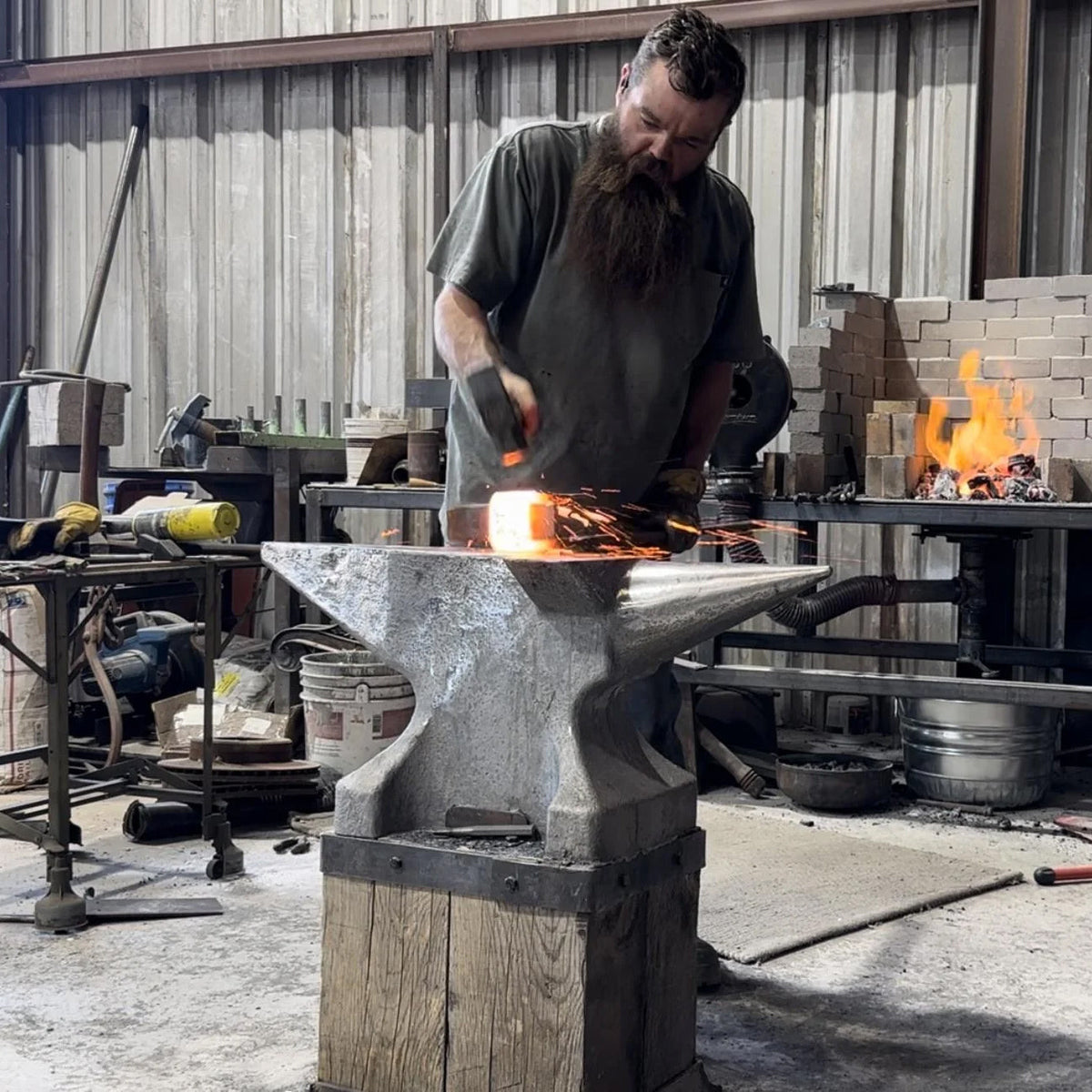
Here's a number worth sitting with. A forging plant was blowing finished rings out of a die with a flattened three-quarter-inch pipe at 90 psig, one second of air on every eight-second cycle. EXAIR swapped that pipe for a single engineered nozzle and projected more than $1,500 a year in savings. From one blow-off. On one press.
Most forge shops have a dozen of those. That's why an air compressor for forging work is less about the hammer than people think, and more about everything that happens between hits.
This article covers closed-die and open-die hot forging: steel and aluminum, presses and hammers, trim and descale. If you pour metal into molds, that's a foundry, and we wrote that one separately in compressed air for foundries. The air problems overlap but they aren't the same.
Where the air goes in a forge shop
The Forging Industry Association counts nearly 480 forging operations across 38 states, Canada and Mexico, with Ohio, Pennsylvania, Illinois and Michigan holding the most. Walk any of them and the air users fall into five groups.
Die spray
Every hit needs lubricant on the die, usually a water-based graphite or a synthetic release agent. On most automated cells the spray head swings in while the ram is up, sprays, blows off scale and swings out. The air does two jobs there: it atomizes the lube and it clears scale that would otherwise get forged into the next part.
This is where the money hides. Spraying Systems Co. documented a UK automotive forger, Stokes Forgings, that was pushing graphite through a pipe with compressed air and putting far too much on the die. After switching to four air-atomizing nozzles on an automatic spray controller, the plant forged four times the product on the same lubricant, saved about £2,000 a month and paid the project back in nine months. EXAIR describes another plant spraying a gear-blank die every six seconds that went from six homemade nozzles to two atomizing nozzles and cut release-agent use roughly in half in the first week.
Neither case study publishes the CFM, so we won't invent one. The lesson is the same either way: homemade spray rigs over-apply lube and over-use air, and fixing them is usually the cheapest air project in the building.
Blow-off and part ejection
Parts stick. Scale piles up. Somebody solves it with an open pipe or a drilled tube on a solenoid, and it runs forever because it works. That flattened pipe in the opening is typical. Open-pipe blow-offs are also an OSHA problem when people use them by hand: 29 CFR 1910.242(b) limits cleaning air to under 30 psi at the nozzle when dead-ended, with chip guarding. Engineered nozzles and safety blow guns fix both the air bill and the citation risk.
Press clutches, brakes and counterbalances
Mechanical forging presses and trim presses usually run pneumatic friction clutches and brakes, and many use air counterbalance cylinders to carry the weight of the ram and upper die. These don't use a lot of air per stroke, but they need it at a steady pressure every stroke. MetalForming magazine puts the typical maximum for pneumatic clutch, brake and counterbalance systems at about 6 bar, or 90 psi. One Bliss clutch/brake manual gives a recommended maximum of 70 psi. Your press has its own number on a plate on the frame. Read it, and regulate to it at the press.
A clutch that sees low or wet air slips, heats and wears. A counterbalance that loses pressure puts the ram's weight on the drive. Both are expensive. The clutch gets its own regulated, filtered drop, never a tee off the spray header.
Hammers
Here's where it gets confusing, because "air hammer" means different machines in different shops.
- Self-contained pneumatic hammers have their own compressor cylinder built in. An Anyang 55 kg, for example, runs on a 10 HP motor and needs no external air at all. If that's what you run, your shop compressor only handles the rest of the building.
- Air-lift and utility-air hammers need an external supply, and it can be a big one. A Department of Energy market study on the forging industry notes that in pneumatic forging, the compressors feeding the hammers are the largest energy user in the plant.
- Old steam hammers converted to air are their own category. Surplus Record's buying guide warns not to assume a steam-designed hammer will run on shop air without checking the pressure and flow it really needs. A big Chambersburg designed for boiler steam can outrun a compressor plant that looked generous on paper.
If you're buying a used hammer, get the air requirement in writing before it ships. If the seller can't give it, budget for an air study before you budget for the hammer.
Descaling and cleanup
Good news here. Most forging descaling is done in wheel blast machines, which throw shot with an electric turbine wheel and use no compressed air for the blast itself. Air blasting does use compressed air, and a lot of it, so if you run a blast cabinet or a blast room for touch-up, size for it separately. Then add your maintenance shop: impact wrenches for die changes, grinders, chipping hammers for flash.
Heat is the real design problem
A forge shop is hot. Furnaces, induction heaters and a few hundred pounds of glowing steel coming off the press every minute will push the air around your compressor well above what the spec sheet assumed. That changes everything downstream.
Air-cooled compressors are generally built to run from about 40°F up to a little over 100°F ambient. Compressed Air Best Practices suggests keeping compressor discharge under 120°F going into the treatment train. Refrigerated dryers are usually rated at 100 psig, 100°F ambient and 100°F inlet. Push the inlet to 115°F and the same source cites a correction factor of 0.69: a dryer rated for 1,550 SCFM handles about 1,070. In a forge shop that's not an edge case. That's August.
What we'd do:
- Give the compressors their own room, with a wall between them and the forge floor and ducted outside air for intake and cooling. Kaishan recommends an enclosed room with ducted outside intake air for anything over 25 HP, and in a forge shop we'd say that's the minimum. Our guide to compressor room requirements walks through the space and ventilation math.
- Add an aftercooler if the package doesn't have a good one, or if your room runs hot. Every degree you pull out before the dryer is capacity the dryer gets back.
- Size the dryer with the derate applied, not off the nameplate. If your summer inlet is 115°F, a dryer that matches your compressor on paper is about a third too small.
- Watch the intake filter. Scale dust and graphite mist find their way into everything. A clogged intake element makes the compressor work harder for less air, and Kaishan figures roughly 1 percent more energy for every 2 psi of extra drop across filters.
Sizing it
Forge shop air loads swing hard. A spray cell fires every few seconds, a press clutch engages on every stroke, an air-lift hammer pulls in big gulps, and the maintenance shop is idle until a die breaks. Sizing to the average starves you on the peaks. Sizing to every peak at once buys a compressor that loafs and short cycles.
The honest way is to measure. Rent or buy a flow meter, log a full production week including a die change, and size to the real peak with some storage behind it. A rotary screw in the 20 to 50 HP range covers a lot of small and mid-size closed-die shops. Plants with several air-lift hammers can go well past that, and that's where a variable speed unit paired with a fixed-speed base-load machine starts to pay.
Put a receiver near each big intermittent user. A hammer or a spray cell that can draw from a local tank stops dragging the whole header down every time it fires, and your press clutches stop seeing pressure dips.
The OSHA lines you'll get asked about
OSHA's forging machine standard, 29 CFR 1910.218, has specific requirements for air-lift hammers. They need an air shutoff valve, two drain cocks (one on the main head cylinder and one on the clamp cylinder), and a safety cylinder head. Air piping to the hammer is supposed to meet the ANSI B31.1 power piping standard referenced in the rule. Rams have to be blocked during die changes and maintenance. The "quick closing emergency valve" people sometimes quote is in the steam hammer section, not the air-lift section, so don't let anyone tell you your air hammer is out of compliance for lacking one.
Pair that with the 30 psi rule on hand-held cleaning air and lockout procedures that bleed stored air before anyone reaches into a press, and you've covered most of what an inspector will look at on the air side. Our article on the OSHA rules that get cited goes deeper on the general requirements.
Three things we see go wrong
One header for everything. The spray cells, the clutch and the maintenance drops all tee off the same line. When the spray fires, the clutch sees the dip. Separate the clutch and counterbalance feeds with their own regulator and a small receiver.
No dryer, because "it's a hot shop." The air leaves the compressor hot and saturated, then cools in pipe that runs past the shipping door in January. Water collects at the low spots and gets sprayed onto hot dies along with the lube, and it reaches the clutch too. A refrigerated dryer costs less than most clutch rebuilds.
Buying the hammer before the air. A used air-lift hammer at a great price can turn into a compressor project that costs more than the hammer did. Get the requirement first.
If you want to start somewhere, start with the die spray and the blow-offs. They're usually the biggest waste and the cheapest fix. Then size the compressor for what's left.


