


In 1871 a man named Simon Ingersoll got a patent for a rock drill. He died in 1894 nearly broke. The company that took his drill and ran with it is still a household name in our trade. That is a decent summary of how the history of the air compressor goes: a lot of clever people solving one problem at a time, and the money showing up later.
We sell compressors for a living, so we get asked who invented the thing. There is no single answer, and anyone who gives you one is skipping chapters. Here is the version we can back up, with a few places where the sources disagree flagged honestly.
Before there was a compressor, there was a bellows
The first mechanical air compressor was the hand bellows. Metalworkers in the ancient world needed hotter fires, so they pushed air at them with blowpipes and then bellows. The foot-operated bellows came along around 1500 B.C. according to one industry history. Water-driven bellows then did the job for something like two thousand years.
It is worth sitting with that. For most of human history, "compressed air" meant a hotter fire.
The blowing cylinder (1762 and 1776)
In 1762 the engineer John Smeaton designed a water-wheel-driven blowing cylinder that started to replace bellows in ironworks. In 1776 John Wilkinson, an English inventor, introduced a more efficient blasting machine. Several industry histories treat that machine as the early ancestor of the mechanical compressor. In between, in 1691, Denis Papin had suggested that fresh air could be forced under pressure into a diving bell to extend working time, which is a compressed air idea with a human life attached.
The tunnel that made compressed air famous
The big public moment was the Mont Cenis (Fréjus) tunnel, about 13.7 km (8.5 miles) under the Alps between Modane in France and Bardonecchia in Italy. Work ran from 1857 and the tunnel opened in 1871. The engineer in charge was Germain Sommeiller.
Drilling by hand moved painfully slowly. Compressed air changed that. Sommeiller's pneumatic drills, fed by water-powered compressors, let crews advance roughly 4.6 meters (15 feet) a day, and one account has a compressed air plant running at about 87 psi on the job. Sources disagree on a few details, including whether air drills went in during 1861 or 1862, and who deserves credit for the drill itself (one source says Sommeiller designed it, another says his patent built on an earlier invention by Giovanni Battista Piatti). We would rather tell you that than pick a winner. What nobody argues is that the tunnel proved compressed air could do heavy work underground.
Ingersoll and the rock drill
Simon Ingersoll, born in Connecticut in 1818, received his basic rock drill patent on March 7, 1871. His percussion drill rotated the steel after each blow and advanced it automatically. It was first steam driven and later ran on compressed air. He held 27 patents, 13 of them for rock drills or related equipment. The company bearing his name traces its founding to 1871. Compressed air drills were in use at American mines through the 1870s, and that is when the air compressor started to look like a product instead of a project.
Trains, pipes and a city of air
George Westinghouse developed his air brake for trains starting around 1869. The idea is simple and still clever: air pressure holds the brakes off, and losing pressure applies them. Meanwhile, in the nineteenth century, Paris ran a pipe network that distributed compressed air to power machines and generators. It was a utility, like gas.
From steam to portable
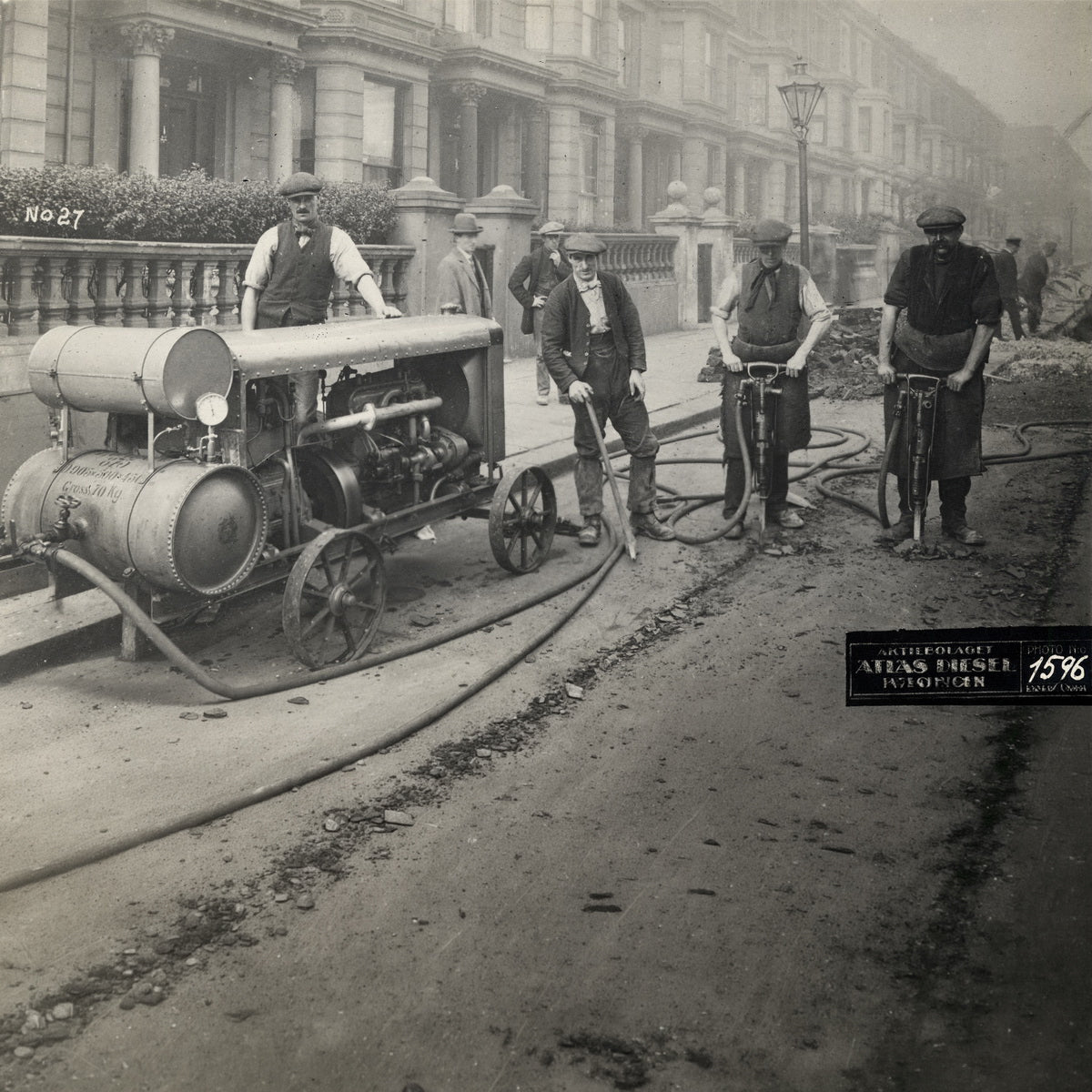
The first compound compressor design, with successive cylinders compressing in stages, was patented in 1829. By around 1910, most compressors were big single-stage machines with one large cylinder, driven horizontally by a steam or oil engine. Portable compressors on wheels appeared around the turn of the century. The first two-stage, air-cooled portable compressor was built in 1933, and standard free-air ratings followed soon after. That is the ancestor of the towable on a jobsite today, like the 400/150 towables we see every week.
The rotary screw
Swedish professor Alf Lysholm designed the first twin-screw compressor while working on steam and gas turbines. It was patented in Sweden in 1935. That single idea is the great-grandparent of the machine running in most plants now. If you want to know how it works and how to size one, start with our rotary screw guide. If you are comparing the older design, see rotary screw vs piston.
What the history teaches a buyer
- Air does work people used to do by hand. Every upgrade, from bellows to screw, was about delivering more air more steadily.
- Staging and cooling matter. Compound compression in 1829 was about efficiency, and a two-stage machine still earns its keep.
- Portability followed demand. The jobsite wanted air that moved, so someone put it on wheels.
When you are ready to look at what is on the market today, browse our air compressors, or see what we have on piston and rotary screw models.
Frequently Asked Questions
Who invented the air compressor?
No single person. The hand bellows was the first mechanical compressor, and later steps include Smeaton's blowing cylinder (1762), Wilkinson's blasting machine (1776), and Sommeiller's and Ingersoll's pneumatic drills in the nineteenth century.
When was the first rotary screw compressor patented?
Alf Lysholm's twin-screw compressor was patented in Sweden in 1935, according to one industry history.
What was the first big use of compressed air?
Among the best known is the Mont Cenis (Fréjus) tunnel, where compressed air drills helped crews cut through the Alps between 1857 and 1871.
When did portable air compressors appear?
Portable compressors on wheels appeared around the turn of the twentieth century, and the first two-stage air-cooled portable unit was built in 1933.


