


"Can I just run poly line out to the bench?"
We get some version of that question every week, and the honest answer is that it depends on which poly line you mean, how long the run is, and whether you plan to hang it off a joist or bury it in a wall. Air tubing is not one product. It covers everything from 1/4 inch polyurethane feeding a cylinder on a machine to a 1 inch aluminum-core composite line carrying a whole shop, and those two things have almost nothing in common except that they both bend.
Here is how to tell which one you actually need, and where tubing is the right call instead of hard pipe.
Tubing and pipe are different tools, not different budgets
People treat tubing as the cheap version of pipe. That is the wrong frame and it leads to bad installs.
Pipe is rigid, joined with threads, glue, press or weld, and sized by nominal bore. It handles high pressure and high temperature, it holds its shape, and once installed it stays where you put it. Steel, copper, stainless and aluminum all land here.
Tubing is flexible or semi-rigid, joined with compression or push-to-connect fittings, and sized by outside diameter. The whole point is that it bends around obstacles, absorbs vibration, and goes in without a threading machine. That flexibility is a genuine engineering advantage in some places and a genuine liability in others.
The two questions that decide it: does the line need to move or route around things, and how hot does it get? If the answer is yes and not very, tubing is often the better choice. If the line leaves the compressor before the aftercooler, or it has to take a hit from a forklift, it wants pipe. Our comparison of compressed air pipe materials walks through the rigid side.
The materials, compared honestly
| Material | Typical service temp | Character | Where it fits |
|---|---|---|---|
| Polyurethane (PU) | About -40°F to 160°F | Very flexible, tight bend radius, abrasion resistant, lower pressure capability | Machine plumbing, cylinder feeds, coiled hose, anything that moves |
| Nylon / polyamide (PA) | About -40°F to 175°F | Semi-rigid, holds its shape, best pressure and temperature capability of the plastics | Equipment lines, exposed runs, higher pressure control circuits |
| Polyethylene (PE / LDPE) | About -40°F to 130°F | Soft, chemically inert, inexpensive, lowest pressure capability | Low pressure signal and instrument lines, not shop air distribution |
| Composite (HDPE / aluminum core) | Check the specific product | Semi-rigid, holds a bend, will not corrode inside, real distribution ratings | Shop air mains and drops in small and mid-size shops |
| PVC | Do not use | Shatters rather than splits | Nowhere above ground on compressed air |
Two details in that table do most of the damage when people skip them.
Working pressure ratings are printed at room temperature. Tubing manufacturers publish derating curves, and the common rule of thumb is to knock roughly 2 percent off the rated working pressure for every degree Celsius above 23°C (73°F), with a 30 to 50 percent derate once you are past 40°C (104°F). That matters more than it sounds. A tube rated 150 psi on the box sitting against a hot press or in a 120°F ceiling space is not a 150 psi tube anymore. Check the manufacturer's chart for the exact product, not a generic number.
Tubing is sized by OD, pipe by nominal bore. This catches people constantly. Half inch nylon tubing has a half inch outside diameter and an inside diameter closer to 0.375 inches depending on wall thickness. Half inch pipe has an inside diameter around 0.622 inches. So swapping "half inch tubing" for "half inch pipe" cuts your flow area roughly in half, and then someone wonders why the sander is starving at the end of a 60 foot run.
Why PVC keeps coming up, and why the answer is still no
PVC is cheap, it is at every hardware store, and it glues together in an afternoon. It also fails by shattering into fragments rather than splitting, and it embrittles over time from compressor oil vapor and UV. OSHA does not allow it for above-ground compressed air service, and every compressed air professional you talk to will tell you the same thing after seeing one let go. We wrote the whole argument up in PVC pipe for compressed air and why OSHA says no, and nothing about it has softened.
The related trap is generic poly irrigation tubing from a farm store. It looks like air tubing, it costs a third as much, and it has no compressed air rating at all. If the tube does not have a working pressure printed on it, it is not air tubing.
Sizing a tubing run
The sizing method is the same as for pipe, and the numbers in our compressed air pipe sizing guide apply directly. Two adjustments for tubing:
- Convert OD to actual ID before you look anything up. Use the ID from the manufacturer's spec, not the label on the tube.
- Count your push-to-connect fittings as real restrictions. A push-in elbow has a smaller effective bore than the tube it sits in. Three elbows in a short run can cost you more pressure than the tube itself.
The practical failure we see most often is a shop running 3/8 inch tubing to a bench because that is what the fitting on the tool took, then hanging a die grinder or a DA sander off it. Those tools want real volume. A 3/8 inch OD tube has roughly a quarter inch of actual bore, and it simply cannot feed a 10 CFM tool at 60 feet no matter how much pressure you put behind it. Run the drop in the larger size and reduce at the last fitting.
The fitting is where tubing fails
Tube rarely bursts. Connections leak. Everything about a reliable tubing install comes down to how the ends are treated.
- Cut square. Use a tube cutter, not side cutters. An angled or pinched end will not seal in a push-to-connect body, and it may hold pressure on the bench and leak at 3 a.m. two weeks later.
- Push it fully home. Most push-in fittings need the tube to go past the grab ring and seat against a shoulder. Partial insertion is the single most common leak we see.
- Match the tube to the fitting. Push-in fittings rely on a precise outside diameter and a certain hardness. Very soft tubing can creep under the grab ring over time and slowly walk out. Metric and imperial ODs are close enough to fool you and not close enough to seal.
- Support it. Unsupported tubing sags, and sagging tubing collects condensate at every low spot. Clip it every few feet and give it a slight pitch toward a drain leg.
- Keep it off hot and sharp things. Tubing against a hot motor frame or over a sheet metal edge will eventually find you.
On the tool end, the coupler matters as much as the tube. If you have a mixed bag of plugs and sockets, the sorting is in our guide to air coupler types and interchanges.
Where composite tubing earns its keep
The middle ground between plastic tubing and hard pipe is composite line: high density polyethylene bonded around an aluminum core. It bends and holds the bend like soft copper, it cuts with a tube cutter, and the aluminum core means it will not corrode from the inside the way black iron does. It goes in fast, and one person can do a small shop in a weekend.
That is what the MaxLine tubing system is, and it is the honest answer for most one to three bay shops, home garages and small production areas. If you want the background on it, there is a walkthrough in MaxLine by RapidAir.
Where composite stops being the answer is scale. Once you are running a plant main, high demand across multiple departments, or lines that need to be tapped and modified regularly, modular aluminum air pipe is the better system. It comes in larger sizes, the fittings are reusable, and the push-connect joints handle repeated changes better. Our take on aluminum air pipe covers where that line falls.
Where tubing does not belong
A short list, because these are the four that cause real damage:
- Between the pump and the aftercooler. That air is hot, often well over 200°F. Use metal.
- Anywhere a forklift, a cart or a pallet can reach it. Tubing at knee height in a traffic lane is a matter of time.
- Buried without a sleeve. If you must go underground, run it inside conduit so it can be pulled and replaced.
- Above a suspended ceiling in a hot building, unless you have done the temperature derate and the tubing still clears your working pressure with margin.
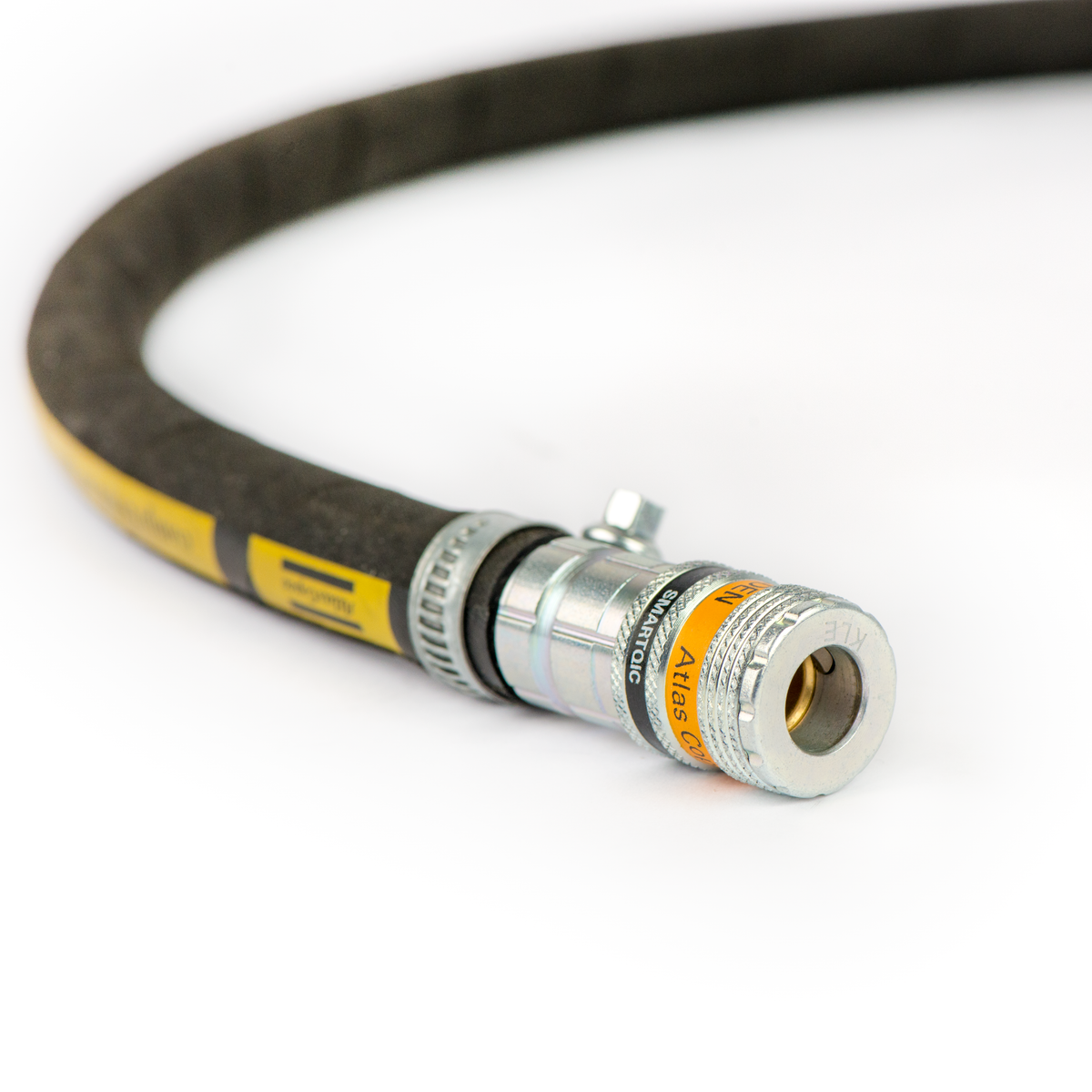
Also worth saying: tubing is not a substitute for air hose at the tool. Hose is built to be dragged, flexed and stepped on. Tubing is built to be installed once and left alone.
Frequently Asked Questions
Is air tubing strong enough for shop air?
The right tubing is. Nylon and composite HDPE-aluminum products carry working pressures that comfortably cover a normal shop running 100 to 125 psi, and composite line is a legitimate distribution system in small and mid-size shops. What is not strong enough is unrated poly, irrigation line or PVC. Look for a working pressure printed on the tube, confirm it clears your maximum system pressure with margin, and then derate it for the temperature it will actually live at.
What size air tubing do I need for a shop?
For a single-bay garage running one tool at a time, 1/2 inch composite main with 1/2 inch drops handles most of it. Two or three bays with a sander or blast cabinet want a 3/4 inch main. Remember that tubing is sized by outside diameter, so a 1/2 inch tube has noticeably less bore than 1/2 inch pipe. When in doubt, go one size up on the main, because the cost difference is small and you cannot easily fix it later.
Can I mix tubing with my existing black iron pipe?
Yes, and plenty of shops do. Transition with a proper threaded-to-push-connect adapter, use thread sealant rated for compressed air, and support both sides of the joint so nothing hangs on the fitting. One caution: if the iron is old and rusty, the rust will migrate into your new tubing and jam the push-in fittings. Blow the old line out, or add a filter at the transition.
How long does compressed air tubing last?
Indoors, protected from sunlight and heat, a properly rated tubing system will run for many years. What shortens it is UV exposure, heat, compressor oil carryover in contact with the wrong polymer, and mechanical abuse. Plastic tubing in direct sun outdoors is the fastest way to a brittle failure. If a run has to go outside, use a UV-rated product or shield it.
Do I still need drops and drip legs if I use tubing?
Absolutely. Water does not care what the pipe is made of. Take drops off the top of the main, pitch the main toward drain legs, and put a drain at every low point. The layout advice in how to install compressed air lines applies the same way to tubing as it does to pipe.
The short version
Pick air tubing when the run needs to bend, when you want the install done fast without threading, or when you want a line that will not rust from the inside. Pick pipe when it is hot, exposed to impact, or larger than the tubing system can comfortably carry. In both cases, size it by real inside diameter, respect the temperature derate, and take the time to cut ends square and seat them fully, because the tube is almost never what fails.


