


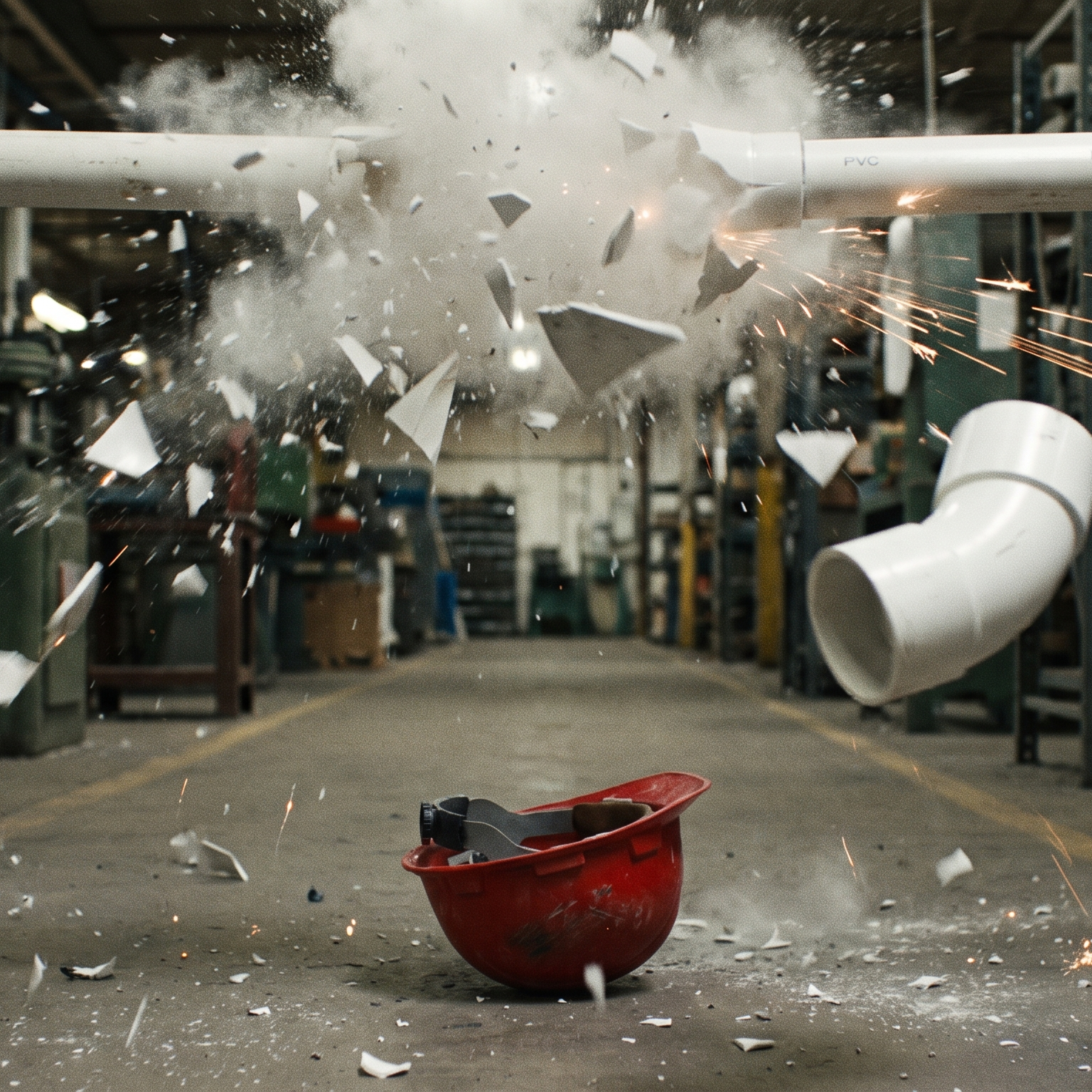
A shop owner called us last spring, still rattled. A run of overhead air line had let go around lunchtime, and white plastic fragments were buried in the drywall fifteen feet away. Nobody was standing under it. He got lucky. The line was Schedule 40 PVC out of a hardware store, glued up on a Saturday, and it had been holding 120 psi for about four years before it quit.
We get this question a lot, so here is the straight answer. PVC pipe for compressed air is a bad idea above ground. OSHA has been warning about it since 1988, the pipe manufacturers say not to do it in their own literature, and the failure mode is the part that should scare you. This is not a code technicality. It is a shrapnel problem.
Why PVC Pipe for Compressed Air Fails the Way It Does
Water lines and air lines fail differently, and that difference is the whole argument.
Water does not compress. When a water line splits, the pressure drops almost instantly and you get a leak, maybe a spray. Annoying, not dangerous. Air compresses. A 100 foot run of 1 inch pipe at 120 psi is holding a real amount of stored energy, and when the pipe wall gives up, all of that energy dumps at once. It has to go somewhere, so it goes into throwing pipe.
PVC also fails brittle. Steel yields, bulges, splits, and lets go with a tear you can usually see coming. PVC just shatters. There is no warning bulge and no slow weep. One second it is fine, the next second there are pieces of it in the wall.
Compressor Oil Attacks It
Every lubricated compressor carries some oil downstream. Even a well maintained rotary screw with a good separator element pushes a small amount of oil carryover into the line, and a worn piston compressor pushes plenty. Synthetic compressor oils in particular are hard on PVC and its solvent cement joints. Over months and years the plastic gets brittle, joints craze, and the pipe loses a chunk of the strength it started with. Nothing on the outside looks different.
Heat Kills the Pressure Rating
This is the one that catches people. PVC pressure ratings are published at 73 degrees F. Run it warmer and the rating drops off a cliff. At 110 degrees F, Schedule 40 PVC holds roughly half its 73 degree rating. At 140 degrees F, which is the top of its usable range, it is down to about 22 percent.
| Pipe temperature | Approximate share of the 73 degree F pressure rating |
|---|---|
| 73 F | 100 percent |
| 110 F | about 51 percent |
| 140 F | about 22 percent |
Now think about where your air line actually lives. Discharge air off a compressor is hot before it hits an aftercooler. The first twenty feet of header near the machine runs warm all day. An overhead line under a metal roof in July in the Carolinas is not sitting at 73 degrees. A pipe you sized off the catalog number can be operating at half its rating without anyone noticing.
Sunlight, Vibration, and Ladder Strikes
UV exposure makes PVC chalky and brittle. Compressor vibration works the joints. And a plastic line takes a forklift mast or a dropped ladder about as well as you would expect. Steel gets dented. PVC gets a crack that finishes the job three weeks later.
What OSHA Actually Says About PVC Pipe for Compressed Air
People throw around "OSHA banned it" without much precision, so here is the accurate version.
OSHA issued a Hazard Information Bulletin in May 1988 on the use of PVC pipe in above ground installations, prompted by failures where fragments injured workers. A 1991 standard interpretation letter covers thermoplastic pipe in above ground locations along the same lines. There is no single line in the standards that reads "PVC shall not be used for compressed air," but OSHA has cited employers for it under the General Duty Clause, which requires a workplace free of recognized hazards likely to cause death or serious harm. A hazard the manufacturer warns about in print is about as "recognized" as it gets.
Two practical consequences:
- Above ground PVC air line is a citable condition, and your insurance carrier will have opinions about it after an incident.
- Buried or encased PVC is treated differently, because the surrounding material contains the fragments. That is a narrow exception, not a loophole for your overhead header.
Worth adding: the major PVC pipe manufacturers already tell you this. Their published literature limits the product to liquids and specifically warns against compressed air and gas service. If it ever goes to court, that warning is exhibit A.
What to Run Instead
Good news is that the alternatives are cheap, fast, and mostly easier to install than gluing plastic. Here is how the common options stack up.
| Material | Best for | Watch out for |
|---|---|---|
| Aluminum modular pipe | Most shops. Push to connect or compression fittings, no threading, no rust, smooth bore, and you can reconfigure it later. | Higher material cost up front, though labor savings usually eat that difference. |
| Black iron and steel | Big industrial headers, high temperature runs near the compressor, and shops that already have a threading machine. | Rust and scale over time, heavy, and every change means cutting and threading. |
| Copper | Clean air work, medical and lab, smaller runs where appearance matters. | Material price, and it takes a torch and a skill set. |
| Stainless | Corrosive plants, food and pharma, and anywhere the air has to stay spotless. | Cost. It is the premium answer. |
| Rated polymer or composite air pipe | Small shops and garages when the product is specifically rated and warranted for compressed air. | Not the same thing as hardware store PVC. Check the rating on the pipe itself, not the aisle sign. |
For most shops we talk to, aluminum is the easy call. One person can run a header in a day with a tubing cutter and a deburring tool, the bore stays smooth so you are not throwing away pressure to friction, and it will not shed rust into your filters and tools. Take a look at our air pipe and fittings and the aluminum air piping systems if you want to price a run.
Ripping Out PVC Without Making It Worse
If you have PVC overhead right now, do not go at it live.
- Shut the compressor down and lock it out.
- Bleed the system all the way to zero at the lowest drain point. Watch the gauge, do not trust the timer.
- Wear a face shield. Old PVC under any residual pressure can still let go when you cut it.
- Support the run before you cut it so a section does not swing down on you.
- Plan the replacement layout before demo day. A loop header with drops taken off the top of the main will do more for your air quality than anything else you change.
While the system is down, it is the right time to look at the rest of the line. Most shops running PVC are also running no filtration and a tank drain that nobody touches. Our air filters section covers the particulate and coalescing stages that keep the new pipe clean on the inside.
Common Objections We Hear
"Mine has been up for ten years and it is fine." So was the one that put plastic in the drywall. Failures are cumulative and the pipe gives no warning. Ten good years is not evidence of an eleventh.
"I ran Schedule 80, it is thicker." Thicker walls raise the pressure rating, but they do not change the failure mode or the oil attack, and Schedule 80 PVC carries the same manufacturer warning against compressed gas service.
"It is only 90 psi in a two car garage." Ninety psi in a 3/4 inch line still holds enough stored energy to throw a fragment across a room. And a garage is exactly where somebody is standing three feet away with no eye protection.
The Short Version
Using PVC pipe for compressed air above ground trades a small savings on material for a failure mode that throws sharp plastic at whoever is nearby. OSHA has flagged it since 1988, the manufacturers warn against it, and there are four or five materials that cost a little more and do the job properly. Pull it, run aluminum or steel, and stop thinking about it.
Frequently Asked Questions
Is PVC pipe for compressed air actually illegal?
There is no standard that names PVC and bans it outright. OSHA published a Hazard Information Bulletin on above ground PVC in 1988 and has cited employers under the General Duty Clause for using it in compressed air service. Practically speaking, treat it as prohibited above ground.
What about buried PVC air line?
Buried or encased PVC is handled differently because the surrounding soil or encasement contains fragments if the pipe fails. That does not make it a good idea for the part of the system running through your shop, and any point where it comes above grade is back to being a hazard.
Does Schedule 80 PVC solve the problem?
No. It holds more pressure than Schedule 40, but it is the same material with the same brittle failure, the same sensitivity to compressor oil, and the same temperature derating. Manufacturers warn against it for compressed gas regardless of schedule.
Can I use PEX or regular poly tubing instead?
Only if the product is specifically rated and warranted for compressed air by its maker. Plenty of polymer tubing sold for water is no better than PVC in air service. Read the print on the pipe, not the shelf tag.
What size pipe should I run once I switch?
Size it for the CFM you actually use plus room to grow, and keep pressure drop across the whole system under about 10 percent. Most shops that go from 1/2 inch to 1 inch on the main are surprised how much tool performance they get back.


