


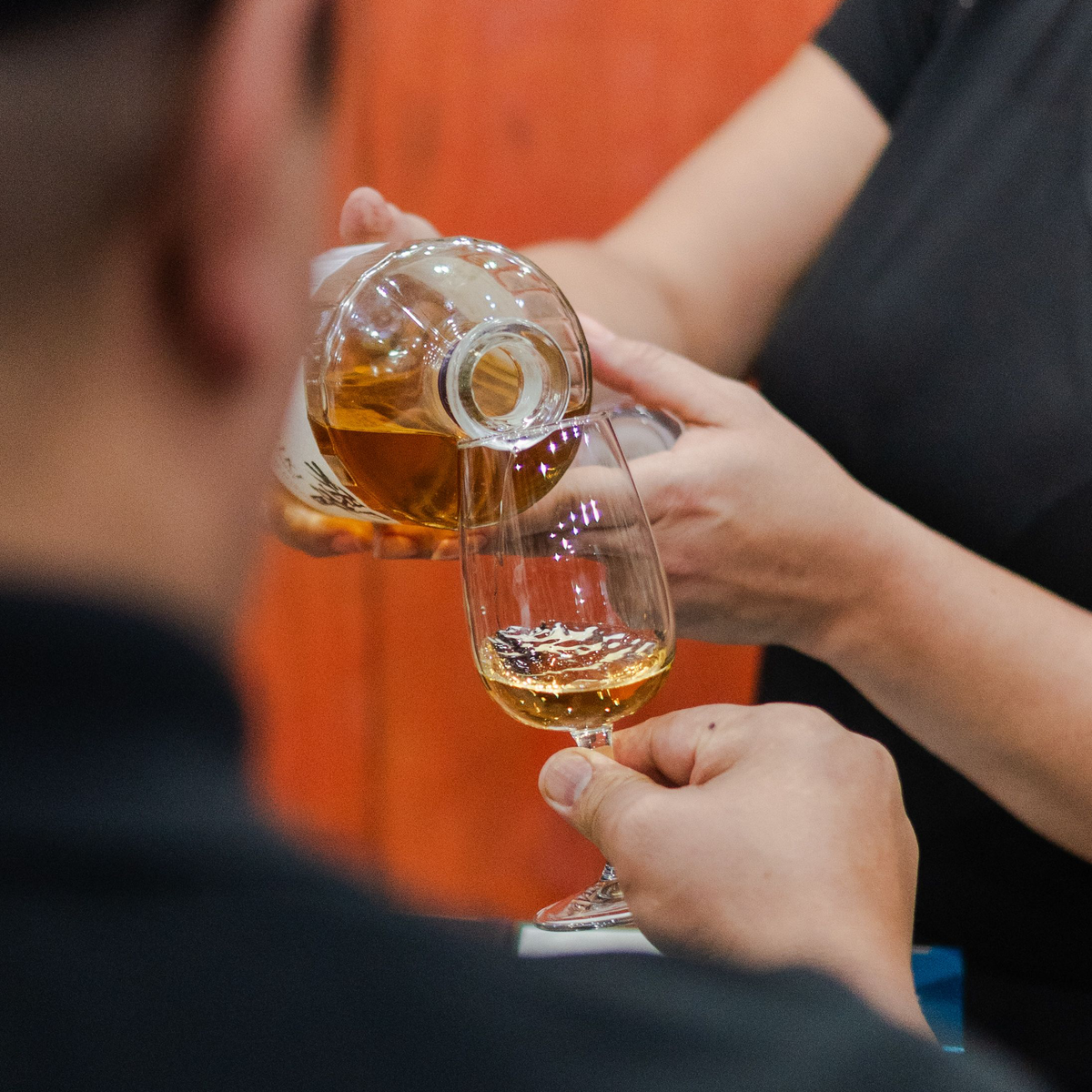
Ethanol vapor burns between about 3.3 and 19 percent by volume in air. That one range decides more about where your compressor sits, how your still house is wired, and what your insurance carrier wants to see than anything else you will read here.
Everything else about compressed air for distilleries is more familiar. You need clean, dry air for the bottling line, actuation air for CIP and transfer valves, and probably nitrogen for tanks and barrels. Those are solvable with normal equipment. The classified area is the part that catches people, usually right after the compressor is already installed.
Where the air actually goes
Walk a working distillery and the air splits into four jobs.
Packaging
This is the big one and the one that drives your sizing. Bottle rinsing, filling, capping and corking, labelers, case packers and the conveyor pushers between them. A bottling line is a steady, high duty load while it runs, and it is often the only thing running when you are packaging, which means your compressor cycles hard on packaging days and loafs the rest of the week.
Process valve actuation and CIP
Butterfly and ball valve actuators on the mash tun, the fermenters, the still, the spirit safe lines and the transfer piping. Individually tiny, continuously present. CIP skids add more, and they want air that will not leave anything behind on a product contact surface.
Grain handling
If you mill on site, you likely have pneumatic conveying, slide gates, and a dust collector with pulse jet cleaning. The dust collector is worth calling out: a pulse jet baghouse fires a short, high volume shot of air on a timer, and those pulses can drag your header down if nobody sized storage for them.
Instrument air
Modulating valves on the still, level and flow instrumentation, and on larger stills a control system that expects stable pressure. This is the smallest volume and the least forgiving.
The classified area, and why the compressor lives outside it
Ethanol is a flammable liquid under OSHA 1910.106 and NFPA 30, and in a distillery the vapor is present in normal operation only in limited quantity and under abnormal conditions in greater quantity. That generally puts the still house and spirit handling areas in Class I, Division 2 territory under the National Electrical Code, with tighter Division 1 zones around specific openings, sumps and fill points. Your authority having jurisdiction and your own classification drawing decide the exact boundaries. We do not, and neither does any vendor.
What that means practically for air:
- A standard packaged air compressor is not rated for a classified area. It has a motor, a starter, a controller and a cooling fan, none of which are built for a Division 2 location. The normal answer is a compressor room outside the classified boundary with pipe run in.
- Pipe crossing into the classified area is fine. Air in a pipe is not the hazard. The electrical package is.
- Air motors become attractive inside the boundary. This is the part distillers often miss. Where you need a mixer, a hoist, a barrel handling drive or a pump in a classified space, a pneumatic drive sidesteps a lot of expensive rated electrical work. We cover the general case in our guide to air motors and when air beats an electric motor.
- Watch your intake. If the compressor is outside but its intake is drawing from near a still vent, a dump tank or a fill point, you are pulling ethanol vapor into a machine that runs hot. Put the intake up, away, and on the clean side of the building.
Air quality: treat it like a food plant, because it is one
Air touching bottles, product contact surfaces or anything downstream of a CIP cycle needs to be clean. Not exotic, but clean, and documented.
| Where the air goes | Reasonable target | What that takes |
|---|---|---|
| Bottle blow-off, rinsing, product contact | Oil free in practice, dry, filtered | Oil-free compressor, or lubricated plus coalescing and carbon filtration, with a dryer |
| CIP and process valve actuation | Dry and clean, not product contact | Refrigerated dryer, particulate and coalescing filters |
| Grain handling and dust collector pulse | Dry, general plant quality | Refrigerated dryer plus storage sized for the pulse |
| Instrument air on the still | Dry and stable | Dryer plus a dedicated receiver and a check valve off the main header |
The honest version of the oil-free question: for most craft distilleries, a lubricated rotary screw with a good coalescing filter and an activated carbon stage is the right economic answer for everything except direct product contact air. If you are blowing air into a bottle immediately before it gets filled, that is where oil free earns its price, or where you at least owe yourself a carbon tower and a testing regime. Our write-up on food grade compressed air covers what an auditor actually asks for, and ISO 8573-1 air quality classes explains the numbers if your spec is written that way.
On dryers: if everything is indoors and heated, a refrigerated dryer holding roughly 38 to 45°F pressure dew point is enough and it is far cheaper to run. Desiccant becomes the answer if you have outdoor pipe in a freezing climate, or an application that genuinely wants a low dew point. The refrigerated vs desiccant comparison walks the decision.
Sizing it
Distillery air demand is lumpy in a very specific way: your peak is almost always a packaging day, and your average across a week is much lower. Size for the peak, then control for the average.
- Get the bottling line numbers from the OEM. Every filler, capper and labeler publishes an air consumption figure. This is the backbone. Do not estimate it.
- Add actuation. Count valve actuators and use the per-stroke volume from the data sheet. Small, but include the CIP skid.
- Add the dust collector pulse separately. Do not average it into the load. A pulse jet cleaning cycle is a transient, and transients are solved with a receiver, not horsepower.
- Add 15 to 25 percent for leaks unless you have actually surveyed, in which case use your number.
- Then think about turndown. A distillery that packages two days a week and idles the other three is a good candidate for a variable speed machine or a two compressor arrangement, because a fixed speed unit running unloaded is burning money for no air.
Most craft distilleries land on a rotary screw air compressor somewhere between 10 and 50 HP, with a receiver sized to swallow the bottling line and the baghouse. Larger regional producers scale from there. A piston machine can cover a very small operation that only runs a bench filler, but a bottling line is continuous duty and continuous duty is what rotary screws are for.
Nitrogen, and why distilleries end up buying a generator
Almost every distillery of any size is buying nitrogen in cylinders or a dewar for one of three reasons: purging headspace in spirit and ethanol storage tanks, sparging or blanketing during transfer to limit oxidation, and pushing product through lines without aerating it. Some also use it for barrel handling and for inerting during maintenance.
Nitrogen blanketing an ethanol tank does two useful things at once. It keeps oxygen away from the spirit, which protects the product, and it keeps the vapor space out of the flammable range, which protects the building. Given the ethanol range noted at the top, that second benefit is not a bonus, it is often the point.
If you are buying cylinders regularly, a membrane or PSA nitrogen generator running off your existing compressor is frequently the cheaper long run answer, and it removes the delivery schedule from your production plan. The math and the purity tradeoff are in our nitrogen generator guide, and the winery version of this same argument is in nitrogen generators for wineries, which is close enough to a distillery bottling line to be worth reading.
One honest limit: a nitrogen generator needs a compressor with capacity to spare, because generating nitrogen consumes a meaningful amount of compressed air. If your compressor is already at its limit on packaging days, the generator is a two part purchase.
What distilleries get wrong
- Installing the compressor first, classifying the area second. Then the machine has to move, or a wall has to go up, and both cost more than planning did.
- Sizing on the average week. The compressor is fine until the first real packaging run.
- No storage for the dust collector. Pulse cleaning drags the header down, the filler hesitates, and everyone blames the filler.
- Using shop air for bottle blow-off. If it is the same untreated header that runs the grain gates, you have a product risk you have not written down.
- Buying nitrogen forever. Worth running the numbers at least once. For a lot of distilleries the generator pays back faster than they expect.
Frequently Asked Questions
Can I put my air compressor in the still house?
Generally no, not a standard packaged unit. Still houses and spirit handling areas are typically classified under the National Electrical Code, most often Class I Division 2, and an ordinary compressor package has electrical components that are not rated for that. The usual arrangement is a compressor room outside the classified boundary with piping run into the process area. Your classification drawing and your AHJ set the actual boundary, so get that settled before you pick a location.
Do I need an oil-free compressor for a distillery?
For valve actuation, CIP and grain handling, no. A lubricated rotary screw with coalescing and carbon filtration is normal and appropriate. Oil free becomes worth the money when air makes direct contact with the product or with a bottle immediately before filling, or when your quality system requires you to prove it. Plenty of distilleries run lubricated air everywhere and keep a separate treated branch for the packaging line, which is a reasonable middle path.
What size air compressor does a craft distillery need?
Most land between 10 and 50 HP, but build it from your bottling line's published air consumption rather than a rule of thumb, because packaging is what sets the peak. Add valve actuation and CIP, handle the dust collector pulse with storage rather than horsepower, and add 15 to 25 percent for leaks. If you package in bursts a few days a week, look hard at variable speed or a two machine setup.
Is compressed air for a distillery the same as for a brewery?
Close, and much of our brewery guide transfers directly, especially on packaging and CIP. The difference is the classified area. A brewery does not have an ethanol vapor problem at concentration the way a still house does, so the siting question that dominates distillery planning barely comes up in a brewhouse.
Should I make my own nitrogen or keep buying cylinders?
It depends on volume and purity. If you go through cylinders steadily and your purity requirement is in the 99 to 99.5 percent range, a generator usually pays back well and removes a delivery dependency. If your use is occasional or you need very high purity, cylinders or a dewar can still be the right call. Check that your compressor has headroom first, because a generator is a real load on the air system.
The short version
Settle the classified area before you buy anything. Size the compressor off the bottling line, not off a guess. Treat the packaging air like food plant air and keep it separate from the grain side if you can. Solve the dust collector with a receiver. Then look at whether you should be making your own nitrogen instead of renting it.
Get us your bottling line model, whether you mill on site, and a rough idea of where the classified boundary falls, and we can help you put a package together.


