


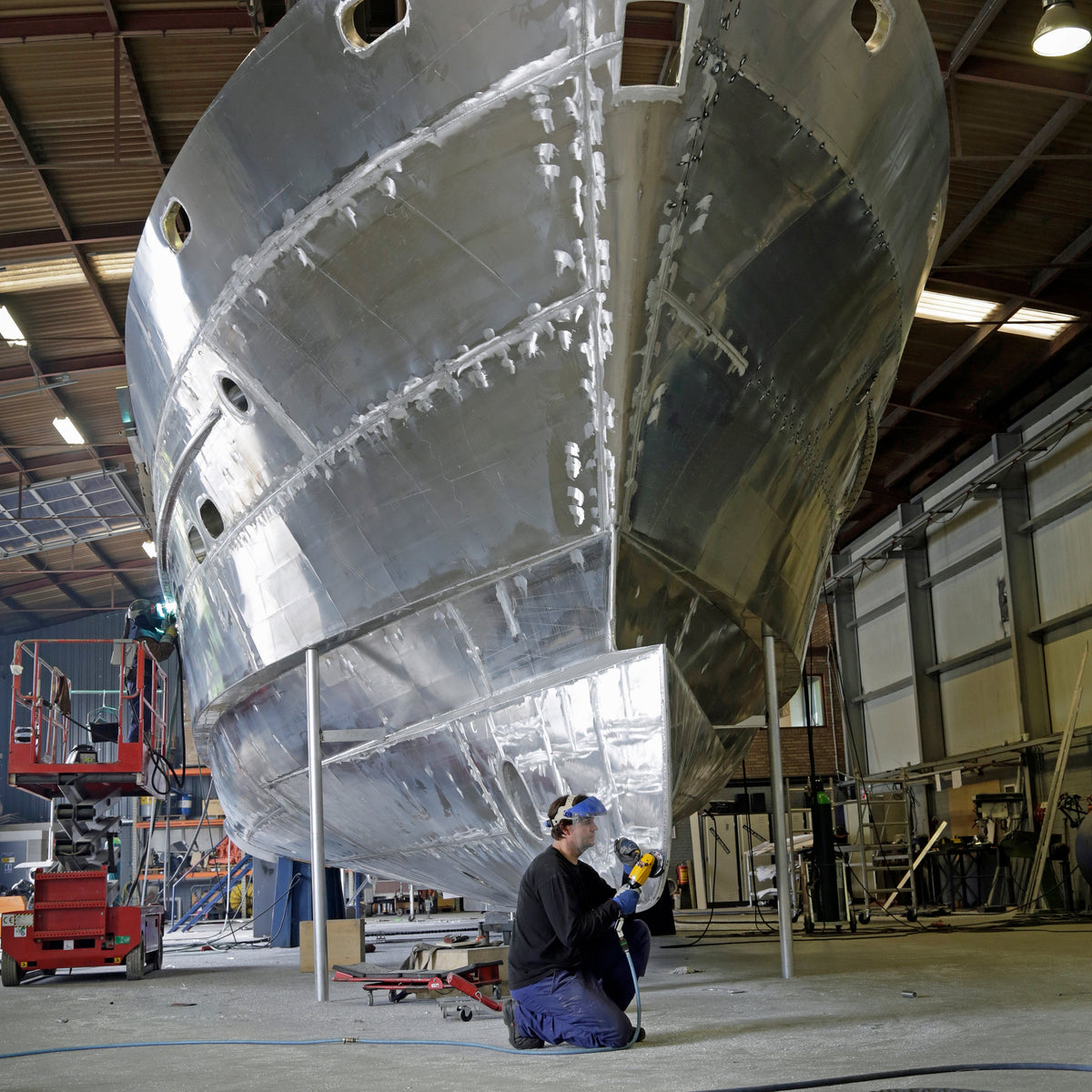
On a ship, the air is never where you need it. The compressor is on the pier, the work is three decks down and two hundred feet aft, and the hose has to go through a hatch, around a staging platform and over a rail to get there. Every foot of that run costs pressure, and the person on the end of it is holding a needle scaler or a blast nozzle that does not care about your excuses.
This guide covers compressed air for shipyards: ship repair and shipbuilding yards, drydock contractors and the subcontractors who bring their own equipment to the pier. We sell compressors, receivers, hose, couplers and filtration. We do not build fixed shipyard power plants, and the yard-wide header on a big yard is a different job from what is covered here. What we can speak to is the portable and shop side, which is where most of the air actually gets made on a repair job.
How a shipyard uses air
Hull work is surface prep, coating and repair, and almost every step is pneumatic.
- Abrasive blasting of hulls, tanks and decks before coating. This is the biggest air consumer by far.
- Needle scalers, chipping hammers and descalers for rust, scale and old coatings in places a blast nozzle cannot reach.
- Pneumatic grinders, sanders and impact tools for fit-up, fairing and fastener work.
- Spray equipment, from airless pump drives to conventional guns for touch-up.
- Air-driven ventilation in tanks and confined spaces, using venturi-style movers that run on compressed air.
- Pneumatic testing of tanks and compartments, done at low pressure with calibrated gauges and a relief device.
- Air-driven pumps and winches where electric equipment is a problem near fuel or vapor.
The ship's own systems are often secured or isolated during repair work, so contractors usually bring their own air. That is why towables and portable machines dominate this trade.
Sizing: start with the blast nozzle
Blast nozzle size sets the compressor. At 100 PSI at the nozzle, a 3/8 inch nozzle uses roughly 195 CFM, a 7/16 inch nozzle roughly 254 CFM and a 1/2 inch nozzle roughly 317 CFM, and those figures climb as the nozzle wears. A nozzle that has worn a size larger can pull 30 percent or more than its label, which is why a blaster who seemed fine in the morning is starving by the afternoon. Our guide to compressed air for abrasive blasting goes deeper on nozzle wear and moisture.
| Load | Approx. CFM | Notes |
|---|---|---|
| One blaster, 3/8 in. nozzle | 195 | Needs a 375 to 400 CFM class machine once hose loss is counted |
| One blaster, 7/16 in. nozzle | 254 | Same machine, no headroom for anything else |
| Needle scalers, each | About 15 to 25 | Check the tool plate, and add all that run together |
| Angle grinder or sander, each | About 15 to 30 | Heavy continuous users |
| Venturi air mover | Varies by model | Check the CFM on the movers you actually use |
Four needle scalers add up to about 60 to 100 CFM. That is a whole 185 CFM towable once you include a couple of grinders. If the same job also needs a blaster, plan on a second machine rather than hoping one big unit can do it all. Many yards run a 375 to 400 CFM towable per blaster and a separate 185 for the hand tools. Browse our towable air compressors and read our guides on sizing a tow-behind and diesel compressors.
The hose run is the real design problem
A compressor that makes 400 CFM at the pier does not deliver 400 CFM at the tool. Pressure drops across every foot of hose, every coupler and every elbow, and in a shipyard the run is long. Two rules cut most of the pain.
Use bigger hose than you think you need. A 1 inch ID hose for blasting and 3/4 inch for the header that feeds hand tools is common. Dropping to a skinny hose at the end of a long run is how a 100 PSI compressor ends up delivering 70 PSI to the nozzle.
Keep couplers full-flow and clean. A worn or undersized quick coupler can choke a run. Look at our quick couplers and hose selection, and use safety clips or whip restraints on large hose connections. A parted hose under pressure on a staging platform is a bad day.
Route hose where it will not get run over, pinched in a hatch or chafed on a sharp plate edge. Protect it at every rail and hatch crossing. Hose that gets dragged across steel for a week does not last the project.
Wet air, salt air and the cold
A pier is damp, often cold in winter, and always full of salt. All three work against compressed air.
- Water. Compressors make water, and humid waterfront air makes more. Water in a blast line turns abrasive into mud and clogs the pot. A moisture separator and an aftercooler at the compressor outlet are the minimum. See our article on wet air and blasting.
- Freezing. A water-logged line freezes on a cold morning and takes the job with it. Drain receivers and traps at the end of every shift.
- Salt. Salt air eats exposed fittings, unprotected hose ends and cheap couplers. Rinse and inspect them, and replace what shows corrosion.
- Placement. Park the compressor upwind of the blasting and painting, with its intake clear of abrasive dust and overspray. Keep engine exhaust well away from confined space openings.
The pressure vessel rule that applies to a yard
Shipyards fall under OSHA's shipyard standards in 29 CFR Part 1915. The scope section for the portable pressure vessel subpart says it covers ship repairing and shipbuilding. Section 1915.172 covers portable air receivers and other unfired pressure vessels. In plain terms:
- New vessels must be marked and reported as meeting the ASME Boiler and Pressure Vessel Code, Section VIII, and are hydrostatically tested at one and a half times working pressure.
- Older vessels not built to that code must be examined quarterly by a competent person and hydrostatically tested every year at one and a half times working pressure.
- Relief valves must be set to the vessel's safe working pressure or the system's lowest safe working pressure, whichever is lower.
- You keep a certification record with the date, the signature of the person who did the examination or test, and the serial number or other identifier of the equipment.
If you buy a receiver or a portable compressor with a tank, make sure the vessel carries the ASME stamp and the relief valve is correct for your system. Our air receiver guide and OSHA rules article are good starting points. Read the current regulation text and talk to your safety officer, because the details of how it applies to your operation are theirs to decide.
Breathing air is a separate system
Blasters and painters working in tanks or confined spaces need supplied breathing air, which is not plant air with a filter bolted on. Our overview of Grade D breathing air explains what the standard requires. If you do coating work in tanks, treat the breathing air source as its own piece of equipment with its own monitoring.
Mistakes yards make with air
Sizing for the tool, not the nozzle after wear. Plan for a worn nozzle, because that is what you will be using by week two.
Running one compressor for blasting and hand tools together. The blaster eats the air, and the hand tools stall.
Skinny hose on the last leg. The restriction shows up as lost production and a crew that blames the compressor.
No drain routine. Water in the lines is the number one cause of bad blast days.
Missing records on receivers. If an inspector asks for the vessel certification, you want it in a binder, not a rumor.
Frequently Asked Questions
How much air does a shipyard blaster need?
It depends on nozzle size. At 100 PSI, a 3/8 inch nozzle uses roughly 195 CFM and a 7/16 inch nozzle roughly 254 CFM, and a worn nozzle uses more. Most yards put one blaster on a 375 to 400 CFM class towable.
What OSHA rule covers air receivers in shipyards?
29 CFR 1915.172 covers portable air receivers and other unfired pressure vessels in ship repairing and shipbuilding. It calls for ASME Section VIII construction on new vessels, hydrostatic testing, relief valves set to the lower of vessel or system pressure, and a certification record.
Do I need a dryer on a pier compressor?
At minimum an aftercooler and moisture separator, plus daily drains. Wet air clogs blast pots and freezes in cold weather. A dryer is worth adding for coating work where moisture affects the finish.
Can I use plant air for breathing air in a tank?
No. Breathing air needs its own supply, purification and monitoring. Do not connect a respirator to a standard compressor and filter set unless the system is designed for breathing air.
Diesel towable or electric compressor for a yard?
Towables suit contractors and remote piers where there is no power. Electric machines make sense for a fixed shop. Keep diesel exhaust away from confined spaces either way.
Planning air for your yard or your next drydock job? Start with our towable air compressors, and call us with your nozzle size and hose length. We will help you pick the right compressed air for shipyards work.


