


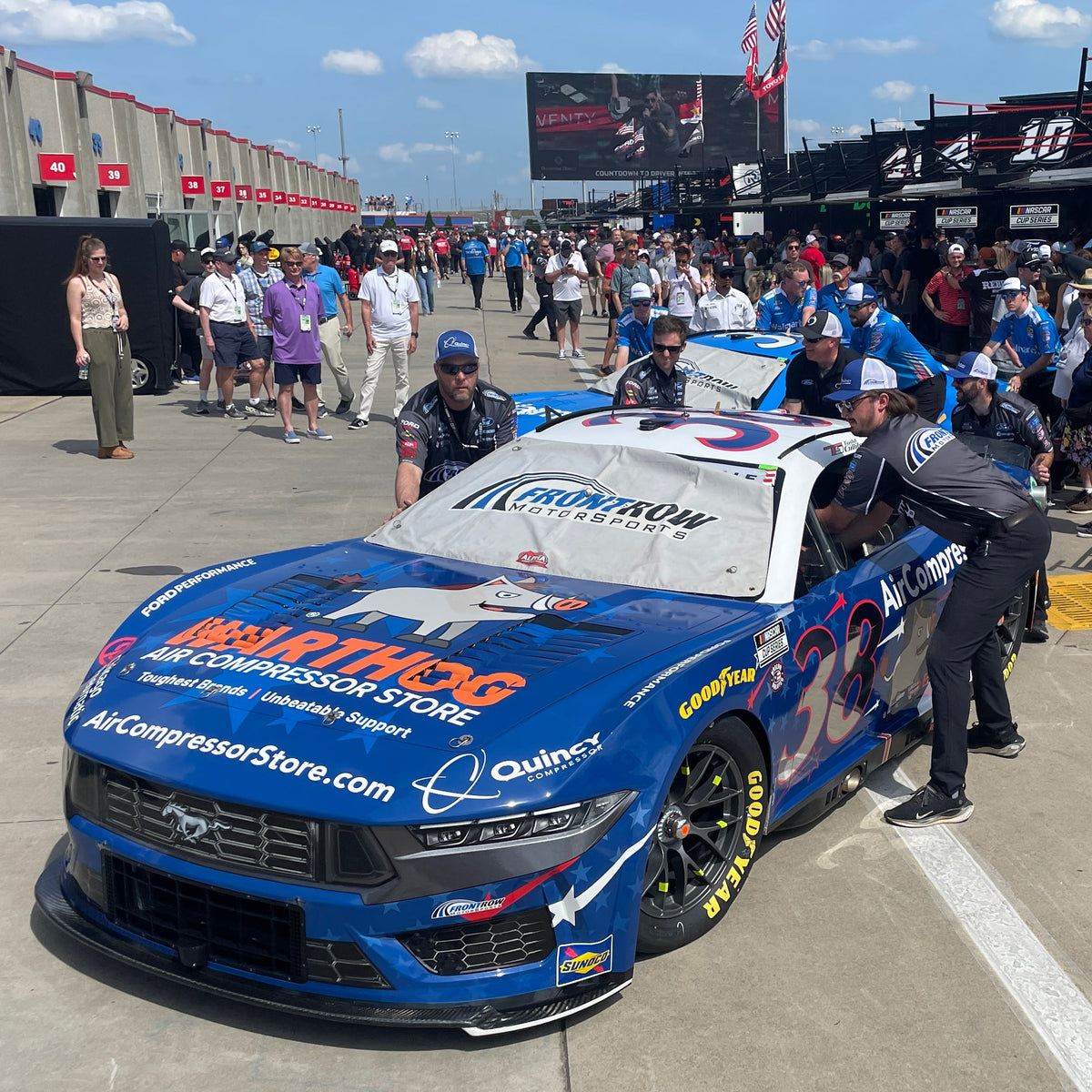
A race shop uses compressed air in short, violent bursts. Two techs hit lug nuts at the same time, somebody pulls the car up on air jacks, a third is blowing out a radiator, and the pressure on the gauge drops 30 PSI in four seconds. Then it all goes quiet for twenty minutes. If that sounds like your Friday night before a weekend event, this is written for you. Whether you build late models, run a road racing team, prep drag cars or turn wrenches for a vintage series, the air problem is the same: demand comes in spikes, the air has to be dry, and everything has to travel in a trailer on Sunday night.
This page covers compressed air for race shops end to end. It leans on what we sell, which is the compressors, dryers, filters, tanks, pipe, nitrogen generators and air tools behind a shop floor. It also says where we stop, because pit road and the dyno cell have their own specialists.
Why a race shop is not a regular garage
A general service garage lives on a steady diet of impact wrenches and tire machines. We covered that in our guide to compressors for tire work. A race shop has a few differences that change the equipment list:
- Spiky demand. The average load is low and the peak is high. That favors storage and pressure control over raw horsepower.
- Fabrication happens in the same building. Die grinders, DA sanders, cut off wheels and often a plasma cutter all share the same air as the impact guns.
- Paint and body work. Many teams spray their own numbers, sponsor panels and clear coat on composite or steel bodies. Wet or oily air shows up in the finish.
- Tire pressure is a setup tool. Teams track hot and cold pressures to a fraction of a PSI, which is where nitrogen enters the conversation.
- It has to travel. The shop air and the track air are two different systems that do the same jobs.
What each job asks of the air
These are typical figures for planning. Tool makers publish the actual number for each model, and you should use the spec sheet on yours (our air tool CFM chart lists common tools side by side).
| Job | Typical operating pressure | Typical air use | Pattern |
|---|---|---|---|
| 1/2 inch impact wrench | 90 PSI | about 4 to 5 CFM average | Short bursts |
| Die grinder | 90 PSI | about 4 to 6 CFM | Steady while cutting |
| DA or orbital sander | 90 PSI | about 8 to 12 CFM | Continuous, hungry |
| HVLP spray gun | set at the gun, supply near 90 | about 10 to 14 CFM | Continuous while spraying |
| Plasma cutter | about 70 to 90 PSI | about 4 to 8 CFM | Continuous while cutting |
| Air jack | commonly rated around 120 PSI | small volume, fill and hold | Occasional |
| Tire fill | usually well under 60 PSI | trivial volume | Occasional |
The sander is the one that surprises people. An impact wrench barely registers over a full day, but a DA sander and a spray gun run continuously, and together they will pull more air than the whole rest of the shop.
Sizing the compressor
Add what runs at the same time, not everything you own. In a typical two or three bay chassis shop that might be one tech on impacts (5 CFM), one on a sander (10 CFM), and one on a die grinder (5 CFM). That is 20 CFM at 90 PSI, and you want some margin, so 25 to 30 CFM. If somebody is also spraying, add another 12 or so.
- Small team, one or two techs: a 5 to 7.5 HP two stage piston compressor on an 80 gallon tank, running on single phase if that is all the building has. Check the amp draw against your panel first.
- Full shop, several techs, paint booth or heavy fab: a 10 to 15 HP rotary screw (roughly 38 to 60 CFM). A screw runs cooler, runs continuously and is easier on the electric bill when the shop is busy. Our rotary screw guide covers how they work.
- Race shop with machine tools or a second building: size for the total and talk to us about two smaller units instead of one big one. A shop that cannot afford a Saturday morning without air should not have a single compressor.
The tank matters as much as the horsepower in a spiky shop. A large receiver is cheap insurance against pressure sag when two guns trigger at once. If you only ever buy one upgrade, add a 120 or 200 gallon tank on the shop side of the dryer and give those peaks a reservoir. Browse air receiver tanks.
Keeping the air dry
Water is the quiet enemy in a race shop. It rusts the inside of impact guns, it freezes tool motors in a cold shop, it makes spray gun fisheyes, and it throws off tire pressure readings. A compressor does not make dry air. It makes hot, saturated air, and the water drops out as it cools in the lines.
A reasonable setup, from the compressor outward: an aftercooler or a water cooled separator, a refrigerated dryer sized for full flow, a coalescing filter, and automatic drains at the tank and every low point. A refrigerated dryer brings the pressure dew point down to the mid 30s Fahrenheit, which is fine inside a heated building. If a line runs through an unheated lean-to or the paint room is cold, a desiccant dryer gets you down to minus 40 and the air stays dry. See refrigerated versus desiccant for the tradeoffs.
Paint is its own category. Even with a dryer, you want a point of use filter and a regulator at the booth, plus an oil removal stage, because a trace of compressor oil will ruin a clear coat job. Our piece on air filtration for paint booths shows the stack.
Nitrogen for tires
Plenty of teams fill tires with nitrogen. The honest case for it: nitrogen from a generator is dry, so the pressure rises more predictably as the tire heats up, and you do not have moisture swinging your hot pressures around. The honest case against: air is already about 78 percent nitrogen, the difference in leak rate is small, and a team with a sloppy gauge routine will not fix its handling with a gas change. If you track tire pressure carefully, dry gas is worth having. If you do not, spend the money on a better gauge first.
You can buy nitrogen in bottles or make it. A membrane or PSA generator pulls it from your shop air, and the gas runs off the same compressor. The generator needs clean, dry air going in and enough flow behind it, which is why the dryer and filter conversation comes first. Our nitrogen generator guide explains purity and flow, and the nitrogen generators in the catalog are sized for shop and light industrial work. Check the purity and flow on the spec sheet against how many wheels you service in an evening.
Piping and drops
Most race shop air is delivered through a mess of coiled hose across the floor. A better plan is a ring or a trunk line down the length of the shop with drops at each bay and at the fab area, sloped back toward the compressor, with a drip leg at each drop. Aluminum pipe is a common choice here because it does not rust and goes together quickly. We cover sizing in the pipe sizing guide, and you can browse aluminum air pipe. Put a quick coupler and a short whip at each drop so techs are not dragging a 50 foot hose around the car.
The track side
At the track you are working from a trailer or a truck bed. The compressor choices are electric on a generator, a gas or diesel engine drive, or a 12 volt unit for light duty. Electric is quiet in a paddock, gas does not care about shore power, and neither is as efficient as the shop machine. Run the generator math before you buy: a compressor draws several times its running current at start, and an undersized generator that stumbles on startup is the usual complaint. Our generator sizing article walks through it. For choosing the compressor itself, see the portable compressor guide.
Keep a regulated hose and a small tank for the pit area, an inline desiccant filter at the tool if humidity is high, and a coupler style that matches everything you own. A mix of coupler types in one trailer is the slowest thing you can have during a tire change.
What we do not cover
Pit road wheel guns built for competition, ultra lightweight composite air jacks, and the very high pressure fills used in some forms of racing are specialty products from specialty suppliers. We sell industrial grade compressors, dryers, filtration, tanks, piping and industrial air tools, not race specific pit equipment. If your air jacks or guns are made for a particular series, buy them from the vendor that supports your series, and bring the compressor, dryer and piping questions to us. We would rather tell you that than sell you something that does not fit.
Questions race teams ask
How many CFM does a pit crew style impact gun use?
It varies by gun and by how often it fires. Competition guns often hit hard and fire in short bursts, so average consumption is moderate while peak demand is large. That is why storage helps. Look up the tool maker's CFM rating and pair it with a receiver big enough to ride through a stop.
Do I need a dryer if my shop is heated?
Yes. A heated shop lowers the chance of freezing, but it does not stop the water that a compressor delivers hot and saturated. Paint, tools and nitrogen generators all need dry air. Heated space just means a refrigerated dryer is usually enough.
Can I run the nitrogen generator off the same compressor as the tools?
Yes, if the compressor has capacity beyond the tools and the air going in is clean and dry. Give the generator its own filtration, and plan for it to draw a steady flow while it fills.
Is a single phase compressor enough?
For a small shop, a 5 to 7.5 HP two stage on single phase is common. Past that, check what the building can deliver. Three phase machines run cooler and cost less to run, so it can be worth adding a phase.


