


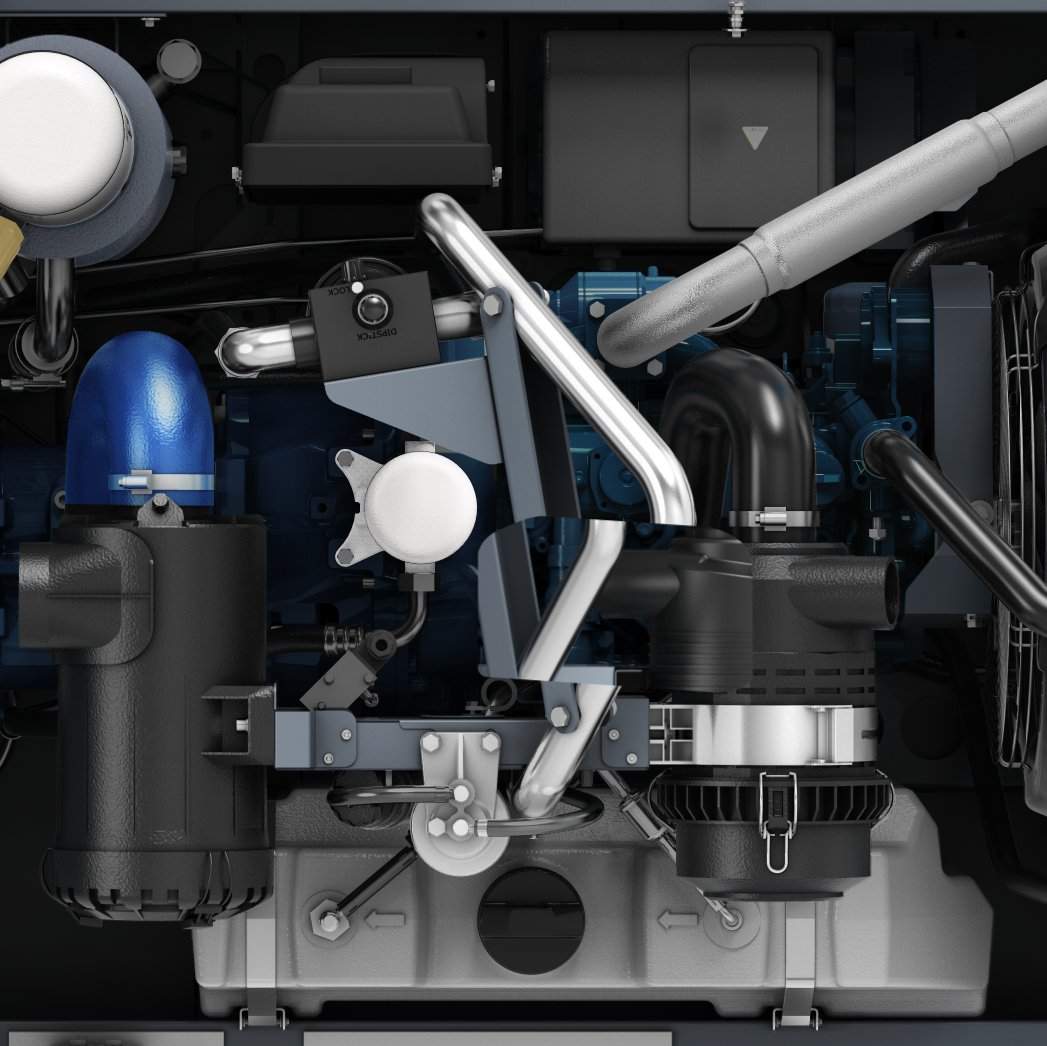
A diesel engine turns about a quarter to a third of the energy in the tank into usable compressed air. An electric motor turns roughly 90 percent of what comes off the wire into the same thing. On paper that should end the argument.
It does not, because half the jobs that need serious air happen where there is no wire. A diesel air compressor is not the efficient choice and it was never trying to be. It is the machine that shows up on a bridge deck, a pipeline right of way, a tank farm or a street cut and makes 185 CFM out of nothing but fuel. The question worth answering is not whether diesel is efficient. It is whether your job actually needs one, and if so, how big.
When Diesel Is the Right Answer
Diesel earns its place in a few specific situations:
- No power at the site. Pipeline work, bridge and highway jobs, remote tank maintenance, utility cuts, disaster response. There is no electric option to compare it against.
- Power exists but not enough of it. A 100 CFM electric machine wants a 25 hp motor and the service to feed it. On a lot of job trailers that panel does not exist, and running temporary service costs more than the fuel ever will.
- The work moves. If the compressor follows the crew down a road or around a plant every few days, a towable is the practical package. Wheels, a lunette or ball hitch, and a fuel tank beat conduit every time.
- Short duration, high demand. Blasting a tank for three weeks does not justify a permanent installation.
If none of those describe your situation and you are running air in a fixed building all day, you probably want an electric machine. Our rotary screw guide is the better starting point in that case.
Sizing: Start With the Tool, Not the Horsepower
Almost every undersized towable we hear about got picked by horsepower or by what fit the budget. Size it by what the tools draw at the pressure they need, then add margin.
Blasting is the common culprit because nozzle demand climbs fast. Venturi nozzle air consumption at 100 psi, for a nozzle in good shape:
| Nozzle orifice | Nozzle number | CFM at 100 psi | Practical compressor |
|---|---|---|---|
| 3/16 in | #3 | 54 | 90 to 100 CFM |
| 1/4 in | #4 | 97 | 150 to 185 CFM |
| 5/16 in | #5 | 152 | 185 to 250 CFM |
| 3/8 in | #6 | 196 | 250 to 375 CFM |
Two things about that table. First, the compressor column is bigger than the nozzle number because you have line losses, a blast pot, and usually a second operator eventually. Adding about 25 percent over the raw nozzle figure is the working habit.
Second, and this is the one that catches people: a worn nozzle eats 30 to 50 percent more air than a new one. The orifice opens up with use, and nobody notices until production drops and somebody blames the compressor. If your blast crew is complaining about pressure, check the nozzle gauge before you call about a bigger machine.
For breaking and drilling, the rough numbers are simpler. A 60 to 90 pound class breaker generally runs in the 60 to 90 CFM range, so a 185 CFM unit handles two of them with a little left over, which is exactly why 185 is the most common size on the rental lot. Our pneumatic breaker guide has the per tool figures.
What It Actually Costs to Run
Fuel is the number people skip and then get surprised by. Published full load consumption for 185 CFM towables spans a wider range than you would expect, because the engine matters:
| Machine size | Full load fuel burn | Per 8 hour day at 4.00 a gallon |
|---|---|---|
| 185 CFM, efficient Tier 4F engine | about 1.6 gal per hour | roughly 51 |
| 185 CFM, larger engine package | about 2.7 to 2.8 gal per hour | roughly 86 to 90 |
| 375 to 500 CFM | about 3.0 to 4.0 gal per hour | roughly 96 to 128 |
Those are full load figures. Real jobs cycle, so a blasting crew that is actually blasting six hours out of eight lands somewhere below the top number. Altitude, ambient temperature and engine condition all move it.
Compare that to an electric machine doing the same work. A 40 hp rotary screw delivering around 170 CFM draws roughly 32 kW at the wire. At 12 cents a kilowatt hour that is about 3.84 an hour, or 31 for an eight hour day. So diesel costs somewhere between 1.5 and 3 times as much per hour of air, depending on which engine you got and what fuel is doing that month.
That gap is the honest case for electric anywhere you have power. It is also why nobody frets about it on a two week bridge job.
Tier 4 Final, Plainly
Every new nonroad diesel sold in the US meets EPA Tier 4 Final, and what that means for you depends entirely on engine horsepower. EPA sorts nonroad engines into bands: 0 to 25 hp, 25 to 75, 75 to 175, 175 to 750, and above 750.
- Under 75 hp, which covers most towables up through about 185 CFM, manufacturers generally hit the standard with high pressure common rail injection, EGR and a diesel oxidation catalyst. No diesel particulate filter, no DEF tank. Nothing extra for the operator to think about.
- 75 hp and up, which is where 250 CFM and larger units live, you are more likely to see SCR aftertreatment, and SCR means diesel exhaust fluid. That is another consumable, another tank to fill, and a fluid that has a shelf life and does not love freezing.
If your crew is not disciplined about DEF, that is a real argument for staying at or below the 185 CFM class, or for buying two smaller units instead of one large one. Two 185s also give you redundancy, which a single 375 does not.
Diesel Versus Electric, Side by Side
| Diesel towable | Electric rotary screw | |
|---|---|---|
| Energy into usable air | roughly 25 to 35 percent | roughly 90 percent |
| Cost per hour, 185 CFM class | about 6.40 to 11.20 in fuel | about 3.80 in power |
| Service interval | around every 250 hours | 2,000 to 4,000 hours |
| Infrastructure needed | none, just fuel | panel capacity and conduit |
| Portability | tow it anywhere | essentially fixed |
| Noise and exhaust | an issue indoors and in occupied areas | far easier to live with |
| Cold weather | starts are a known problem, fuel gels | generally a non issue |
That 250 hour service interval is worth sitting with. A towable running full time hits service every six weeks or so, and each one is labor plus filters plus oil. In a production setting that maintenance load adds up faster than the fuel bill does.
What to Check Before You Buy One
- CFM at the pressure you need, not the headline number. A machine rated 185 at 100 psi is not making 185 at 150 psi. If you are running a blast pot at 125, read the curve.
- Aftercooler and moisture. Straight out of a towable the air is hot and wet. For blasting that means a wet blast and a clogged pot. For anything with a tool or a filter downstream it means rust. An aftercooler option, or a water separator and filtration at the hose, is worth having. Our piece on air dryers for sandblasting covers why wet air ruins the work.
- Service outlets. Count them and size them. A machine with one 3/4 inch outlet is a nuisance when you need to run two breakers and a blow line.
- Fuel tank and runtime. A tank sized for eight hours means somebody refuels midday. Ten to twelve hour runtime keeps the crew on the tools.
- Cold weather package. Block heater, battery, fuel heater. In a northern winter this is not optional equipment.
- Trailer and brakes. Confirm the GVWR against what your truck can legally pull, and check whether your state requires brakes at that weight.
Mistakes We See
Buying on horsepower. Two machines with the same engine hp can differ meaningfully in delivered CFM. Compare air output at your working pressure.
Ignoring nozzle wear. The single most common cause of a towable that suddenly feels undersized. Gauge the nozzles monthly.
Idling all day. A compressor idling between breaks still burns fuel and still adds hours toward that 250 hour service. Shut it down.
Running it indoors. Carbon monoxide is not a maybe. If air has to go into a building, the machine stays outside and the hose goes in.
Renting forever. Rental makes sense for a season. Past roughly six to nine months of steady use, the math usually favors owning, especially if you can buy a good used unit. Our rent versus buy breakdown works the numbers.
Frequently Asked Questions
How much fuel does a diesel air compressor use?
A 185 CFM towable burns roughly 1.6 to 2.8 gallons per hour at full load depending on the engine, and a 375 to 500 CFM unit runs about 3 to 4 gallons per hour. Real world consumption sits below those figures because jobs cycle, and climbs with altitude, heat and engine wear.
What size diesel air compressor do I need for sandblasting?
Match it to the nozzle. A 1/4 inch nozzle at 100 psi wants about 97 CFM, so plan on 150 to 185 CFM once you account for line losses. A 3/8 inch nozzle wants about 196 CFM and needs a 250 to 375 CFM machine. Remember a worn nozzle can consume 30 to 50 percent more air than its rated size.
Is a diesel air compressor cheaper to run than electric?
No. Electric converts roughly 90 percent of input energy into compressed air against about 25 to 35 percent for diesel, and the hourly cost difference is typically 1.5 to 3 times. Diesel wins on portability and on jobs where there is no adequate power, not on operating cost.
Does my towable need DEF?
Only if its engine is 75 hp or larger and uses SCR aftertreatment, which generally means units above the 185 CFM class. Most towables under 75 hp meet Tier 4 Final with common rail injection, EGR and an oxidation catalyst, with no DEF tank and no particulate filter.
Can I use a diesel air compressor for shop air?
You can in a pinch, with the machine outside and hose run in, but it is the wrong tool for a permanent installation. Fuel cost, exhaust, noise and a 250 hour service interval make it expensive compared to an electric rotary screw, which is built to run all day in a fixed location.
The Short Version
Pick a diesel air compressor when the job has no power or the equipment has to move, size it off the tools at working pressure with a 25 percent cushion, check the nozzle condition before blaming the machine, and stay under 75 engine horsepower if you would rather not deal with DEF. Browse our towable air compressors by CFM, and if the machine is going to live in one building, look at electric rotary screws instead and keep the fuel money.


