


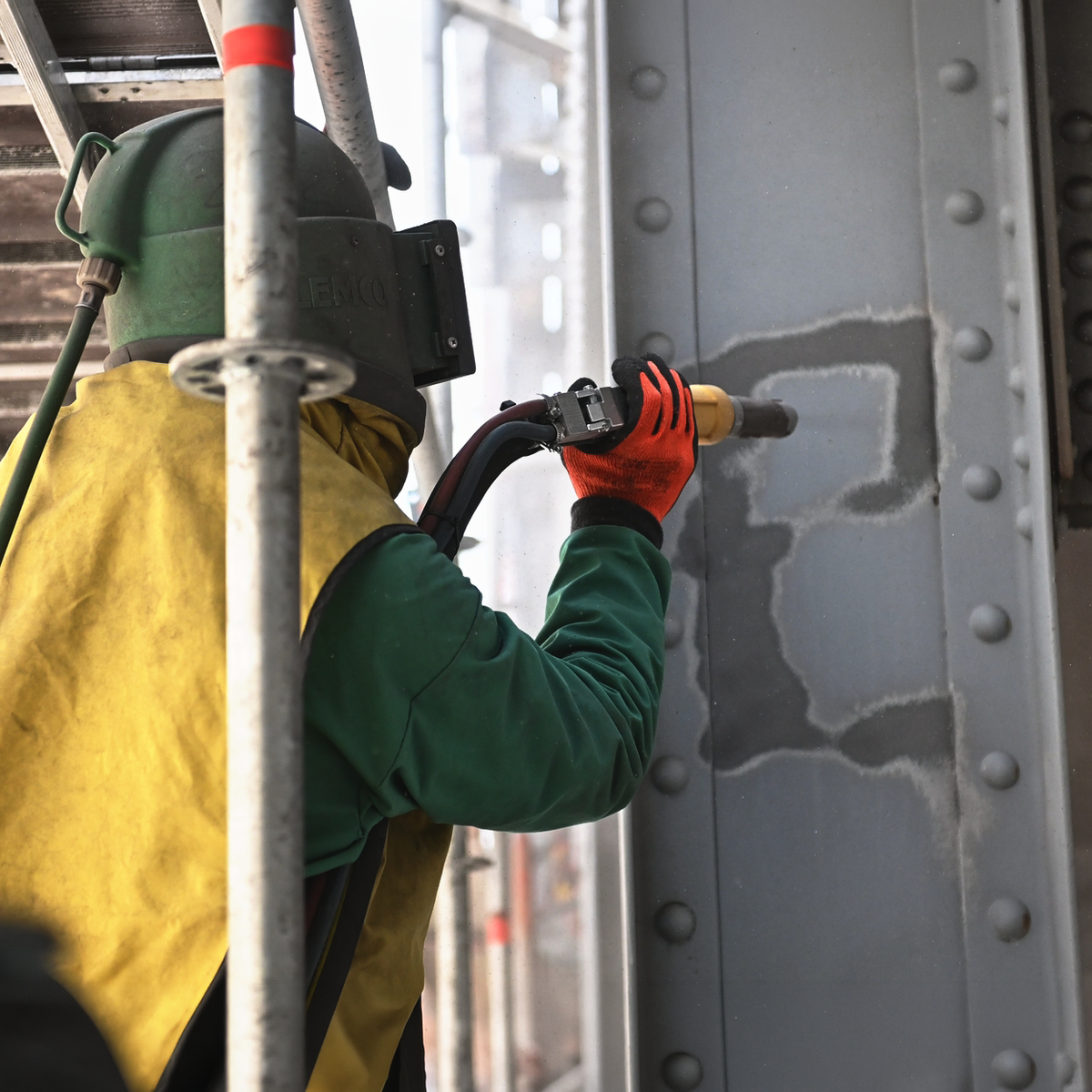
A blaster calls and says the pot keeps clogging. He has cleaned the metering valve twice, screened the media, and swapped the nozzle. Third question we ask: what is your discharge air temperature going into the pot? Long pause. He does not have an aftercooler.
That is the whole story on most blasting complaints. Compressed air for abrasive blasting fails in two ways and only two: you do not have enough volume, or you have water in the line. Everything else is downstream of those. Here is how to get both right, plus the operator safety piece that a lot of shops find out about the hard way during an inspection.
Volume Is Set by the Nozzle, Not the Compressor
Blasting is different from every other air application in one respect. Your tool has a fixed orifice and it will flow whatever you feed it, continuously, for as long as the trigger is down. There is no duty cycle to average. There is no tank that carries you through. The nozzle is an open hole and it is the entire load.
So the sizing question is backwards from a normal shop. You do not pick a compressor and see what it runs. You pick the nozzle and the compressor follows.
| Nozzle size | Orifice | CFM at 100 psi | Practical compressor |
|---|---|---|---|
| #3 | 3/16 in | Roughly 60 to 70 | 85 to 100 CFM |
| #4 | 1/4 in | Roughly 105 to 120 | 130 to 150 CFM |
| #5 | 5/16 in | Roughly 165 to 180 | 185 to 210 CFM |
| #6 | 3/8 in | Roughly 230 to 250 | 275 to 325 CFM |
| #7 | 7/16 in | Roughly 310 to 340 | 375 to 425 CFM |
| #8 | 1/2 in | Roughly 400 to 425 | 475 to 550 CFM |
Two things to understand about that right-hand column.
First, the 20 to 25 percent margin is not padding. You lose roughly 0.75 psi across the blast pot itself and about 2 psi per 50 feet of blast hose. A 150 foot hose run is costing you 6 psi before the nozzle sees anything, and pressure at the nozzle is what sets your production rate.
Second, and this is the one that surprises people: a worn nozzle flows far more air than a new one. A nozzle that has opened up one size, which happens quietly over a few hundred hours with aggressive media, can pull 40 to 70 percent more CFM than it did new. Shops size a compressor perfectly for a #5, run it for six months, and then wonder why pressure fell off. Gauge your nozzles. When the orifice has grown enough to move you up a size, you are either buying a bigger compressor or buying a new nozzle, and the nozzle is cheaper.
Pressure, and Why 90 to 100 psi Is the Target
Most blast nozzles are designed to deliver optimum abrasive velocity between 90 and 100 psi at the nozzle. Production rate falls off steeply below that. The rough figure the industry uses is that dropping from 100 psi to 80 psi costs you somewhere around 15 percent of your production rate, and the loss compounds as you go lower.
There is also a floor you cannot go under. A pressure pot needs roughly 50 psi just to seat its pop-up valve and seal. If your compressor is so undersized that pot pressure sags toward that number while the operator is blasting, the pot starts behaving erratically before it stops entirely.
So measure at the nozzle, not at the machine. A hypodermic needle pressure gauge pushed into the blast hose just behind the nozzle holder costs very little and is the only honest reading in the whole system.
If that gauge shows pressure dipping every time the pot cycles and then recovering, you have a storage and distribution problem rather than a capacity problem, and a receiver is a far cheaper fix than a bigger machine. We work through the sizing math, wet versus dry tanks and putting a tank at the pot in air receivers for abrasive blasting.
Moisture Is the Other Half of the Job
This is where most blasting operations lose money, and the numbers are worse than people expect.
A 375 CFM compressor running on an 85 F day at 75 percent relative humidity will condense somewhere in the range of 2.5 to 3 gallons of liquid water per hour. If nothing is taking that out, all of it goes into your blast pot. Media turns to mud, the metering valve packs, flow goes erratic, and in the worst case you are putting moisture onto a freshly profiled surface that is about to be coated.
The minimum treatment for any pressure blasting operation is two pieces:
- An aftercooler. Air leaves a working compressor hot, and hot air holds its water as vapor, which means a separator sees almost nothing and passes it all downstream to condense later in your hose. The aftercooler drops discharge temperature so the water actually becomes liquid where you can catch it. This is the piece most undersized shops are missing, and it is the single highest-value addition to a blasting rig. See aftercoolers for sizes.
- A centrifugal moisture separator with a working automatic drain immediately after the aftercooler, so the condensed water leaves the system instead of riding along. Browse water separators.
Add a moisture trap at the pot as a last line of defense, especially on a portable rig where the air travels a long way in the sun. If you are blasting anything that gets coated immediately afterward, or you are blasting in humid conditions where flash rust is a real risk, a desiccant dryer downstream of the separator is worth the running cost. Our piece on the right order to build a treatment train covers why sequence matters, and dew point explained covers what you are actually targeting. For the full breakdown of which dryer type to buy for blasting, how to size it, and how to pass an ASTM D4285 blotter test, see air dryers for sandblasting.
Operator Air Is a Separate System
Here is the part that gets shops cited. Abrasive blasting generates respirable dust, and if you are blasting anything containing crystalline silica, you are inside OSHA's silica standard with a permissible exposure limit of 50 micrograms per cubic meter as an 8 hour time weighted average. For most open blasting, that means the operator is in a supplied air respirator, typically a Type CE abrasive blasting hood.
Feeding that hood is not a matter of teeing off the blast line. You need Grade D breathing air per CGA G-7.1, which sets limits on oxygen content, hydrocarbons, carbon monoxide, carbon dioxide and odor. Two requirements catch people:
- Carbon monoxide. If your breathing air comes from an oil-lubricated compressor, OSHA requires either a high temperature alarm or a carbon monoxide alarm, and in practice you want the CO monitor regardless. An overheating oil-lubed compressor can generate CO, and the operator in a hood has no way to know.
- A dedicated filtration panel. Breathing air needs its own filtration train, usually a coalescing stage plus activated carbon, feeding a manifold with a pressure regulator sized for the number of hoods on the system.
Two more practical notes. Draw your breathing air intake from clean outside air, well away from the blast plume and any engine exhaust, and remember an engine-driven portable compressor is sitting right next to its own exhaust. And do not let anyone use a standard dust mask or a half-face respirator in a blast enclosure, because they are not rated for it.
We went into the full spec in what Grade D breathing air actually requires, and the system build for a blast crew, stage by stage, is in breathing air for blasting. Read both before you plumb a hood.
Cabinet Blasting Is a Different Animal
Everything above is about pressure blasting, open or in a room. A siphon-feed cabinet in the corner of a machine shop is a much smaller problem.
| Setup | Typical demand | Notes |
|---|---|---|
| Siphon cabinet, small nozzle | 10 to 20 CFM | A 5 hp two stage will run one, barely |
| Pressure cabinet | 25 to 50 CFM | Roughly four times the removal rate of siphon |
| Portable pot, #4 nozzle | 130 to 150 CFM | Tow behind territory |
| Blast room, #6 or #7 | 275 to 425 CFM | Dedicated plant compressor |
The jump from cabinet to pot is where shops get caught. A cabinet feels like it validates the compressor you own. Moving outside to a pot with a #5 nozzle is a five to ten times increase in demand and it almost always means a new machine. Look at air compressors sized on the nozzle table above, or at tow behind units if the work moves.
What Goes Wrong Most Often
Sizing on the compressor you already own. The nozzle sets the demand. If you buy the nozzle to match an undersized compressor, you have bought a slower job, and blasting is billed by the hour.
No aftercooler. Covered above. If you take one thing from this page, take this one.
Ignoring nozzle wear. Free to check, expensive to ignore, and the most common cause of "my compressor got weaker."
Undersized blast hose. Blast hose should be roughly three to four times the nozzle orifice diameter. Too small and you are throttling the job at the hose instead of the nozzle.
No storage, or all of it in the wrong place. A swinging load like blasting needs a dry receiver tank behind the treatment train, and often a small tank right at the pot. Buying a bigger compressor to solve a storage problem is an expensive way to not fix it. See air receivers for abrasive blasting.
Treating breathing air as an afterthought. It is a separate system with its own standard, its own filtration and its own monitoring. Budget for it when you budget for the pot.
Frequently Asked Questions
What size compressor do I need for sandblasting?
Size it on the nozzle. A #4 (1/4 inch) nozzle needs roughly 105 to 120 CFM at 100 psi, so plan on a 130 to 150 CFM machine. A #6 (3/8 inch) needs roughly 230 to 250 CFM, so plan on 275 to 325. Add 20 to 25 percent over the nozzle's rated consumption to cover hose loss, pot loss and nozzle wear.
Why does my blast media keep clumping in the pot?
Almost always water. A compressor working on a warm humid day condenses several gallons an hour, and without an aftercooler and separator that water ends up in the pot, where it turns media into mud and packs the metering valve. Fix the air treatment before you change media or rebuild the valve.
Do I really need an aftercooler if I already have a water separator?
Yes. A separator can only remove water that has already condensed into droplets. Hot discharge air holds its moisture as vapor, so it sails straight through the separator and condenses later in the hose or the pot. The aftercooler is what turns the vapor into liquid so the separator has something to catch.
What pressure should I blast at?
90 to 100 psi at the nozzle for most nozzle designs and media. Measure it at the nozzle with a needle gauge, not at the compressor. Production rate falls off sharply below 90, and a pressure pot needs about 50 psi just to seal its pop-up valve.
Can I use my shop compressor to feed a blasting hood?
Only if it meets Grade D breathing air per CGA G-7.1, which means the right filtration train, an intake drawing clean outside air, and, on an oil-lubricated compressor, a high temperature alarm or a carbon monoxide monitor. Most shop compressors do not meet that as installed. Treat operator air as its own system.
Where to Start
Pick your nozzle, read the CFM off the table, add 25 percent, and that is your compressor. Then spend the next chunk of the budget on an aftercooler and a separator, because a correctly sized machine feeding wet air into a pot is still a bad day. Get those two right and compressed air for abrasive blasting mostly stops being something you think about, which is the goal.


