


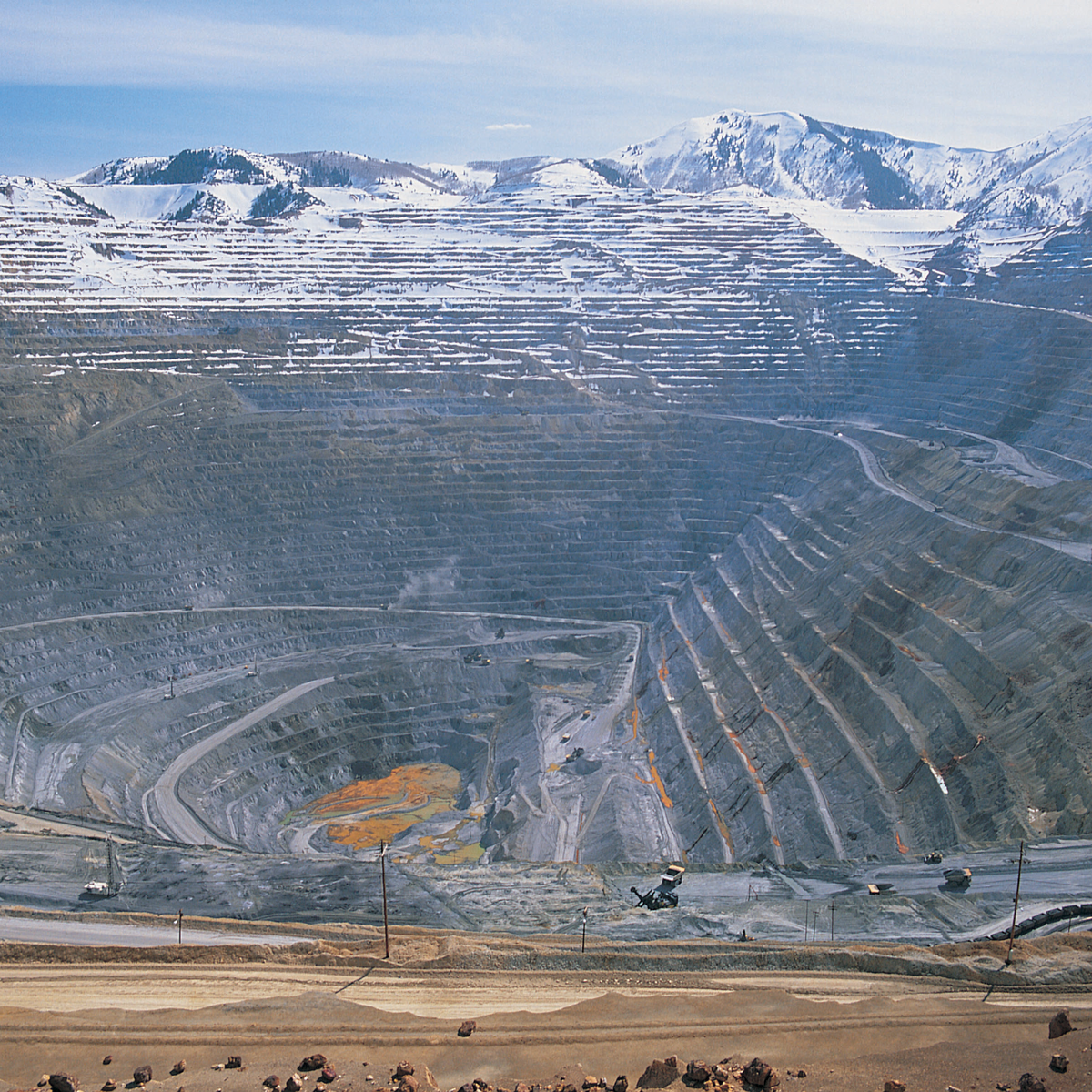
A quarry foreman wants to know why his 375 is struggling on a down-the-hole hammer that the spec sheet says needs 350 CFM. Two questions in, it turns out the hammer wants that 350 at 250 psi, and his compressor makes 375 at 125. Those are not the same machine and they are not even the same category of machine.
That confusion is the single most expensive mistake in this business. Compressed air for mining and quarry work is not scaled-up shop air. The pressures are higher, the volumes are in the hundreds or thousands, the machine lives outdoors in dust at whatever elevation the deposit happens to be, and the regulator watching you is MSHA rather than OSHA.
Know which kind of drilling you're feeding
Everything downstream depends on this, so start here.
Pneumatic rock drills. Jacklegs, sinkers, stopers, hand-held drifters. These run at normal utility pressure, generally around 90 to 110 psi, and consume in the range of roughly 90 to 150 CFM each depending on size. A 185 or a 375 towable runs one or two of them. This is the category most small quarries and contractors actually live in.
Down-the-hole hammers and rotary drill rigs. Completely different animal. The hammer is at the bottom of the hole and the air has to travel down the drill string, do the work, and carry cuttings all the way back up the annulus. That takes both high pressure, commonly in the 100 to 350 psi range, and high volume, frequently in the hundreds and running into the thousands of CFM on large rigs.
Here is the rule that gets violated: a compressor's CFM rating is only meaningful at a stated pressure, and the two trade against each other. A machine rated 375 CFM at 125 psi does not make 375 CFM at 250 psi. It makes considerably less, if it can reach 250 at all, and most standard portables cannot. High pressure work needs a machine actually built and rated for it. We laid out the underlying relationship in CFM vs PSI.
| Application | Typical pressure | Typical flow | Machine class |
|---|---|---|---|
| Hand-held rock drill, jackleg or sinker | 90 to 110 psi | Roughly 90 to 150 CFM each | 185 to 400 CFM towable |
| Paving breaker, chipping, scaling | 90 psi | 30 to 90 CFM each | 185 CFM towable |
| Small DTH hammer | 150 to 250 psi | Several hundred CFM | High pressure portable |
| Large DTH or rotary blasthole rig | 250 to 350 psi | Many hundreds into the thousands | Rig-mounted or large dedicated portable |
| Plant air, conveyors, valves, cleanup | 90 to 125 psi | Site dependent | Fixed rotary screw |
Sizing, with the things people leave out
Add up the tools that genuinely run together, then account for four things a flatland shop never has to think about.
Altitude. Mines and quarries are frequently at elevation, and a compressor loses roughly 3 percent of rated capacity per 1,000 feet. At 7,500 feet you're keeping about three quarters of what the nameplate promises. Worse, the diesel engine derates independently for the same reason, so a towable takes the hit twice. Your air tools get weaker too. The full math is in air compressor altitude derating, and on a mine site it is not a rounding error.
Hose and drill string losses. Long runs to a face or a bench cost real pressure, and on DTH work the drill string itself is part of the circuit. Size hose generously and measure at the tool, not at the machine. We go through hose sizing by tool, plus the MSHA rules on restraints, in air hose and couplers for mining and quarry.
Bit and tool wear. A worn drill or an opened-up orifice consumes more air than a new one. Size with margin or you'll be short by mid-shift.
Heat and dust. A machine running at 105 degrees in a dust cloud with a loading intake filter is not going to make plate rating. Keep intake filters clean and check them far more often than the manual suggests.
Practical margin: land at roughly 1.3 to 1.5 times calculated demand before you apply the altitude correction, then divide by the altitude factor. Browse what fits in towable air compressors.
MSHA, silica and why wet drilling matters to your air system
Mining has its own regulator, and dust is the issue that drives most of it.
MSHA's respirable crystalline silica rule sets a permissible exposure limit of 50 micrograms per cubic meter as an 8 hour time weighted average, the same number OSHA uses on the construction side. Drilling rock is one of the most reliable ways to generate respirable silica, so the controls are not optional.
Wet drilling is the primary engineering control. Water injected through the drill steel suppresses dust right at the bit and helps clear cuttings at the same time. What that means for your air system is that water delivery is now part of the rig, and the air and water have to be balanced. Too little water and you're not controlling dust. Too much and you're making mud in the hole and killing penetration rate.
Where wet drilling isn't practical, dust collection systems on the drill do the job, and those have their own air or power demand you need to account for.
And if anyone on site ends up in a supplied air respirator, that air is a separate system with its own standard. Grade D breathing air per CGA G-7.1 means dedicated filtration, a carbon monoxide monitor on oil-lubricated machines, and an intake drawing clean air well away from the diesel exhaust sitting right next to it. Read Grade D breathing air requirements before you plumb a mask off anything.
Air treatment on a mine site
For drilling, minimal. Rock drills tolerate wet dirty air and want a steady shot of tool oil more than they want a dryer. Keep an inline lubricator in the circuit and keep the receiver drained.
Three places where that changes:
- Cold weather. Water in a line at 20 degrees is an ice plug, and an ice plug in a drill circuit stops the shift. This is where wet air stops being a tolerable nuisance. See winterizing.
- Instrument and control air. Crusher controls, actuated valves, plant automation and dust collector pulse cleaning all want clean dry air like any plant. Treat that leg properly with filtration and an air dryer.
- Abrasive blasting and equipment painting. Any maintenance shop doing surface prep needs an aftercooler, separator and dryer, same as anywhere else. Covered in air dryers for sandblasting.
What goes wrong on site
Buying CFM without checking the pressure it was rated at. The foreman in the opening paragraph. Always read the rating as a pair.
Ignoring altitude in the purchase decision. Easy to correct for on paper, expensive to discover on a bench at 8,000 feet.
Neglecting intake filters. A quarry is the dustiest environment a compressor will ever work in, and a restricted intake costs you capacity and cooks the machine. This is the highest-return maintenance item on a mine site, by a wide margin.
Undersized hose to the face. Same disease as every jobsite, just over longer distances. Put a gauge at the tool under load, and check that your hose restraints and couplers meet 30 CFR 56.13021 while you are out there.
Treating breathing air as an afterthought. It's a separate system with its own standard and its own monitoring. Budget it as one.
Skipping cooling checks. High ambient plus high altitude plus a dusty radiator is how machines fail in July. Start with overheating causes and fixes.
Frequently Asked Questions
What size compressor do I need for a rock drill?
For hand-held pneumatic drills like jacklegs and sinkers, figure roughly 90 to 150 CFM each at 90 to 110 psi, so a 185 CFM towable runs one comfortably and a 375 handles two with margin. Down-the-hole hammers are a completely different requirement, needing both much higher pressure and far more volume, and they need a machine rated for that pressure rather than a standard portable turned up.
Why won't my 375 CFM compressor run a DTH hammer?
Almost certainly because the ratings are at different pressures. A portable rated 375 CFM at 125 psi delivers substantially less air at 250 psi, and many cannot reach that pressure at all. DTH work needs a high pressure machine rated at the pressure your hammer actually requires. Compare machines at the same pressure or you are comparing nothing.
How much capacity do I lose at a high altitude mine?
Roughly 3 percent of rated capacity per 1,000 feet of elevation, so about 25 percent gone at 7,500 feet and closer to a third at 10,000. On a diesel towable the engine derates separately for the same reason, so the losses compound. Size your demand first, then divide by the altitude factor rather than multiplying by it.
What does MSHA require for drilling dust?
MSHA's respirable crystalline silica rule sets a permissible exposure limit of 50 micrograms per cubic meter as an 8 hour time weighted average. Wet drilling, with water injected through the drill steel, is the primary engineering control, with dust collection systems used where wet drilling is not practical. Confirm the current requirements with MSHA directly, since enforcement details and compliance dates change.
Do I need an air dryer for rock drilling?
Not usually for the drilling itself, since rock drills tolerate wet air and want lubrication more than dryness. You do need treatment for instrument and control air in the plant, for any blasting or painting in the maintenance shop, and in cold weather, where water in a line freezes and shuts the circuit down.
Where to start
Write down what your drills need as a pair, CFM at a specific pressure, not CFM alone. Add the tools that run together, add 30 to 50 percent, then correct for your elevation. Then spend real attention on intake filtration and cooling, because a quarry will punish a machine faster than anywhere else it could work. Get compressed air for mining and quarry work sized right at the front and most of what follows is just maintenance.


