


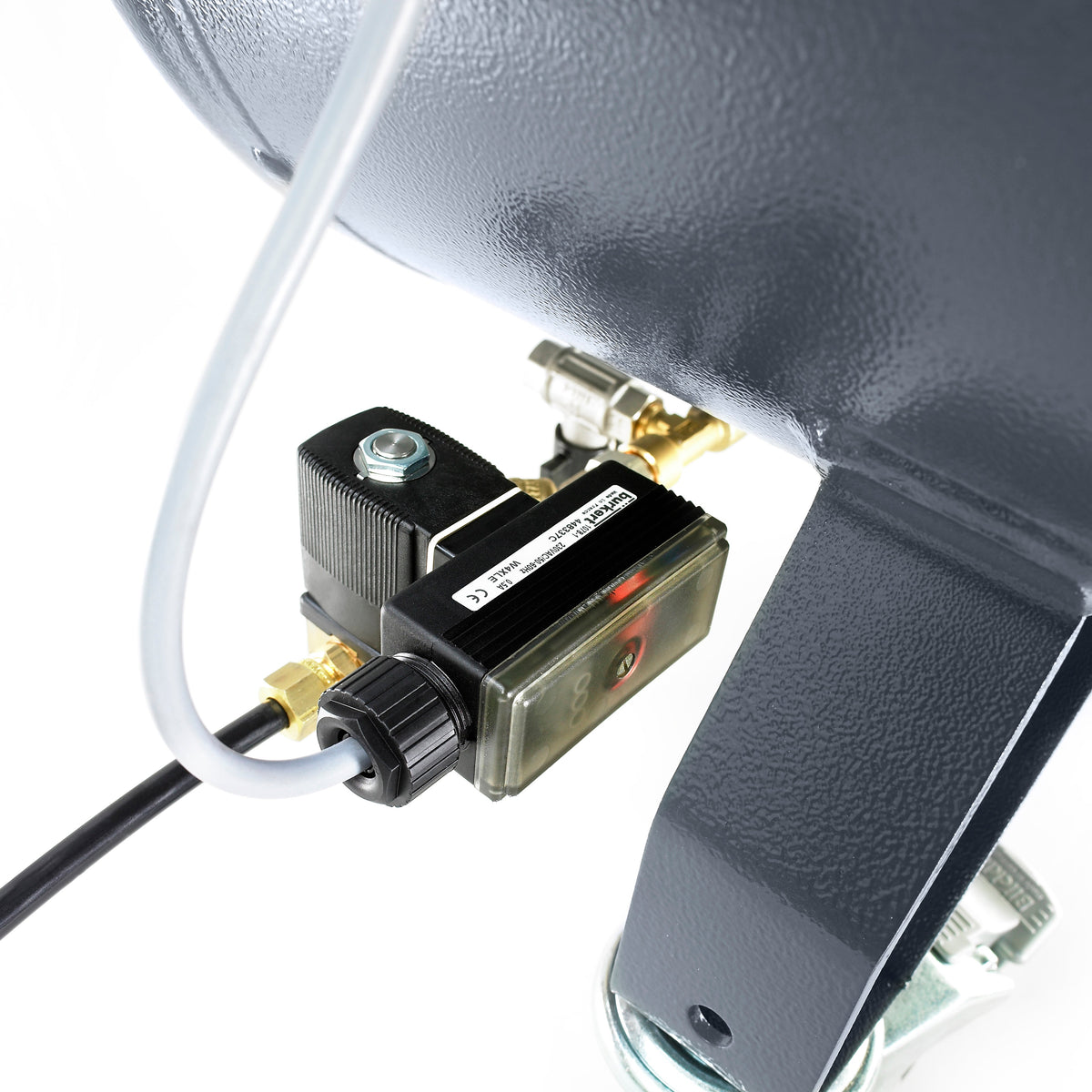
Stand in a compressor room for five minutes and you will hear it. A sharp hiss every couple of minutes, from somewhere down by the receiver. Everybody knows what it is and nobody thinks about it, because that is just what a drain does.
It is not what a drain has to do. That hiss is compressed air you paid to make, leaving the building, and on a timer drain it leaves whether there was any water to remove or not. The comparison of timer drains vs zero loss drains comes down to that single fact, and the numbers are larger than most people expect.
The four kinds of drain, and why two of them are a problem
Manual valve
A ball valve somebody is supposed to open. Costs nothing, wastes nothing, and does not work, because nobody opens it. In a shop where one person walks past the receiver every morning and actually cracks it, fine. Everywhere else, this is how tanks rust from the inside. See tank rust and when a tank is done.
Float or internal float drain
A mechanical float rises with the liquid and opens a valve. No power needed, and in principle it only opens when there is water, so it wastes nothing. The catch is reliability: floats stick, seats foul with oil and scale, and a failed float either stops draining or sticks open and vents continuously. They need checking.
Timer solenoid drain
An electronic timer energizes a solenoid for a set duration at a set interval. Simple, cheap, and everywhere. It is also the one costing you money, because the valve opens on the clock rather than on the condensate. If the interval comes around and the bowl is empty, you vent compressed air into the room for the full duration anyway.
Zero loss, demand or level sensing drain
A capacitance sensor detects the actual liquid level and signals the valve to open, then closes it before the liquid is gone and air starts escaping. It drains on demand rather than on a timer, and it releases little or no compressed air doing it. Costs more up front, usually several hundred dollars or more depending on size.
What a timer drain actually costs
This is the part that makes the decision easy.
A commonly cited figure puts the loss from a single properly installed timed condensate drain at roughly 1,900 dollars a year. Properly installed. That is not a drain somebody set wrong, that is one doing what it was designed to do.
Now count how many you have. Most systems have more than people remember: the wet receiver, the dry receiver, the aftercooler separator, each filter bowl, the dryer. Five or six drains in a modest plant is normal, and a larger facility has many more.
| Drain count | Rough annual loss on timers | What that buys in zero loss drains |
|---|---|---|
| 2 | Around 3,800 dollars | Pays for the replacements several times over in year one |
| 5 | Around 9,500 dollars | Payback typically measured in weeks |
| 12 | Around 22,800 dollars | This is a line item worth a meeting |
Treat those as order of magnitude rather than gospel, because the real number depends on drain size, cycle setting, your discharge pressure and your electricity rate. Run it for your own plant. But the conclusion holds across a very wide range of assumptions: on a system running meaningful hours, zero loss drains pay back fast, and the more drains you have the faster it gets.
The industry figure often quoted is that eliminating timer drain losses improves overall system efficiency by up to 20 percent in bad cases. Even if your situation is a fraction of that, it is free money sitting in a compressor room.
The failure mode nobody talks about
Here is the other half of the argument, and it is arguably worse than the energy.
A timer drain has two settings: how often it opens and how long it stays open. Set the interval too long or the duration too short and it does not remove all the condensate. Water backs up, carries downstream, and now you have wet air at the tools, waterlogged filter elements and a dryer working harder than it should.
So the operator, reasonably, sets the duration longer to be safe. Which wastes more air. The timer drain forces you to choose between wasting air and not draining properly, and most plants quietly choose to waste air without ever framing it as a decision.
A demand drain removes the choice. It opens when there is liquid and closes when there is not, so it drains completely and vents nothing. That is the real argument. The energy saving is the number that gets you the purchase order, but the reliability is why you want it.
Where drains go, and where they get forgotten
Walk your system and find all of them. In our experience the forgotten ones are the expensive ones.
- The wet receiver. The biggest water volume in the system, right after the aftercooler. This one matters most.
- The aftercooler separator. Often has its own drain and often ignored. See our aftercooler guide.
- The dry receiver. Less water but not zero.
- Every filter bowl. Coalescing filters collect real volume. Their drains are small and frequently in the worst condition.
- The dryer. Refrigerated dryers produce continuous condensate and have their own drain.
- Drip legs and low points in the piping. The ones in the ceiling that nobody has looked at since installation. See drops and drip legs.
- Point of use FRL bowls. Small, numerous, and collectively significant.
Our general guide to drain valve types covers the hardware, and the condensate drains collection has the range.
Practical selection and installation
- Size to the condensate volume, not the pipe. A drain on a wet receiver behind a 100 HP machine is handling a great deal more liquid than one on a point of use filter.
- Check the pressure rating. Obvious, and still gets missed on high pressure systems.
- Look for a fault alarm. Better zero loss drains signal when they cannot clear, which turns a silent failure into a work order. On the wet receiver this is worth paying for.
- Keep the inlet accessible and fit a strainer where the condensate is dirty. Scale and rust are what kill drain valves, and on an older system there is plenty of both.
- Do not run a long horizontal discharge line. Back pressure stops a drain working properly.
- Protect from freezing. A drain in an unheated room in January is a drain you no longer have. See winterizing.
- Do not forget where the condensate goes. It is oily water and in most jurisdictions you cannot put it down a floor drain. Our note on condensate disposal rules covers that, and an oil water separator is usually the answer.
When a timer drain is still fine
Being fair, because we would rather you spend the money where it helps.
On a small piston compressor in a home garage that runs an hour a week, a timer drain is fine and a zero loss drain is over-specified. The losses scale with run hours and system size, and a machine that barely runs is barely wasting anything.
The break point is roughly wherever the compressor runs enough hours that you notice the power bill. If it runs a shift a day, replace the timers. If it runs three shifts, do it this month.
And if you are not sure how much you are losing, meter it. Our flow meter guide covers measuring properly, and a compressed air audit will find drain losses along with everything else.
Frequently Asked Questions
How much does a timer drain cost in wasted air?
A commonly cited figure for a single properly installed timed drain is around 1,900 dollars a year. Multiply by the number of drains on your system, which is usually more than people remember once you count receivers, separators, filter bowls, the dryer and drip legs. The exact number depends on drain size, cycle settings, pressure and your power rate.
What is a zero loss condensate drain?
A drain that uses a capacitance sensor to detect actual liquid level, opening only when condensate is present and closing before compressed air can escape. It is also called a demand drain or level sensing drain. It costs more up front than a timer solenoid, usually several hundred dollars or more, and releases little to no compressed air.
Are float drains as good as zero loss drains?
On paper they waste nothing either, since a mechanical float only opens with liquid present. In practice floats stick, seats foul with oil and scale, and a failure is silent in both directions: either it stops draining or it sticks open and vents continuously. They work, but they need inspection on a schedule.
Where should I replace timer drains first?
The wet receiver, because it handles the largest condensate volume and typically has the biggest drain cycling most often. After that the aftercooler separator and the dryer, then filter bowls. If you only replace one drain this year, replace that one.
Can I just set my timer drain to open less often?
You can, and it is exactly the trap. Shorten the duration or lengthen the interval and you save air but stop removing all the condensate, which pushes water downstream into filters and tools. Lengthen it to be safe and you waste more air. The timer forces that trade-off, which is the argument for a demand drain that does not have to make it.
The short version
Count your drains, then multiply. Timer drains cost real money every year and they force you to choose between wasting air and draining properly. Zero loss drains remove that choice and usually pay back in weeks on any system running meaningful hours.
Browse our condensate drains, or send us a list of where your drains are and what size machine feeds them and we will tell you which ones to replace first.


