


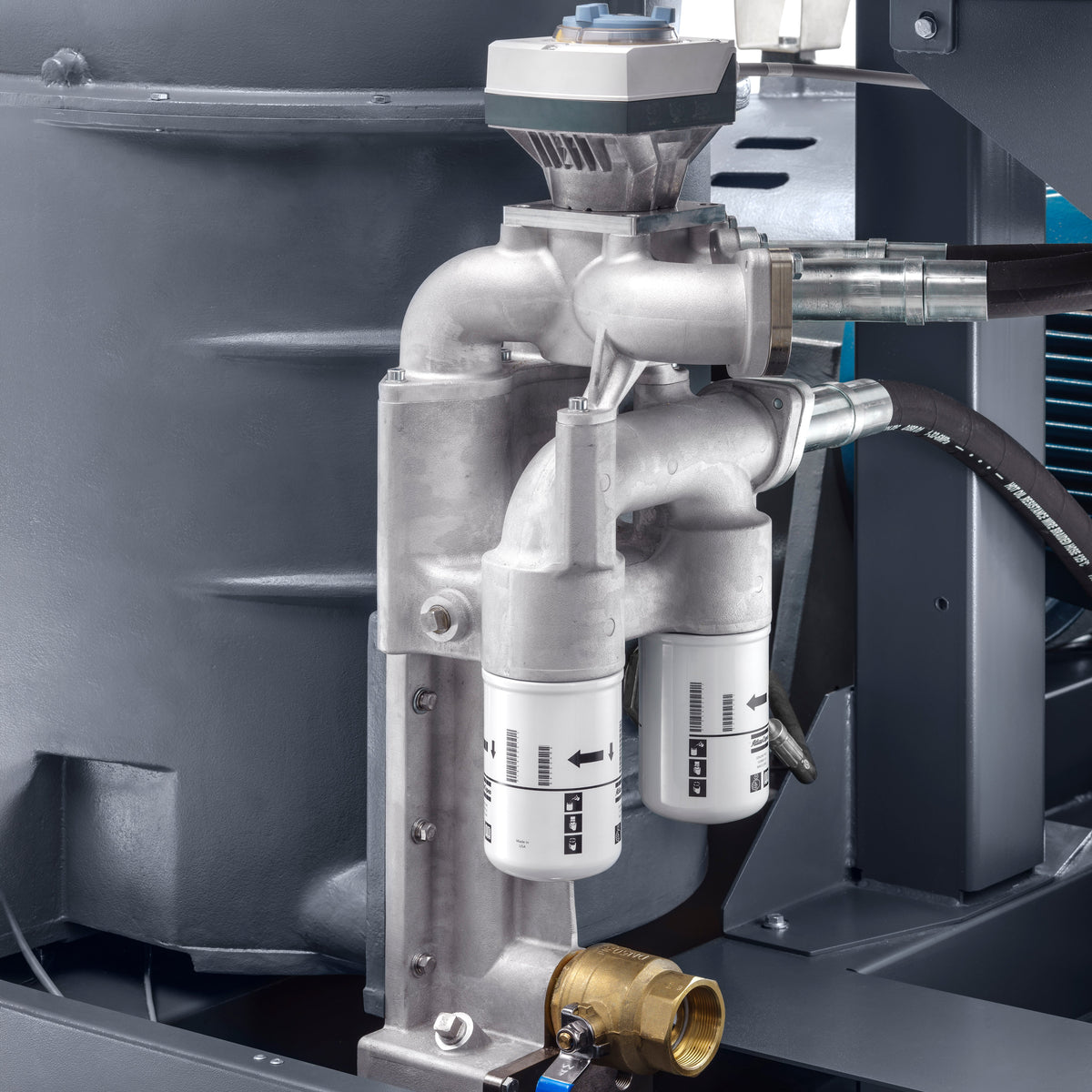
We get this call a lot. A rotary screw that used to make 125 psi now tops out at 95. Or one that blows separators every few months for no reason anybody can name. Or one that keeps tripping on overload at random. Different symptoms, and more often than you would guess, the same two valves are behind all of them.
The minimum pressure valve and the inlet valve are the two moving parts that actually control how a screw compressor behaves. They are not glamorous, most techs replace them without ever explaining them, and when either one sticks the machine does something that looks like a totally unrelated failure. Here is how each one works and how to tell which one is lying to you.
The Inlet Valve: How the Machine Decides to Breathe
The inlet valve sits on top of the airend, between the intake filter and the rotors. Its job is simple: open when the compressor should be making air, close when it should not.
On a load/unload machine it is basically a two-position device. Control pressure from a solenoid strokes it open to load and lets it shut to unload. When it closes, the airend is spinning against almost nothing, the sump blows down through the blowdown valve, and the motor coasts at maybe 25 to 30 percent of full load power. That is the whole point of unloading.
On a modulating machine the same valve throttles partway, which is why modulation is less efficient than load/unload at part load. The airend is still pulling against a restriction the whole time.
What it looks like when the inlet valve is bad
- Will not build full pressure. Valve is not opening fully. Usually the control solenoid, the control air line, or a gummed-up piston in the valve body.
- Will not unload. Valve is stuck open. The machine runs at full load against the setpoint and the safety valve eventually lifts. This is the one that makes people think the pressure switch failed.
- Oil out the inlet filter housing. The check function inside the inlet valve has failed, so on shutdown sump pressure pushes oil backward up through the airend and out the intake. You will find the filter soaked and oil in the bottom of the housing.
- Surging or hunting at part load. On a modulating machine, a worn valve or a sticking regulator makes it chase.
The Minimum Pressure Valve: The Gatekeeper on the Outlet
The minimum pressure valve, often shortened to MPV or called a minimum pressure check valve, sits at the outlet of the air/oil separator tank. It is a spring-loaded check valve, and it does two jobs at once.
Job one: hold a minimum sump pressure. Typical designs start to crack open around 35 psig and are fully open by roughly 70 psig. Below that, the valve stays mostly shut so the sump builds pressure. Why does the machine need that? Because oil circulation on a lubricated screw is driven by sump pressure. No differential, no oil flow to the bearings and the rotors. Start a cold machine with the MPV wide open and it runs for a while with almost no lubrication. That is the failure mode the valve exists to prevent.
Job two: act as a check valve. When the compressor unloads or shuts down, the MPV stops the entire plant air header from backfeeding into the sump. Without it, downstream pressure pushes oil back through the separator and out the blowdown.
What it looks like when the MPV is bad
This is where it gets expensive, because a sticking MPV usually kills something else before anyone looks at the valve.
- Collapsed separator elements. The classic signature. The valve varnishes shut and does not crack until 75 to 100 psig instead of 35. When it finally lets go, it opens fast and slams a big slug of air through the separator element from the inside. The element collapses inward. If you are replacing separators more than once a year on an otherwise healthy machine, look at the MPV before you blame the element brand.
- High sump pressure and overload trips. Valve stuck shut raises discharge pressure inside the package, the motor current climbs, and the machine trips on overload. People chase the starter and the motor for weeks on this one.
- Oil carryover downstream. A valve that opens too early, or one with a broken spring, means the sump never reaches the pressure the separator needs to work properly. Separation is poor and oil goes down the line. You will see it as oil in the drops and in the filter bowls.
- Air blowing back out the blowdown on shutdown. The check function has failed and the header is emptying backward into the sump.
- Oil pushed into the airend on shutdown. Also a failed check function. Next start is a noisy one.
Telling Them Apart
| Symptom | Points to | Check first |
|---|---|---|
| Can't reach setpoint pressure | Inlet valve not opening fully | Control solenoid, control air line, inlet valve piston |
| Won't unload, safety valve lifts | Inlet valve stuck open | Solenoid, valve linkage or piston |
| Separator elements collapsing | MPV sticking shut, opening late | MPV spring, seat, varnish buildup |
| Motor overload trips, high sump pressure | MPV stuck shut | Sump gauge vs discharge gauge differential |
| Oil carryover downstream | MPV opening too early or broken spring | MPV, then separator element and scavenge line |
| Oil out the intake filter after shutdown | Inlet valve check function failed | Inlet valve check disc and seat |
| Header empties backward on shutdown | MPV check function failed | MPV seat and o-ring |
The single most useful diagnostic here costs nothing: compare the sump pressure gauge to the discharge pressure gauge with the machine fully loaded. A healthy differential across the separator and MPV is usually in the 3 to 10 psi range. If you are seeing 25 or 30 psi, something between the sump and the outlet is restricted, and that is either a plugged separator element or an MPV that is not opening. If you see near zero differential at low load, the MPV is likely not holding sump pressure at all.
Rebuild or Replace
Both valves are usually rebuildable, and on larger machines a rebuild kit is a fraction of the cost of the assembly.
Rebuild when the body is in good shape and you are dealing with a worn o-ring, a tired spring, or varnish. Clean the bore properly, replace every soft part in the kit, and do not reuse a spring because it looked fine. Springs take a set and a weak MPV spring is exactly the problem that lets oil downstream.
Replace the assembly when the seat is pitted or scored, when the bore is worn oval, or when the valve has already been rebuilt once and failed again. On a small package the labor difference between rebuilding and swapping is often enough that the new assembly wins.
Either way, find out why it varnished. Varnish on an MPV is a lubricant story: wrong oil, oil run too long, or a machine running hot. Fix that too or you will be back in a year. Our guide on air compressor oil covers which fluid belongs in your machine.
Ordering the Right Part
Screw compressor valves are not generic. Two machines from the same brand with the same horsepower can use different MPV assemblies depending on year and pressure rating. Get these before you order:
- Model and serial number off the data plate, not off the sales order
- The part number stamped or tagged on the existing valve
- Rated pressure of the package (100, 125, 150, 175 psig versions are often different parts)
- A photo of the valve installed, showing port orientation
We stock and source valves, kits and elements across the major brands. Start in air compressor parts, and if you want to knock out the whole maintenance interval at once, filters and separator elements are here. If the diagnosis points at the machine being past its life, our rotary screw compressors page is the other end of that conversation.
Frequently Asked Questions
What pressure does a minimum pressure valve open at?
Most designs begin to crack open around 35 psig in the sump and are fully open by roughly 70 psig. Check your service manual, because the setting varies by manufacturer and by the package pressure rating. If yours is not passing air until well above that range, it is sticking.
Can I run a screw compressor without the minimum pressure valve?
No. Without it the sump never builds enough pressure to circulate oil properly at startup, and the header backfeeds into the sump every time the machine stops. You will damage bearings and push oil downstream. Bypassing it is not a temporary fix, it is a fast way to buy an airend.
Why does my separator element keep collapsing?
A collapsed, dented-inward element almost always means a sudden inrush from the outlet side, and the usual cause is a minimum pressure valve that sticks shut and then opens abruptly. Replacing the element without addressing the valve just resets the clock.
How do I know if the inlet valve is stuck?
Run the machine and watch it try to unload at setpoint. If amps and discharge pressure stay at full load and the safety valve eventually lifts, the inlet valve is not closing. If it never reaches setpoint at all and the airend sounds like it is starving, it is not opening. Verify control air is actually reaching the valve before you condemn it.
How often should these valves be serviced?
There is no fixed interval on most machines. Practically, inspect both at the same time you do a major service or an airend inspection, and any time you pull a separator element. If you are running a machine hard in a hot, dirty environment, look sooner.
Bottom Line
Before you replace a separator for the third time or start pulling a starter apart, check the differential between the sump and the discharge. A sticking minimum pressure valve or a lazy inlet valve explains a startling share of the problems that get blamed on everything else.


