


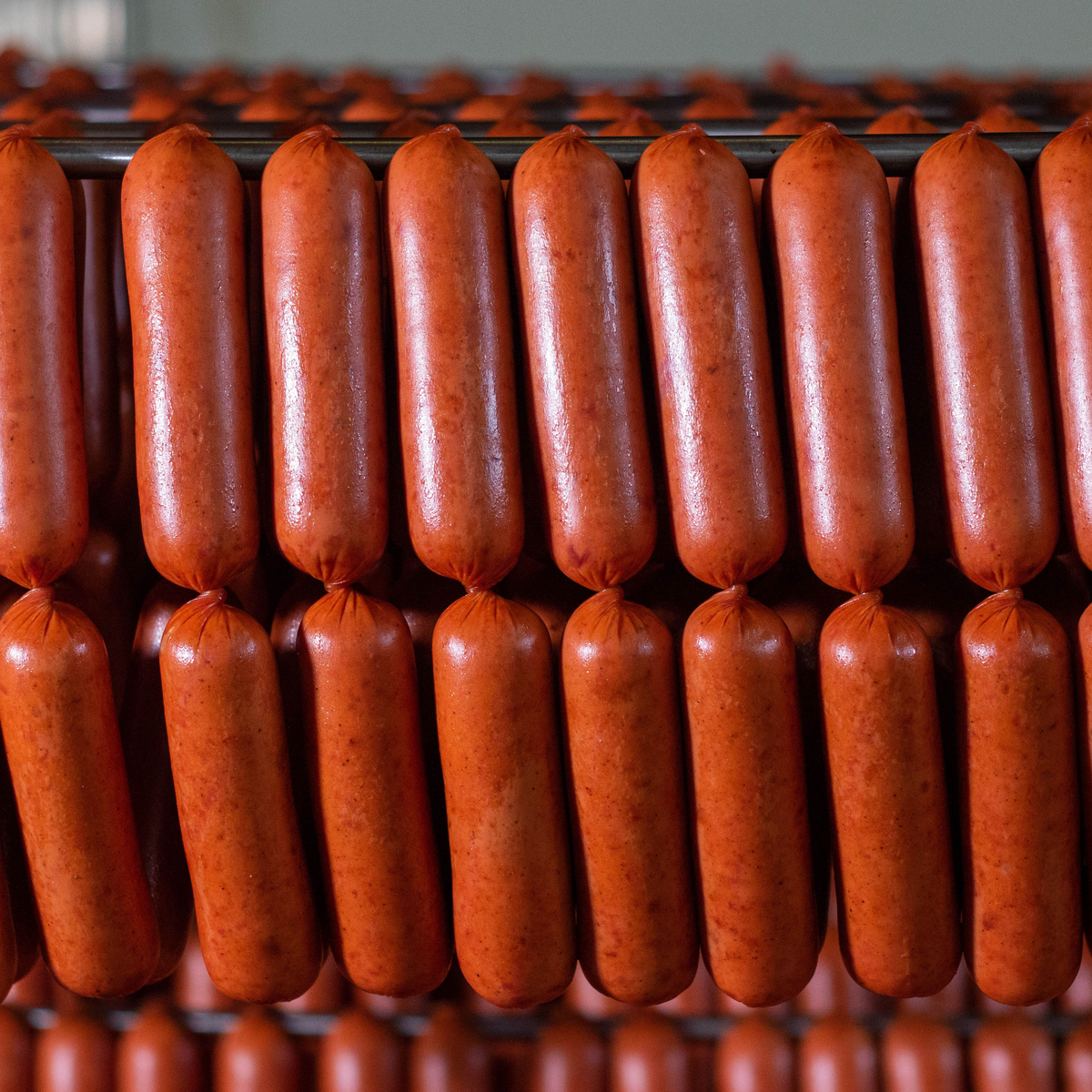
Ask a plant engineer at a poultry operation what his hardest utility is and he will not say electricity. He will say the air system, because it runs through a building that gets hosed down with caustic at the end of every shift, it feeds knives that people are holding, and if the inspector decides the air touching product is a problem, the tag goes on the equipment and the line stops.
That last part is what makes compressed air for meat processing different from compressed air at a generic food plant. The regulator is FSIS, the inspector is in the building every day, and the standard is performance based rather than numerical. There is no compressed air class printed in the rule. There is a requirement that you not adulterate product, and an inspector with the authority to decide you did.
What the rule actually says
Worth reading the real language, because people quote a spec that does not exist. The sanitation requirements for an official establishment live in 9 CFR Part 416, and none of them mention compressed air by name. Four provisions still land on it.
| Citation | What it requires | How it touches your air |
|---|---|---|
| 416.1 | Operate and maintain the establishment in a manner sufficient to prevent insanitary conditions and ensure product is not adulterated | The catch-all. Air that contaminates product is a 416.1 problem no matter what else you can point to |
| 416.2(d) | Ventilation adequate to control odors, vapors and condensation to the extent necessary to prevent adulteration | Condensation is the word to notice. Wet air blown onto a cold surface in a cold room makes exactly that |
| 416.3(a) | Equipment used for processing or handling edible product must be of material and construction that facilitates cleaning and will not cause adulteration | An air knife, a blow-off nozzle, a pneumatic saw and the piping feeding them are equipment under this paragraph |
| 416.4(a) and (d) | Food-contact surfaces cleaned and sanitized as frequently as necessary, and product protected from adulteration during processing and handling | Air that blows water off a carcass is contacting product. It gets treated accordingly |
Then there is the part that makes it real. Under 416.6, an FSIS program employee who finds equipment insanitary, or whose use could cause adulteration, attaches a "U.S. Rejected" tag, and that equipment cannot be used until it is made acceptable. Only an FSIS employee can remove the tag.
And under 416.12 and 416.13, whatever you decide about compressed air has to be written into your Sanitation SOPs, performed at a stated frequency, monitored daily, and documented under 416.16 with records kept at least six months.
So the honest answer to "what air quality does FSIS require" is that FSIS requires you to have decided, written it down, and be able to show you do it. Most plants land on ISO 8573-1 Class 1.2.1 or similar for product contact air, because that is what customer audits and SQF or BRCGS certification ask for, not because a federal rule prints it.
Where the air goes in a kill and processing plant
Product contact and near-contact
Air knives blowing water off carcasses and packages before labeling or bagging. Blow-off on the thermoformer web. Air assisting product transfer. Purge on vacuum packaging. This is the leg that needs real treatment.
Blow-off deserves its own look, because on a poultry line it sits directly on top of yield, pack appearance and the retained water rule in 9 CFR 441.10 all at once. We go through where the knives go, what the contact air branch has to be, and why drilled pipe is the expensive option in air knives for poultry processing.
Pneumatic hand tools
Dehiders, breaking saws, hock cutters, brisket saws, shears. High duty, held by people, and living in the wettest part of the building. These tools are also a reason the plant runs lubricated air on that leg, which means it has to be a separate leg from the product contact air.
Cylinders, actuators and conveyors
Diverters, indexing on the line, gates, lifts, cabinet doors, air-operated double diaphragm pumps moving trim and blood and brine.
Packaging and chilling
Thermoformers, vacuum chamber machines, bag loaders, case erectors, and the actuator air on chillers and spiral freezers.
Instrument air in the refrigeration plant
Most of these plants run ammonia refrigeration, and the valve actuators on that system are pneumatic. This is a quiet, critical load. It sits in a machine room with its own hazards and its own requirements.
Washdown is the environment problem
Everything above happens in a building that gets torn down and sanitized every single day, usually with hot caustic. That does three things to an air system.
It destroys carbon steel piping from both sides. Wet air corrodes black iron from the inside while caustic and water attack it from the outside, and the rust scale ends up in your air knives and your cylinders. Stainless is the right answer in wet processing areas. Aluminum holds up well in dry areas and in offices and packaging. If you have black iron in a kill floor, it has a remaining life, not a service life.
It floods anything that is not sealed. Quick connects, FRL bowls, solenoid enclosures, drain discharge points. Specify washdown rated components in the wet areas and expect to replace the ones that are not.
It goes after the motor. An open drip proof motor on a compressor near a wash bay is a short story. TEFC at minimum, and washdown duty where it is genuinely getting sprayed. We went through the enclosure types in TEFC vs ODP motors.
Dew point, and why cold rooms change the math
This is the piece most plants get wrong, and it is a physics problem rather than a compliance one.
A refrigerated dryer holding a 38 degree F pressure dew point is fine on a shop floor at 70 degrees. Run that same air into a chiller at 28 degrees or a freezer at minus 10 and you are below the dew point of the air in the pipe. Water drops out inside the line, and in a freezer it freezes. Now you have a blocked air knife, an actuator that will not stroke, and condensation dripping in a room where 416.2(d) says you are supposed to be controlling condensation.
The rule is the same one instrument air uses: get the pressure dew point below the lowest temperature the piping will ever see. For a header that runs into a blast freezer, that means a desiccant dryer. For the warm side of the plant a refrigerated dryer is enough. Plenty of plants run both, with the desiccant leg feeding only the cold rooms and the product contact points.
Oil-free or filtered oil-flooded
The same argument as every food plant, with one extra wrinkle. On the product contact leg, an oil-free compressor makes the SOP conversation short. You write down that the source is oil-free, you document the filtration, and the auditor moves on.
An oil-flooded screw with a coalescing filter and a carbon stage can deliver air that tests clean, and many plants run exactly that. It is defensible. The cost is that your defense now depends on filter elements being changed on a schedule that somebody has to execute and document, in a building that already has a long list of daily documented tasks.
The wrinkle: your pneumatic hand tools want lubrication. So you are running a lubricated leg regardless. Keep it physically separate from the product contact leg, with its own FRL and lubricator at the tool, and make sure nobody can cross-connect the two with a hose during a Saturday repair. That is a piping decision made once, and it protects you forever.
Sizing notes specific to these plants
- Hand tools are a bigger load than the drawing says. A dehider or a breaking saw is a continuous duty tool in the hands of somebody working a line at speed. Do not apply a 25 percent duty factor to a tool that runs all shift.
- Sanitation shift is its own demand profile. Some of the air load goes away, some of it goes up. Know what runs during teardown.
- Air knives are usually undersized or overfed. Engineered air knives use dramatically less air than drilled pipe for the same blow-off, and blow-off is often the single largest product-contact air load in the building.
- Add the refrigeration machine room. Small, continuous, and nobody puts it on the list.
Where to put the compressor
Not in the processing area, and not next to the ammonia machine room air intake. You want clean, dry intake air from outside, a room that does not get washed down, and enough ventilation that the machine is not recirculating its own heat. The intake is the part people skip, and pulling caustic aerosol or ammonia-laden air through an airend is a slow expensive mistake that shows up first in the oil analysis.
Frequently Asked Questions
What compressed air quality does FSIS require?
FSIS does not publish a compressed air class. 9 CFR Part 416 is performance based: 416.1 requires you to prevent insanitary conditions and adulteration, 416.3(a) covers equipment that handles edible product, and 416.4 covers sanitary operations and protecting product from adulteration. What you decide has to be written into your Sanitation SOPs under 416.12, performed and monitored daily under 416.13, and documented under 416.16. Most plants adopt ISO 8573-1 Class 1.2.1 or similar for product contact air because customer audits and SQF or BRCGS ask for it.
Can an inspector shut down my line over compressed air?
Effectively yes. Under 9 CFR 416.6, an FSIS program employee who finds equipment insanitary, or whose use could cause adulteration of product, attaches a "U.S. Rejected" tag, and that equipment cannot be used until it is made acceptable. Only an FSIS employee can remove the tag. Air blowing visible moisture or oil onto product is the scenario to avoid.
What dew point do I need for a plant with freezers?
Below the coldest temperature the piping will ever see. A refrigerated dryer at 38 degrees F is fine for the warm side of the plant and will drop liquid water inside any line running into a 28 degree chiller or a minus 10 freezer. Those legs need a desiccant dryer. Running both, with desiccant feeding the cold rooms and the product contact points, is common and usually cheaper than putting the whole plant on desiccant.
Do I need an oil-free compressor for a meat plant?
For the product contact leg it makes the audit conversation much simpler, and many plants choose it for that reason alone. An oil-flooded machine with coalescing and carbon filtration can meet the same air quality, but then your compliance rests on documented element changes. Either way you will still run a separate lubricated leg for pneumatic hand tools, and those two legs must stay physically separate.
What piping material belongs in a washdown area?
Stainless in wet processing areas. Carbon steel corrodes from the inside with moist air and from the outside with caustic and water, and the scale ends up in your air knives and cylinders. Aluminum works well in dry areas such as packaging, offices and the maintenance shop. If you have black iron on a kill floor today, plan its replacement rather than its maintenance.
Where to start
Find every point where air touches product or a product-contact surface, write down what treats that air, and check that it is in your Sanitation SOP with a frequency and a record. Then walk the cold rooms with the dryer spec in your hand. Most of what goes wrong with compressed air for meat processing is not exotic, it is a dryer sized for a room that is 40 degrees warmer than the one the pipe actually runs through.


