


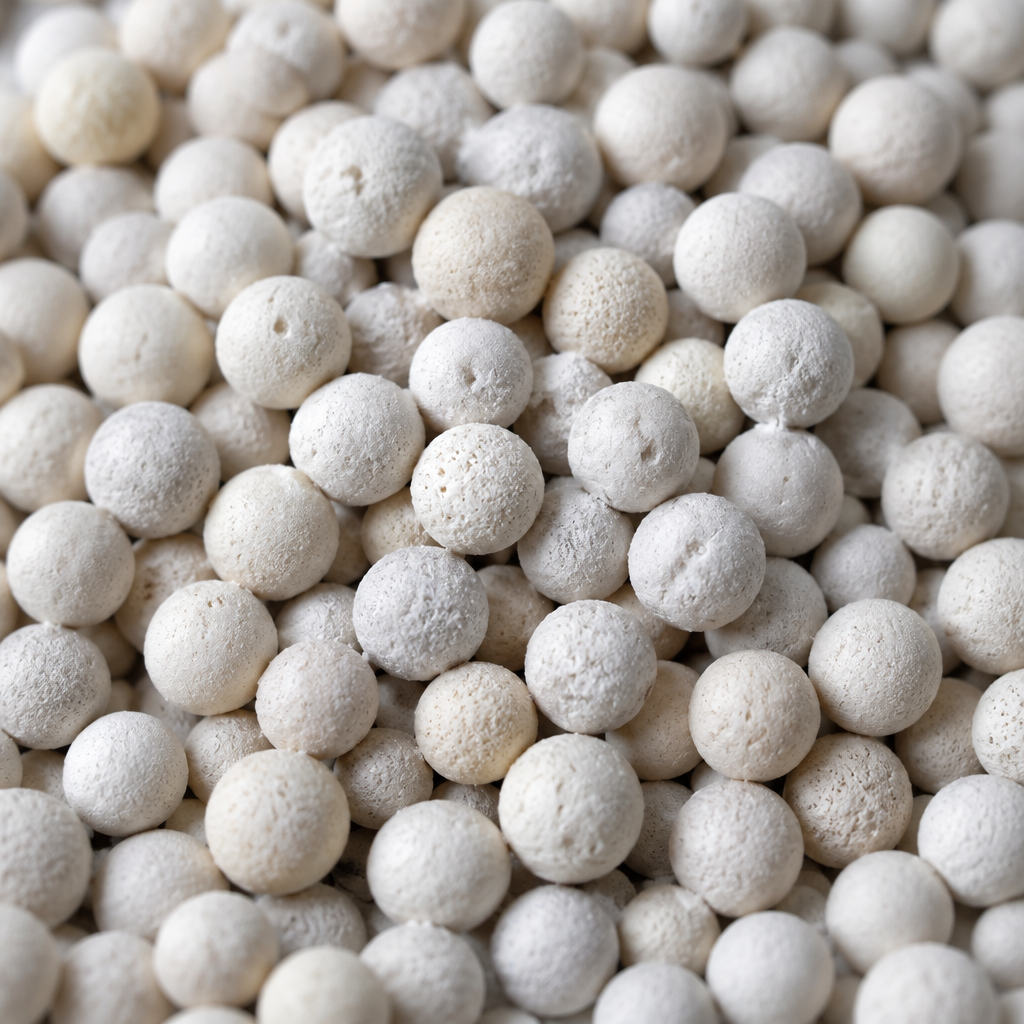
Somebody calls and says their desiccant dryer quit holding dew point, and they want to know how many pounds of beads to order. Fair question. The one I ask back is what the beads looked like coming out, because that tells you whether replacing them fixes anything or whether you are about to ruin a second charge the same way you ruined the first.
Activated alumina desiccant is the workhorse media in compressed air drying. It is cheap relative to what it protects, it is forgiving compared to the alternatives, and it lasts a long time if you keep oil and liquid water off it. Almost every premature failure we see traces back to one of those two things rather than to the alumina.
What it is and why dryers use it
Activated alumina is aluminum oxide processed into a porous bead with an enormous internal surface area. Water vapor adsorbs onto that surface as air passes through the bed. When the bed is saturated, the dryer regenerates it, either by expanding a slice of dry compressed air back through it (heatless), or by pushing heated air through it (heated or blower purge). Adsorption capacity comes back after a complete regeneration, which is why a charge lasts years rather than weeks.
In compressed air and gas drying, activated alumina will get you pressure dew points in the range of minus 40 degrees F down toward minus 100 degrees F, depending on the dryer design and how hard it regenerates. For the vast majority of industrial work, minus 40 is the spec and alumina hits it comfortably.
Bead size, and why it is not a preference
The two sizes you will actually be choosing between in a compressed air dryer:
| Size | Roughly | Where it goes |
|---|---|---|
| 1/8 inch | 2 to 5 mm | The most common size in compressed air desiccant dryers. More surface area per unit volume, which is what you want in a standard twin tower unit |
| 3/16 inch | 5 to 10 mm | Used when the tradeoff between pressure drop and surface area sits between 1/8 inch and 1/4 inch. Larger beads mean lower pressure drop through the bed |
Two rules. First, use what the dryer manufacturer specifies, because the tower, the diffusers and the screens were designed around a bead size. Second, do not mix sizes in one tower. Mixed beds channel, and a channeled bed means air finds a path through and leaves saturated while most of the desiccant sits there doing nothing.
That is also the argument for buying uniform, well graded media rather than the cheapest drum you can find. Uniform bead size minimizes pressure drop, prevents channeling, and gets you use of the whole bed instead of the part of it the air happens to flow through.
Crush strength, dusting, and why the after-filter exists
Alumina beads abrade. They rub against each other every time the tower switches, and over years they round off, shed fines, and settle. High crush strength is the spec that limits how much dusting you get, and it matters most during loading, when you are pouring beads several feet down into a tower and the ones at the bottom take the impact.
Two practical consequences:
- Load gently. Use a fill tube or a sock so beads are not free falling the full height of the tower. The dust you make during loading goes straight downstream the first time that tower comes online.
- Never run without a particulate after-filter. Desiccant fines are abrasive and they go directly into whatever you are protecting: valve positioners, solenoids, instrument pneumatics. If you have a dryer with no after-filter, that is a bigger problem than the desiccant.
Alumina versus the alternatives
| Activated alumina | Silica gel | Molecular sieve | |
|---|---|---|---|
| Typical use | General compressed air drying, the default | Higher capacity at moderate dew points | Very low dew points, final polishing layer |
| Dew point reach | Minus 40 down toward minus 100 degrees F | Moderate | The lowest of the three |
| Tolerance for liquid water slugs | The most forgiving of the three | Poor, beads can shatter | Poor |
| Cost per pound | Lowest | Middle | Highest |
Plenty of dryers use a layered bed, with alumina doing the bulk of the work and a molecular sieve layer on top to reach the final dew point. If your dryer is built that way, replace it that way. We compare all three in more depth in desiccant types compared.
The tolerance row is the one that matters most in the real world. Alumina puts up with an upset better than the other two, which is exactly why it is the default. That is tolerance, not immunity, and a steady diet of liquid water will still finish it.
What actually kills a charge
Not time. Three things, in order of how often we see them.
Oil
The number one cause by a wide margin. Oil coats the pore structure and the bead simply stops adsorbing water. Regeneration does not remove it, because oil does not boil off the way water does. Once a bed is oil fouled, it is scrap.
The defense is a coalescing prefilter ahead of the dryer, maintained on a schedule. If you are running a lubricated compressor into a desiccant dryer with a tired prefilter element, you are converting an inexpensive filter element into an expensive charge of desiccant.
Liquid water
Bulk liquid arriving at the tower, usually because a drain failed or a refrigerated pre-dryer or separator is not doing its job. Alumina survives this better than silica gel does, but repeated slugging still degrades the bed and can pack it.
Heat and flow abuse
Running the dryer far above its rated inlet temperature, or far over its rated flow, means the bed never fully regenerates between cycles. Dew point creeps up, somebody assumes the desiccant is spent, and the new charge does exactly the same thing because nothing about the conditions changed.
When to change it
Go by dew point, not by calendar. A dew point transmitter on the dryer outlet is the cheapest diagnostic you can own, and it converts this whole question from a guess into a reading.
Signs it is time, or that something else is wrong:
- Outlet dew point climbing steadily over weeks and not recovering after a full regeneration cycle
- Beads that come out discolored, oily to the touch, or clumped rather than free flowing
- A lot of fines in the bottom of the tower or loading up the after-filter
- Bed level noticeably down from where it was filled
If the beads come out oily, fix the prefilter before you load a new charge. Otherwise you will be doing this again. We walk through the wider set of symptoms in when to replace the desiccant in your air dryer and the dew point spike diagnostics in desiccant dryer troubleshooting.
Changing a charge without making it worse
- Depressurize and lock out. A desiccant tower holds a lot of stored energy and both towers need to be isolated.
- Wear a respirator and eye protection. Spent desiccant is dusty, and if the bed was oil fouled the dust carries that with it.
- Empty completely. Do not top off a partly spent bed with fresh beads. You get a mixed age bed and uneven performance.
- Inspect the screens and diffusers while the tower is open. This is the only time you will see them.
- Load gently through a fill tube, to the level the manufacturer specifies. Overfilling restricts flow and underfilling lets air bypass over the top of the bed.
- Change the prefilter and after-filter elements at the same time. Every time.
- Run through several full cycles and watch the dew point come down before you call it done.
Shop desiccant air dryers and media, and filter elements for the prefilter and after-filter that go with them.
Frequently Asked Questions
What dew point can activated alumina reach?
In compressed air and gas drying, roughly minus 40 degrees F down toward minus 100 degrees F, depending on the dryer design and how thoroughly it regenerates. Minus 40 is the common industrial spec and alumina reaches it comfortably. Getting to the very bottom of that range usually means a molecular sieve layer on top of the alumina.
1/8 inch or 3/16 inch beads?
Use what the dryer manufacturer specifies. The 1/8 inch bead, roughly 2 to 5 mm, is the most common in compressed air desiccant dryers because it packs more surface area into the tower. The 3/16 inch bead, roughly 5 to 10 mm, trades some surface area for lower pressure drop. Never mix sizes in one tower, because a mixed bed channels.
How often does activated alumina need replacing?
Go by outlet dew point rather than by the calendar. In a clean system with a working coalescing prefilter, a charge lasts years. What ends it early is almost always oil fouling or repeated slugs of liquid water, not age. If dew point is climbing and does not recover after a full regeneration cycle, it is time.
Can oil-fouled desiccant be regenerated?
No. Regeneration drives off water, and oil does not leave the same way. Oil coats the pore structure and the bead stops adsorbing. Once a bed is fouled it is scrap, which is why the coalescing prefilter ahead of the dryer is the cheapest insurance in the system.
Do I need a filter after the desiccant dryer?
Yes, always. Alumina beads abrade against each other and shed fines, and those fines are abrasive. Without a particulate after-filter they travel downstream into solenoids, positioners and instrument pneumatics. A dryer running without an after-filter is a bigger problem than whatever prompted you to look at the desiccant.
Bottom line
Buy uniform, high crush strength media in the size your dryer was designed for, keep oil and liquid water off it, and load it gently through a tube. Do that and a charge of activated alumina desiccant is a multi-year consumable rather than an annual surprise, and the dew point reading will tell you long before anything downstream does.


