


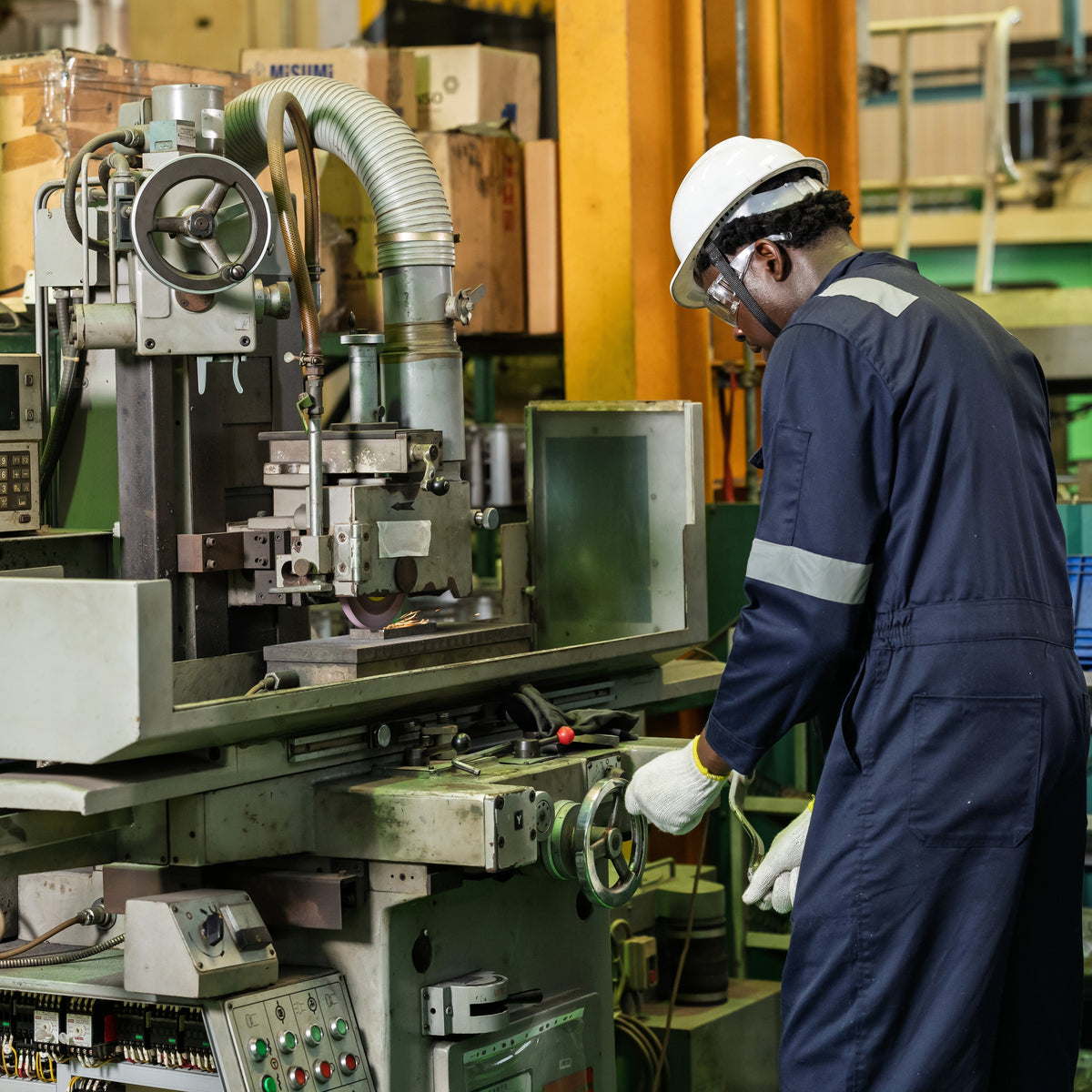
Third VMC of the day faults out with a low air pressure alarm right in the middle of a tool change. The spindle is sitting there with a half-released holder, the operator is walking over to the compressor room, and the 50-piece lot you promised for Friday just lost twenty minutes. If that sounds familiar, your air system was sized for the shop you had three machines ago.
We get this call a lot. Machine shops grow one machine at a time, and nobody re-does the air math when the new mill shows up. So here is the whole picture on compressed air for machine shops: what your machines actually pull, how clean and dry it has to be, how to size the compressor and dryer, and where shops tend to get burned.
Why machine shop air is different from a general shop
A body shop needs volume for sanders. A tire shop needs quick bursts for impacts. A machine shop needs something pickier: steady pressure that never sags below the machine's alarm setpoint, and air that is dry enough to not corrode a $12,000 spindle.
Every modern CNC machine has a pressure switch on the inlet. Haas, for example, wants a steady 100 psi and will throw an alarm if the line drops much below that during a tool change or pallet swap. Okuma, Mazak, DMG Mori and the rest are similar, with setpoints landing somewhere between 70 and 100 psi at the machine. Miss the setpoint for a second and the control stops the cycle. That is the real difference. Your tools do not slow down when the air is low, they stop.
The other difference is where the air goes. Inside the machine, compressed air feeds the spindle air purge (a constant trickle that keeps coolant out of the spindle bearings), the drawbar and tool release, the tool changer arm, chuck or vise clamping, way cover and scale purges, probe air blast, and chip blow-off through the spindle or nozzles. That spindle purge and the probe air are the reason moisture matters so much. Wet air through a spindle purge is a slow way to buy a new spindle.
What each piece of equipment actually pulls
Most machine builders quote two numbers: a pressure requirement and a flow requirement, and the flow number is almost always higher than what the machine idles at. Haas publishes 100 psi and 4 SCFM for most mills and lathes, with the note that a 2 hp two-stage compressor with a 20 gallon tank is the minimum for a single machine. That 4 SCFM is average consumption. Peak demand during a tool change or an air blast cycle spikes well above it for a second or two, which is exactly when the alarm trips on an undersized system.
Here is what we see in the field, per machine, as a planning number:
| Equipment | Pressure at the machine | Planning flow | Notes |
|---|---|---|---|
| 3-axis VMC, no through-spindle air blast | 90-100 psi | 4-6 SCFM | Spindle purge and tool changes dominate |
| VMC with programmable air blast or through-spindle air | 90-100 psi | 10-15 SCFM | Air blast for chip clearing is the big draw |
| CNC lathe with bar feeder | 75-100 psi | 6-10 SCFM | Chuck actuation, parts catcher, bar feeder |
| Horizontal machining center with pallet changer | 90-100 psi | 10-20 SCFM | Pallet clamping and heavy purge |
| Wire EDM | 75-90 psi | 2-5 SCFM | Low volume, but must be very dry |
| CMM | 60-90 psi | 2-4 SCFM | Air bearings, cleanest air in the building |
| Bench blow gun | 90 psi | 10-20 SCFM while trigger is pulled | Biggest hidden load in most shops |
Do not skip that last row. Chip clearing with a blow gun is often the largest single consumer of air in a small machine shop, and the noisiest. Two operators cleaning vises at the same time can pull 30 CFM for thirty seconds. That is a whole compressor's worth of air spent on housekeeping.
Compare that to a dedicated air blast system. Light chip clearing on aluminum runs fine at 20 to 40 psi and 2 to 4 CFM per spindle. Regulating the blow-off circuit down instead of running it at line pressure is one of the easiest air savings in the trade.
Sizing the compressor
Add up the planning flow for every machine, add your blow guns and any air-powered fixtures, then apply a use factor. In a job shop, not every machine is cutting at the same instant and not every machine is in a tool change at the same instant. A 60 to 70 percent use factor is typical for a shop with five or more machines. A shop with two machines running lights-out with a pallet pool needs closer to 100 percent because the demand is continuous.
Worked example, six-machine shop: four VMCs with air blast (4 x 12 = 48 SCFM), one lathe with bar feeder (8 SCFM), one wire EDM (4 SCFM), four blow gun stations (figure 15 SCFM as an allowance for overlap). That is 75 SCFM raw. At a 65 percent use factor you are at roughly 49 SCFM continuous. Add 25 percent for growth and pressure drop through treatment and you land near 60 SCFM at 125 psi. That is a 15 hp rotary screw, and it is a very common size for a shop that grew out of a 5 hp piston unit and did not realize it.
Piston or rotary screw?
For one or two machines, a two-stage piston compressor on an 80 gallon tank works fine. Two-stage matters because you want 175 psi tank pressure so you have a real cushion above the 100 psi the machine wants. The catch is duty cycle. Piston units are built to run roughly half the time, and a CNC shop that runs a second shift will cook one.
Three or more machines, or anything that runs unattended, and you want a rotary screw. Rotary screws are 100 percent duty cycle, quieter, and hold pressure flat instead of sawtoothing between cut-in and cut-out. If your load swings a lot between day shift and lights-out running, a variable speed drive unit trims its output to match and saves real money on the power bill. Our rotary screw air compressors collection covers 5 through 100 hp, and the variable speed units are the right call for the swing-load shop. If you want the deeper explanation, read Rotary Screw vs Piston Air Compressor.
Storage
Machine tools create short, sharp demand spikes. Storage is what smooths them out. A common rule is 3 to 5 gallons of receiver per CFM of compressor output, so a 60 CFM system wants roughly 200 to 300 gallons total. Put a wet tank right after the compressor to knock out bulk water, and consider a small dry receiver near a cluster of machines that share a big tool changer or pallet system. A 60 gallon tank next to a horizontal machining center takes the edge off a pallet swap without asking the compressor to do anything.
Air quality: the dew point and the spindle
Here is the number to write down: your air needs a pressure dew point below 40 F for a machine shop, and most builders quote 37 F (3 C) or a filtration spec that stops particles over 1 micron. That is ISO 8573-1 Class 4 for water, and a refrigerated dryer hits it. If you do not know what the ISO classes mean, we decoded them in ISO 8573-1 Air Quality Classes, Decoded.
A reasonable target for a general machine shop is ISO 8573-1 Class 2.4.2: particles down to 1 micron, refrigerated dew point, and oil aerosol held to 0.1 mg/m3 with a coalescing filter. Two situations call for tighter air. Wire EDM wants very dry air because the dielectric and the guides do not tolerate condensate, and many EDM builders spec a desiccant dryer or at least a point-of-use membrane dryer. CMMs run on air bearings, so the probe and bridge float on a film of air. Any oil or water on those bearings scores the granite and the ways. A CMM should have its own filter set, usually a coalescing filter and an activated carbon filter, with the machine builder's spec in hand.
The equipment train for a typical shop looks like this: compressor, aftercooler (built into most rotary screws), wet receiver, particulate pre-filter, refrigerated dryer, coalescing filter, then out to the header. Our refrigerated air dryers are sized in CFM, and you want one rated at or above the compressor output at your inlet temperature, not just the average flow. Undersizing a dryer by 20 percent is how a shop that bought a dryer still gets water at the spindle in August. We go deeper on picking and sizing the dryer itself, including when a shop genuinely needs desiccant instead of refrigerated, in Air Dryers for Machine Shops.
Filters go in the air filters collection. Change elements on schedule, because a loaded coalescing element is a pressure drop generator, and every psi you lose in treatment is a psi you have to make up at the compressor.
Piping the shop
Machine shops need pressure at the far end of the building to be almost the same as at the compressor, and the typical failure is a long 3/4 inch run to a machine that is fine until three machines are pulling at once. Size the header for the total flow at a pressure drop under 3 psi, run a loop if the layout allows so air reaches each machine from two directions, and drop to each machine from the top of the header with a drain leg at the bottom of every drop. Aluminum pipe systems are the standard answer here because they are clean inside, quick to install, and easy to modify when the next machine shows up. We stock air pipe and fittings in the common sizes, and Compressed Air Pipe Sizing walks through the math.
Put a filter-regulator at each machine. The machine wants a stable 90 to 100 psi, and your header is running higher. Regulating at the drop also means one machine cannot pull the whole header down when its air blast fires.
The mistakes machine shops actually make
Running the header at 100 psi because the machines want 100 psi. The machine wants 100 psi at its inlet. With a filter, regulator and 100 feet of pipe in between, the header needs to be at 115 to 125 psi. Most low-air alarms are a pressure drop problem, not a compressor problem.
Sizing for average, not peak. The 4 SCFM in the machine manual is an average. The 40-tool changer at the end of a program pulls a lot more than that for a couple of seconds. Storage and adequate pipe are how you cover it.
Skipping the dryer to save money. Compressed air leaving a compressor is saturated. A 15 hp compressor pulls several gallons of water out of the air on a humid day, and without a dryer some of it lands in your spindle purge. A refrigerated dryer costs a fraction of a spindle rebuild.
Air-blasting chips at line pressure. Regulate blow-off circuits down. You will use less air, make less noise, and stop blasting fine chips into the way covers.
Ignoring leaks. Machine shops have a lot of quick-connect fittings and a lot of cheap air blow guns. Ten small leaks add up to a compressor that never shuts off. Our leak detection guide covers how to find them.
Forgetting the second shift. A piston compressor sized for a 40-hour week has no reserve when you add lights-out machining. If unattended running is in your plans, buy the rotary screw now.
Frequently Asked Questions
What size air compressor do I need for one CNC mill?
For a single VMC with no programmable air blast, a two-stage piston compressor of at least 2 hp on a 20 gallon tank meets the builder's minimum, but a 5 hp two-stage on 60 or 80 gallons gives you real margin for a blow gun and future growth. If you add air blast or a second machine, move to a 7.5 to 10 hp rotary screw.
What pressure does a CNC machine need?
Most CNC machines call for 90 to 100 psi at the machine inlet, with a low pressure alarm somewhere in the 70 to 85 psi range. Set your header pressure 15 to 25 psi above what the machine needs so the drop through filters, regulator and piping does not trip the alarm.
Do I really need an air dryer for a machine shop?
Yes. Machine builders spec a pressure dew point around 37 to 40 F, which requires a refrigerated dryer. Wet air goes straight into the spindle purge and the tool changer valves, and the corrosion and sticking valves that follow cost far more than the dryer.
Why does my machine alarm for low air only during tool changes?
Because that is the peak demand moment. The drawbar and changer arm pull a burst of air, and if your pipe is too small or your storage is too low, the pressure at the machine dips below the alarm setpoint for a second. Bigger pipe, a local receiver, or moving the regulator setpoint up usually fixes it.
How much air does a CMM need and how clean?
A typical CMM pulls 2 to 4 SCFM at 60 to 90 psi, but it needs the cleanest air in the shop because it runs on air bearings. Give it a dedicated coalescing filter and an activated carbon filter at the point of use and follow the manufacturer's ISO 8573-1 class exactly.
If you are planning a new shop or adding machines, start with the compressor. A properly sized rotary screw with a refrigerated dryer and a real header is the foundation that everything else in the building sits on, and it is what makes compressed air for machine shops a non-issue instead of a Friday afternoon fire drill.


