Two bottles sit on the shelf in most shops. One says air compressor oil, one says air tool oil, and plenty of people treat them as the same thing in different packaging.
They are not. One of those substitutions works in a pinch and the other one gums a vane motor solid. Knowing which direction is safe is most of what you need from this page.
Air tool oil is thinner than compressor oil, it carries rust inhibitors because it is going into a tool that sees moisture, and it is non-detergent. That last word is the one that matters most and the one nobody explains.
Why Non-Detergent Is the Whole Point
Motor oil is detergent oil. Detergent additives are there to hold combustion byproducts in suspension so they drain out with the oil, which is exactly right in an engine.
Put that same additive package into an air tool and you have a problem. The detergents react with the moisture that is always present in compressed air, and the result is a gummy residue that settles in the smallest passages in the tool. Those passages are the air motor ports, the valve, and the throttle. They are not large and they do not clean themselves.
The failure is slow, which is why it fools people. The tool does not stop. It just gets gradually weaker over months until somebody says the compressor must be getting tired.
The Two Oils, Side by Side
| Air tool oil | Compressor oil | |
|---|---|---|
| Typical viscosity | ISO VG 22 to 32, roughly an SAE 10 weight | Commonly ISO VG 32 to 100 depending on machine |
| Detergents | No | No |
| Rust inhibitors | Yes, it lives in wet air | Yes, formulated for the sump |
| Job | Atomize into the air stream and coat vanes and bearings | Seal, cool and lubricate the compression element |
| Where it goes | Lubricator or tool inlet | Compressor sump only |
The practical rule: a low viscosity compressor oil will lubricate an air tool acceptably if that is what you have. Tool oil in a compressor sump is not acceptable, because it is too thin to do the sealing and cooling job an airend or a pump needs. The substitution works in one direction only.
For what goes in the compressor itself, our compressor oil guide covers grades and change intervals.
What Not to Use
- Motor oil. Detergent package, wrong viscosity, and the gumming problem above. The most common wrong answer.
- Automatic transmission fluid. Detergents and friction modifiers, neither of which belongs in a vane motor.
- Penetrating spray. It is a solvent with a little oil in it. It will strip what lubrication is there and evaporate, leaving the tool drier than it was.
- Household light oil. No rust package, no thermal stability, and it varnishes.
- Nothing at all. The quiet favorite, and the reason most air tools die.
How Many Drops a Minute
This is where people either overdo it or give up. The rate is tied to flow, not to the tool.
The common guidance is one to two drops per minute for every 10 to 20 SCFM passing through the lubricator. A frequently quoted baseline is one drop per minute per 10 to 15 CFM of consumption. At least one tool manufacturer specifies one drop per minute per 20 SCFM. Your tool manual beats all of those if it gives a number.
| Tool | Rough consumption | Starting drip rate |
|---|---|---|
| Air ratchet or small die grinder | 4 to 8 CFM | About 1 drop per minute, checked after a shift |
| Impact wrench, half inch | 4 to 6 CFM at duty | About 1 drop per minute |
| Wet polisher or large sander | 10 to 16 CFM | 1 to 2 drops per minute |
| Air motor, continuous duty | 20 CFM and up | 2 drops per minute, then tune |
Set it, run the tool for a shift, then look at the exhaust. A light oil film on a rag held near the exhaust is right. Visible mist or oil spotting on the work means you are over, and bone dry with a warm, labored tool means you are under.
Where the Lubricator Goes
Order matters and distance matters.
The lubricator belongs last, after the filter and the regulator, and close to the tool. Filter first so you are not oiling dirt, regulator second so the tool sees the right pressure, lubricator last so the oil does not have to survive the rest of the system.
Oil falls out of an air stream over distance and at every elbow. A lubricator at the compressor feeding a tool a hundred feet away is mostly lubricating the inside of your pipe. Put it at the drop. Our FRL guide covers the assembly.
And a line that is lubricated should stay lubricated. Running a plant where some drops are oiled and some are not means somebody will eventually plug a sensitive instrument into an oily drop. Mark them.
When You Should Not Lubricate At All
Being straight about this, because an inline lubricator is the wrong answer more often than people think.
- Tools marked do not lubricate. Many modern tools have sealed or pre-lubricated motors, and adding oil washes out the grease that was supposed to last.
- Food, pharmaceutical and medical device plants. Either no lubricator in the product zone or an NSF H1 rated fluid with the documentation to prove it. See food grade compressor oil.
- Paint booths and finishing. Oil in the air is the defect you have spent money to eliminate. See paint booth air filtration.
- Electronics assembly and instrument air. Oil carryover is a contamination problem, not a lubrication benefit.
- Anywhere the exhaust blows at the work. A hand polisher in a stone shop blows its exhaust onto a slab headed for somebody's kitchen, which is why a lot of those shops oil manually at the inlet instead.
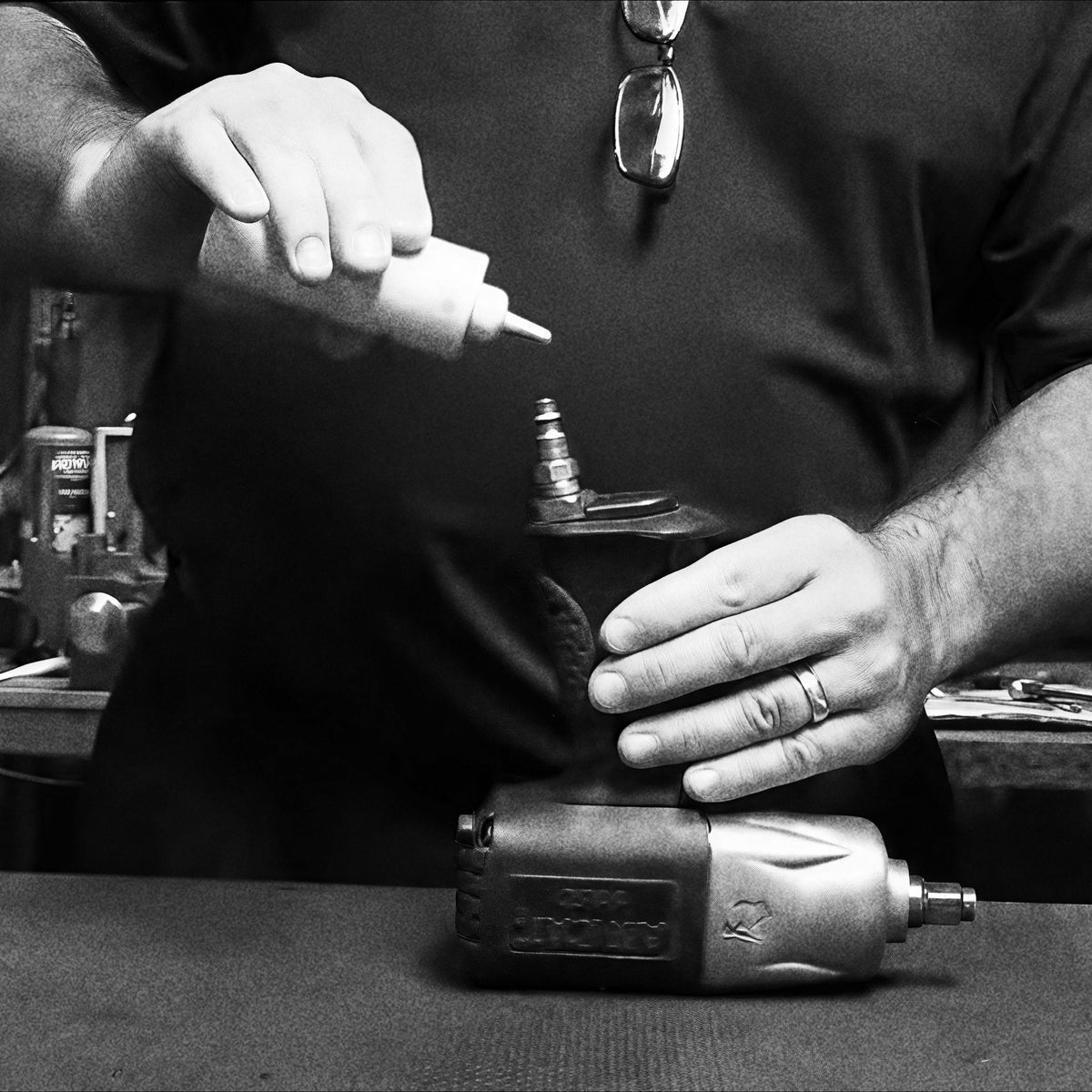
Manual oiling is a legitimate program, not a fallback. A few drops in the tool inlet at the start of each shift, run it for a few seconds to distribute, done. It works provided somebody actually does it, which is the same condition a lubricator has.
Oil Will Not Fix Wet Air
The most common reason air tools fail is not missing oil. It is water.
Water washes lubrication out of the motor, rusts the vanes and the cylinder bore, and in cold weather freezes in the exhaust. Adding more oil to a wet system is treating a symptom. Fix the moisture first with a dryer, a separator at the drop and drains that somebody checks, then set the lubricator.
If you are pulling rust-colored residue out of a tool, you do not have an oil problem. You have a water problem that has already done damage.
Frequently Asked Questions
Can I use air compressor oil in air tools?
A low viscosity compressor oil will work acceptably if it is what you have on hand, because both are non-detergent. The reverse is not true. Air tool oil in a compressor sump is too thin to seal and cool the compression element properly. Tool oil is also formulated with rust inhibitors for life in wet air, which compressor oil does not need to the same degree.
What viscosity is air tool oil?
Typically ISO VG 22 to 32, which corresponds roughly to an SAE 10 weight. It has to be thin enough to atomize into the air stream and travel to the motor, which is why heavier oils do not work even though they seem like they would protect better.
Can I use motor oil in an air tool?
No. Motor oil is a detergent oil, and the detergent additives react with the moisture that is always present in compressed air to form gummy deposits in the small passages of the tool. The tool does not fail immediately, it weakens gradually over months, which is why the cause usually gets missed and blamed on the compressor.
How many drops per minute should an air tool lubricator be set to?
Tie it to flow rather than to the tool. Common guidance is one to two drops per minute for every 10 to 20 SCFM through the lubricator, with a frequently used baseline of one drop per minute per 10 to 15 CFM, and at least one manufacturer specifying one drop per minute per 20 SCFM. Check the tool manual first, then verify by looking for a light oil film at the exhaust after a shift.
Where should the lubricator go in the air line?
Last in the assembly and close to the tool. Filter first so you are not oiling dirt, regulator second so the tool sees the right pressure, lubricator last. Oil drops out of the air stream over distance and at every elbow, so a lubricator at the compressor feeding a tool a hundred feet away mostly lubricates the pipe.
Where to Start
Walk to your lubricator and look at the bowl. If it is empty, or if nobody can tell you when it was last filled, that is your answer and it costs almost nothing to fix. While you are there, check what is actually in the bottle somebody has been using, because the wrong oil does more damage than no oil.
Browse compressor and tool oil, or the regulators and air prep that belong at the drop. Tell us what tools you run and we will tell you what they want.